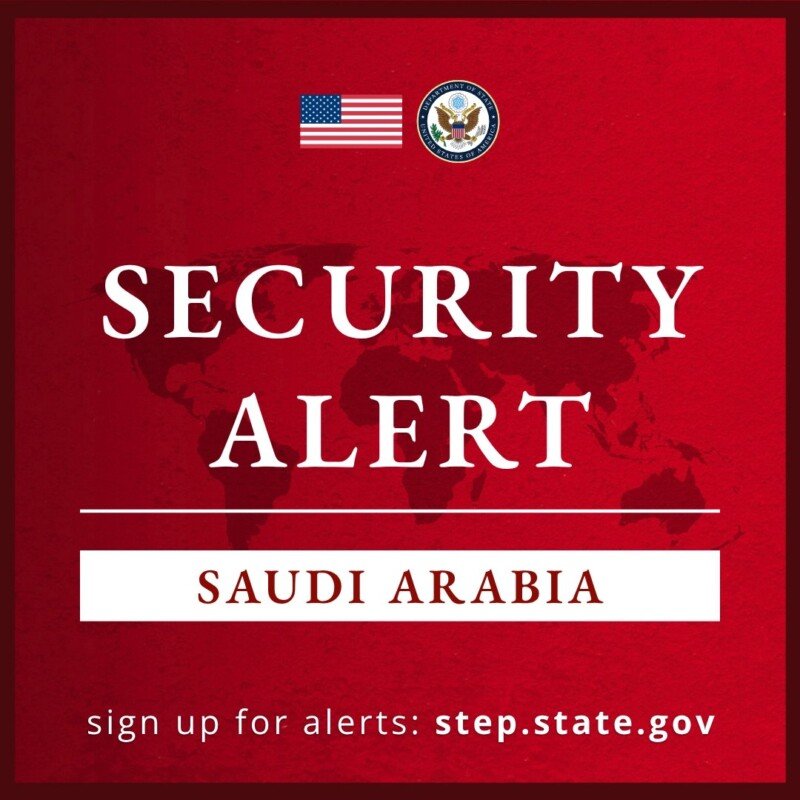
MOGADISHU, The U.S. Embassy in Saudi Arabia issued a security alert on Sunday warning American citizens of potential attacks on airports, airspace closures, and travel disruptions following a series of missile and drone strikes on Saudi infrastructure, a development with direct implications for Somalia’s security and economy.
The alert, dated October 18, 2026, stated that operations at King Khalid International Airport in Riyadh remain suspended, while airports in Jeddah and Dammam are operational with delays and cancellations. U.S. government employees now require special authorization to use any airport in the Kingdom. The embassy advised citizens to consider private car, train, or bus options as alternatives to air travel.
Why Saudi Arabia Matters to Somalia
Somalia’s connection to the Saudi crisis is not incidental. As a Red Sea littoral state, Somalia has consistently framed Gulf and Red Sea security as inseparable from its own. When Houthi attacks struck Abha and King Khalid International Airports earlier this month, Somalia’s Foreign Ministry issued a statement condemning the strikes “in the strongest terms” and affirming that “the security of the Gulf and Red Sea region is an integral part of its own security.”
The economic stakes are equally direct. Houthi disruptions in the Bab al-Mandab Strait have driven up costs across Somalia. The price of a 10-kilogram cooking gas cylinder has risen from roughly $25 to $40, while fuel prices have more than doubled to as much as $1.50 a litre. Food prices are climbing as transport and import costs surge. Somali importers report sharp increases in construction materials and fuel, with the Indian Ocean-Gulf of Aden corridor serving as the country’s economic lifeline.
The security vacuum created by international naval forces pivoting toward the Red Sea crisis has also given Somali pirate networks renewed operational freedom. More than 90 seafarers remain held hostage by pirate groups, and analysts warn that sustained instability could push shipping companies to avoid the Gulf of Aden entirely, raising insurance and freight costs further.
A Deepening Defense Relationship
Somalia and Saudi Arabia have moved closer militarily as Red Sea threats have mounted. In February 2026, defense ministers from both countries signed a memorandum of understanding on military cooperation in Riyadh, aimed at strengthening defense ties and improving regional stability and Red Sea security.
In October, Somalia’s State Minister for Foreign Affairs Ali Balcad met with Saudi Ambassador Ahmed Mohamed Saleh Al-Muwallad in Mogadishu to discuss trade, investment, and Red Sea security, with both sides reaffirming their interest in expanding coordination on issues of common concern.
Somalia has also joined a 14-member multinational maritime defense coalition led by Saudi Arabia, alongside Djibouti, Sudan, Egypt, Jordan, and others, to protect navigation in the Bab al-Mandab, Gulf of Aden, and Red Sea, as reported in FTL Somalia’s coverage of the new maritime coalition.
International Naval Responses
The Saudi airspace closures are occurring alongside broader international efforts to stabilize the Red Sea. This week in Brussels, the EU’s Task Force on the Red Sea met to discuss the urgent challenges in the waterway, led by European External Action Service Deputy Secretary General Olof Skoog and EU Special Representative for the Horn of Africa Annette Weber. As reported in FTL Somalia’s coverage of the Brussels meeting, the discussions took place as the EU’s naval mission, Operation Aspides, faces a critical shortage of vessels, operating with only about six warships despite a stated requirement for at least ten to escort commercial vessels effectively.
The intersection of the Saudi airport attacks and the European naval shortfall underscores the fragmented nature of Red Sea security. Somalia’s maritime interests are caught between regional powers like Saudi Arabia, which are directly absorbing attacks, and European missions that lack the capacity to fully secure the shipping lanes on which Somali trade depends.
Critical Note
The U.S. Embassy’s security alert is a routine consular notice, but it documents a crisis that Somalia cannot afford to ignore. Saudi Arabia is not a distant actor in Somalia’s strategic calculus. It is a defense partner, a diplomatic ally, and a barometer of the broader Red Sea security environment on which Somali trade depends.
The attacks on Saudi airports have already produced measurable consequences in Somali markets: higher fuel costs, more expensive food, and a shipping industry increasingly reluctant to traverse the Gulf of Aden. These are not abstract geopolitical ripples. They are price tags on goods that ordinary Somalis buy every day.
The deeper problem is one of exposure without capacity. Somalia has condemned the attacks, signed defense agreements, joined maritime coalitions, and watched as European navies struggle to muster enough ships to protect the same waters. But Mogadishu lacks the naval capability to protect its own waters, the economic resilience to absorb sustained shipping disruptions, and the political cohesion to present a unified front on regional security. The Saudi crisis has exposed these vulnerabilities rather than created them. The question is whether Mogadishu’s diplomatic alignment with Riyadh and its Gulf partners will produce tangible protection, or whether Somalia will remain, as it has for decades, a state that suffers the consequences of conflicts it cannot influence.
Recommended Reading On ftlsomalia.com
- Red Sea Shipping Under Threat: Tanker Hit by Unknown Projectile Off Saudi Coast
- Saudi Arabia, Somalia and 11 Nations Form New Maritime Coalition to Secure Red Sea and Bab al-Mandab
- Brussels Hosts High-Level Red Sea Meeting While Aspides Faces Critical Shortfall
- President Irro Holds Critical Talks with EU Horn of Africa Envoy in Hargeisa
- Somali PM Calls for Stronger Collaboration with the EU in Multiple Sectors