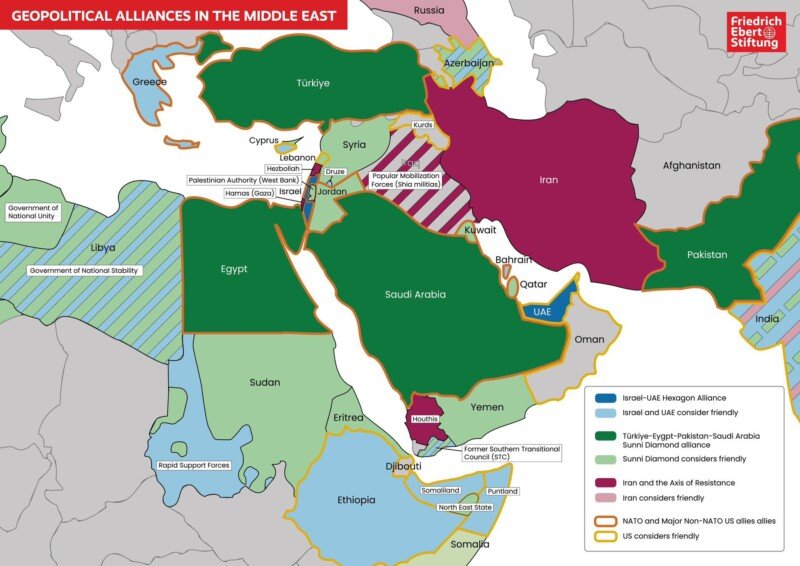
MOGADISHU, A geopolitical map displayed by Israeli Prime Minister Benjamin Netanyahu, which categorizes Somaliland and Puntland as “friendly” to Israel and the UAE, has circulated widely on social media, highlighting a strategic vision that treats Somalia’s territorial integrity as an obstacle to be bypassed.
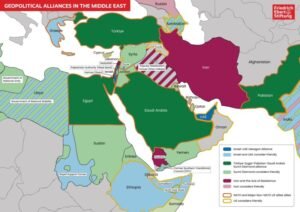
According to the map’s legend, both Somaliland and Puntland are shaded in light blue, designating them as territories that “Israel and UAE consider friendly.” While Somaliland’s inclusion reflects its December 2025 recognition by Israel, Puntland’s classification is factually misleading. Puntland has not established diplomatic relations with Israel, nor has it recognized the state. Its inclusion in the map stems from its deep security and economic ties with the United Arab Emirates, a signatory to the Abraham Accords whose Red Sea strategy intersects with Israel’s.
Somaliland: The Direct Alignment
Somaliland’s designation as a friendly entity reflects Israel’s December 2025 recognition of the region as an independent state, a move that broke decades of international consensus and was immediately rejected by Mogadishu as a violation of sovereignty.
The strategic logic behind this alignment is transparent. Israel views Somaliland’s location on the Gulf of Aden, near the Bab al-Mandab strait, as a potential forward base for intelligence monitoring and military operations against the Houthis in Yemen. Somali President Hassan Sheikh Mohamud has accused Israel of planning to establish a naval base in Berbera and use the city’s airport, describing Israel as a “destabilising force,” as reported in FTL Somalia’s coverage of the President’s remarks.
The relationship has deepened rapidly. Somaliland President Abdirahman Mohamed Abdullahi (Irro) visited Israel in June 2026, opening an embassy in Jerusalem and signing a strategic declaration with Netanyahu, as detailed in FTL Somalia’s coverage of the visit. Direct flights between Hargeisa and Tel Aviv are also expected to begin in the near future, further cementing the ties, as reported in FTL Somalia’s coverage of the planned air link.
Puntland: The UAE Connection and the Israeli Misclassification
Puntland’s coloring in the same light blue category points to a transactional relationship, driven by counterterrorism and maritime security rather than formal diplomatic recognition. The primary driver of this alignment is the United Arab Emirates, not Israel.
The UAE maintains deep interests in Puntland, funding and training the Puntland Maritime Police Force (PMPF) and operating in the port of Bosaso. In August 2026, the United States signed a security agreement with Puntland President Said Abdullahi Deni in Bosaso that allowed for the expansion of a U.S. military facility at the airport. This deal was negotiated without the Federal Government of Somalia at the table, as reported in FTL Somalia’s coverage of the Bosaso base expansion.
Mogadishu has previously alleged that the UAE facilitated Israel’s recognition of Somaliland to integrate Israel into the Red Sea security architecture. In the logic of Netanyahu’s map, Puntland is likely classified as “friendly” because it hosts the UAE’s partners, not because it has direct dealings with Tel Aviv.
Mogadishu’s Political Weapon Against Deni
The visual effect of this map is more important to Mogadishu than the underlying facts. President Hassan Sheikh Mohamud’s government can use this map to portray Deni as a separatist colluding with Israel, shifting the focus of the federal government’s conflict with Puntland from disputes over constitutional amendments and the electoral timetable to the higher moral ground of safeguarding national sovereignty.
The government does not need to prove that Deni has direct contacts with Israel. It only needs to point to the map and say that Israel considers Puntland its own. Mogadishu can leverage Puntland’s relatively restrained reaction to Israel’s recognition of Somaliland in December 2025. At the time, Puntland’s Information Minister stated that Puntland “supports a functioning Somali federal government” and does not endorse division, but did not strongly condemn Israel. Mogadishu can interpret this as a tacit stance.
Furthermore, Mogadishu can link Puntland’s reliance on the UAE to Israel’s broader regional strategy. The federal government has already canceled all agreements with the UAE, citing actions that undermined Somalia’s unity. It can argue that Puntland’s continued alignment with Abu Dhabi indirectly serves Tel Aviv’s interests.
Deni’s Balancing Act and Internal Puntland Dynamics
Deni faces a delicate situation. If Mogadishu successfully labels him as “pro-Israel,” he will face pressure on two fronts within Puntland. Clan elders and religious conservatives may question his stance on the Palestinian issue, while pro-federal factions may use this to weaken his domestic authority.
However, Deni has a counter-narrative. Puntland can argue that its cooperation with the UAE is a pragmatic choice to address local security and economic needs, particularly given the federal government’s long-standing failure to provide security and development resources. Puntland can also point out that it is fighting ISIS and piracy on the front lines, while Mogadishu uses the map to divert attention from its own governance failures.
If Mogadishu chooses to launch a full-scale political offensive against Deni over this map, the consequences could be severe. Puntland has already withdrawn from the federal constitutional review process and threatened to establish a parallel administration. Further isolation could push Deni closer to the UAE and prompt him to adopt a more hardline posture on receiving direct international assistance that bypasses Mogadishu.
Critical Note
The display of this map is a diplomatic provocation dressed as a strategic briefing. It visualizes a policy that has already materialized in recognition, basing agreements, and security deals. The map’s clean color-coding of friends and adversaries erases the legal and political reality that Somaliland and Puntland remain, under international law and the consensus of the African Union, parts of the Federal Republic of Somalia.
What the map reveals is a hierarchy of convenience. Somaliland, willing to accept Israeli recognition and potential military presence, is elevated to a friendly partner. Puntland, useful for counterterrorism and maritime access, is designated in the same category despite having no formal ties to Israel. Somalia, the internationally recognized state, is not even labeled as a unified actor.
The deeper issue is that Mogadishu’s attack on Deni exposes the federal government’s own weakness: it cannot control Puntland’s external relations and can only exert pressure through labeling. This labeling may score rhetorical points, but it will not change Puntland’s actual external alignment, and may even further erode the already fragile trust between the two sides. The map is not a blueprint for Somali unity. It is a mirror reflecting the fractures that external powers are content to exploit.
Recommended Reading On ftlsomalia.com
- Direct Hargeisa–Tel Aviv Flights Expected Soon
- President Cirro Arrives in Hargeisa, Vows to Strengthen Somaliland’s International Engagement After Israel Trip
- Somali President Accuses Israel of Seeking Berbera Base to Target Iran
- US Building Military Base in Bosaso as Airstrikes Against ISIS Escalate