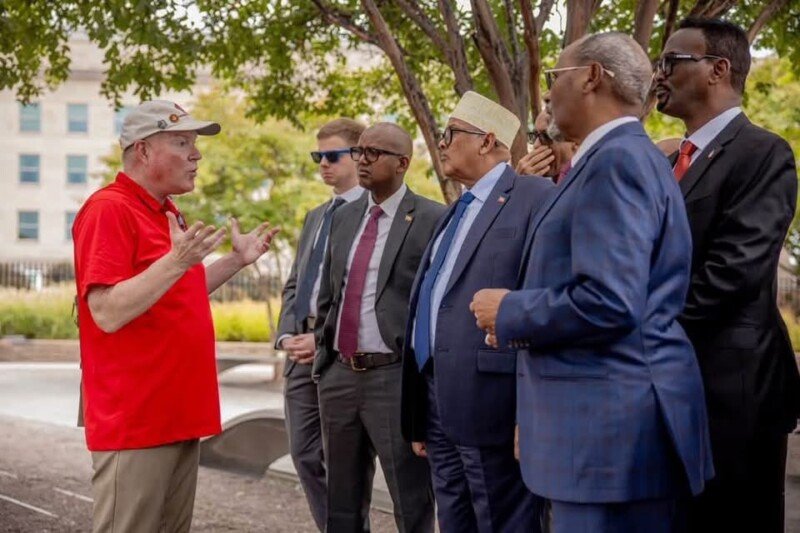
WASHINGTON — Somaliland President Abdirahman Mohamed Abdullahi (Cirro) visited the National 9/11 Pentagon Memorial in Arlington, Virginia, on Thursday, paying tribute to the 184 victims of the September 11, 2001 terrorist attack and reaffirming Somaliland’s alignment with the United States in counter-terrorism efforts.
During the solemn visit, President Cirro said that 25 years later, Somaliland honors the memory of those who perished and remains united with the United States in the global fight against terrorism and violent extremism. The visit comes as part of a broader diplomatic push in Washington aimed at securing US recognition and deepening security cooperation.
A US congressional report submitted to Congress in June 2026 reaffirmed Washington’s longstanding policy of recognizing Somalia’s sovereignty and territorial integrity, while also outlining areas for deeper engagement with Somaliland authorities, including maritime security, counterterrorism, and trade. The report described Somaliland as part of the Federal Republic of Somalia but acknowledged its growing strategic importance to US interests in the Horn of Africa.
The Washington Diplomatic Contest
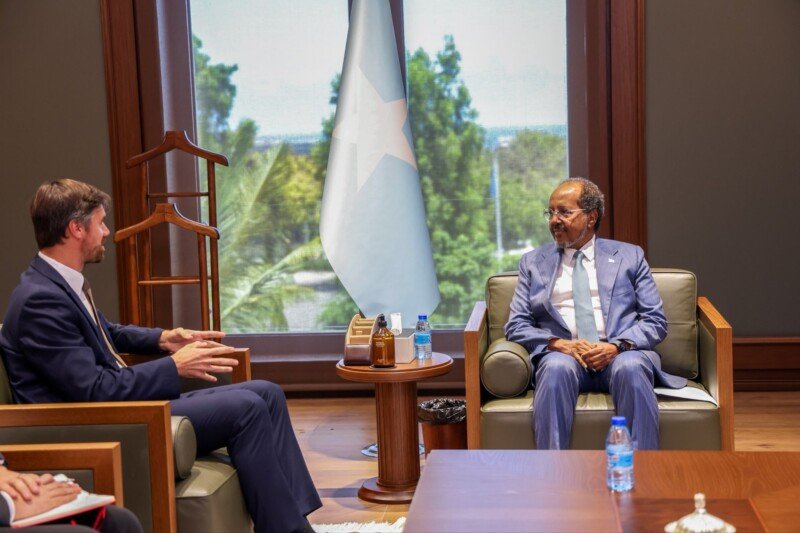
President Cirro’s visit coincides with a parallel diplomatic mission by Somalia’s federal government. Mogadishu has dispatched an upgraded delegation to Washington, led by Deputy Prime Minister Salah Ahmed Jama, after reportedly sidelining its own foreign ministry from the planning. The federal government’s message remains unchanged: Somaliland’s claims are void, its ports and minerals belong to the Somali state, and no arrangement involving Berbera or any other Somali facility can proceed without Mogadishu’s consent.
According to Irro’s staff, his Washington itinerary included a meeting with Republican Senator Ted Cruz of Texas, who chairs the Senate Foreign Relations Subcommittee on Africa and has publicly advocated for US recognition of Somaliland. Cruz wrote to President Trump in August 2025 urging recognition on national-security grounds. Irro also planned to meet House Foreign Affairs Committee chairman Brian Mast and Pentagon officials.
The White House has stated there has been no change in US policy towards Somaliland, signaling no shift toward recognition as President Cirro presses his case. Irro himself acknowledged that discussions with Washington had produced no commitment on recognition, telling Yedioth Ahronoth: “There are talks with the United States, but I cannot say there are currently any American promises.”
Somaliland’s Security Pitch
Somaliland has increasingly placed security and geography at the center of its case in Washington, highlighting its position on the Gulf of Aden, opposite Yemen and close to the Bab el-Mandeb Strait. AFRICOM Commander General Dagvin Anderson has stated that the United States has no plans to establish a military base in Somaliland, dismissing widespread speculation that has fueled tensions in the Horn of Africa. He reaffirmed Washington’s longstanding policy of supporting the sovereignty, unity, and territorial integrity of the Federal Republic of Somalia.
General Anderson completed an unprecedented high-level visit to Ethiopia, Somaliland, and Puntland in November 2025, labeling them “administrations within Somalia” and offering military diplomatic engagement unavailable via formal US State Department routes. The “security-first” method allows the US to partner directly with capable local entities while formally acknowledging Mogadishu’s sovereignty.
Irro said Somaliland had around 25,000 troops and a coast guard of roughly 1,500 personnel but could benefit from additional technology and training. He did not rule out a future Israeli or American security presence, saying: “We will cooperate with any friendly country, and we need security partners, including Israel. If Israel is present, it will provide deterrence.”
The Israel Dimension
Israel became the first country to formally recognize Somaliland as an independent state in December 2025, a decision Prime Minister Benjamin Netanyahu announced personally. Ambassadors followed within months, and in June 2026, Cirro traveled to Israel for the first state visit any Somaliland leader has made anywhere. Israel’s Defense Minister Israel Katz said his country has worked with Somaliland discreetly for years and that the two sides are now determined to raise security cooperation to new levels.
Israel’s recognition has sharply escalated tensions with Mogadishu. Somalia and a group of Arab, African and Islamic countries condemned the move, and the African Union’s Peace and Security Council called on Israel to revoke its recognition. Somalia maintains that Somaliland remains an integral part of the country.
Critical Note
President Cirro’s visit to the Pentagon 9/11 Memorial is a carefully calibrated diplomatic gesture, tying Somaliland’s recognition campaign to the shared security interests that Washington has prioritized in the Horn of Africa. By honoring the victims of 9/11 and positioning Somaliland as a counter-terrorism partner, Cirro is appealing directly to the security-first logic that has driven US engagement with regional administrations.
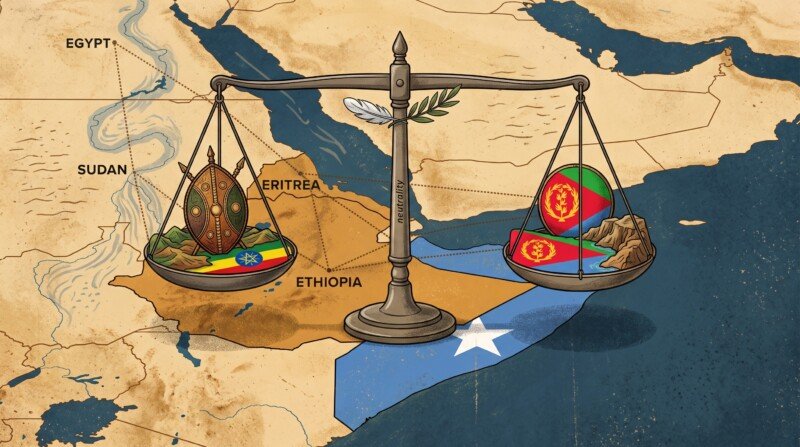
Yet the White House’s unchanged position underscores the limits of this strategy. Washington continues to formally recognize Somalia’s sovereignty and territorial integrity, even as it deepens practical cooperation with Somaliland on security and trade. The parallel diplomatic missions from Hargeisa and Mogadishu in the same week capture the unresolved nature of the dispute: Somaliland seeks recognition, while Somalia seeks to preserve its territorial integrity, and the United States is attempting to balance both.
For Somaliland, the visit may strengthen its standing as a reliable security partner, but it has not produced the recognition it seeks. For Somalia, the challenge is to demonstrate that it remains the indispensable interlocutor for US engagement in the region. The coming weeks, including the UN General Assembly, will test whether either side can translate their Washington outreach into meaningful diplomatic gains.