HARGEISA — Somaliland’s government has dismissed Somali President Hassan Sheikh Mohamud’s recent remarks on its foreign relations, asserting that Mogadishu has no authority to speak for Somaliland or dictate its diplomatic partnerships.
The statement from Somaliland’s Ministry of Foreign Affairs followed Mohamud’s interview with Al Jazeera, in which he said Somalia would not accept an Israeli presence “under any circumstances” and alleged that Israel plans to establish a naval base in Berbera and use its airport. Mohamud also linked Somaliland’s external partnerships to wider Red Sea security concerns, describing Israel as a destabilizing force.
Somaliland rejected those claims, stating that its relations with Israel are “sovereign decisions of two states” aimed at advancing peaceful cooperation, development, and regional stability. It also denied that Berbera would serve as a platform for attacks on other countries.
Somalia’s UNCLOS Proposal for Ethiopia
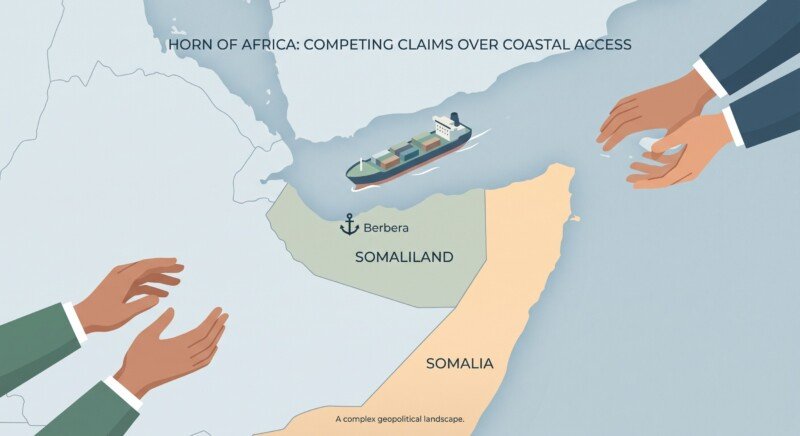
In the same interview, President Mohamud addressed Ethiopia’s pursuit of sea access, stating that Somalia does not object to Ethiopia obtaining a commercial port through Somali territory. He referenced the United Nations Convention on the Law of the Sea (UNCLOS), noting that 16 African landlocked states have sea access and that rules exist governing relations between coastal and landlocked states.
Under UNCLOS Part X, landlocked states have the right of access to and from the sea for commercial purposes, with terms agreed through bilateral or regional agreements. Mohamud suggested Ethiopia could use two or three Somali ports for import and export, with a potential economic agreement governing fees and tariffs. However, Mohamud said Ethiopia has not yet submitted a formal request for this arrangement.
The Failed January 2024 MoU
Somalia’s UNCLOS-based proposal stands in contrast to the January 1, 2024 Memorandum of Understanding between Ethiopia and Somaliland, which would have leased 20 kilometers of Somaliland’s coastline to Ethiopia for 50 years, including a naval base near Berbera, in exchange for Ethiopia’s potential recognition of Somaliland. As reported in FTL Somalia’s coverage of the signing, the agreement was signed in Addis Ababa by Ethiopian Prime Minister Abiy Ahmed and Somaliland’s then-President Muse Bihi Abdi.
That deal collapsed under pressure from Somalia, Egypt, the Arab League, and other international actors. As detailed in analysis published by the Addis Standard, former Somaliland President Muse Bihi Abdi later acknowledged that Mogadishu’s diplomatic offensive forced the deal’s abandonment, with the African Union and Arab League siding with Somalia. The MoU has been described as “largely dormant,” with no substantive changes on the ground and no formal recognition delivered.
As detailed in FTL Somalia’s coverage of Somaliland’s internal concerns, the MoU was not universally welcomed within Somaliland. A Somaliland minister expressed strong concerns about the agreement, reflecting the political divisions that the deal generated within Hargeisa itself.
Somaliland’s latest statement defended its position on the MoU, saying it supports agreements that allow Ethiopia to gain sea access through cooperation beneficial to both sides and rejects interference in its agreements with other parties.
Egypt Summit and Regional Alignment
The exchange comes as President Mohamud participates in a four-way summit in New Alamein, Egypt, alongside Egyptian President Abdel Fattah el-Sisi, Eritrean President Isaias Afwerki, and Sudanese leader Abdel Fattah al-Burhan. The summit is focused on regional developments amid the ongoing conflict in northern Ethiopia.
During a bilateral meeting, El-Sisi reaffirmed Egypt’s support for Somalia’s sovereignty and territorial integrity, and the two leaders agreed on continued coordination on security in the Horn of Africa, the Gulf of Aden, Bab al-Mandab, and the Red Sea.
Critical Note
The competing statements from Mogadishu and Hargeisa reveal a fundamental disagreement that cannot be resolved through diplomatic exchanges alone. Somalia insists it has the sole authority to speak for Somaliland and objects to any foreign engagement with Hargeisa. Somaliland rejects that premise entirely, asserting that its sovereignty and foreign relations are not subject to Mogadishu’s approval.
President Mohamud’s UNCLOS-based offer to Ethiopia is a significant shift in tone, moving from outright rejection of Ethiopia’s sea access ambitions to a framework for commercial port access under Somali sovereignty. But it remains a proposal without a formal Ethiopian request or a negotiated agreement. Ethiopia has not publicly responded, and it is unclear whether Addis Ababa would accept a commercial-only arrangement after pursuing a naval base through the collapsed MoU.
For Somaliland, the failed MoU remains a source of strategic frustration. Former President Bihi’s admission that Somalia’s diplomatic offensive defeated the deal is a candid acknowledgement of Hargeisa’s limited leverage when confronted with a unified regional and international backlash. The concerns expressed by Somaliland’s own minister at the time of the signing also indicate that the deal was contested internally, not just externally. Somaliland’s latest statement defending its foreign relations is consistent with its longstanding position, but it does not change the fundamental reality: no country besides Israel has formally recognized it, and its agreements with external partners remain vulnerable to diplomatic pressure coordinated through Mogadishu.