
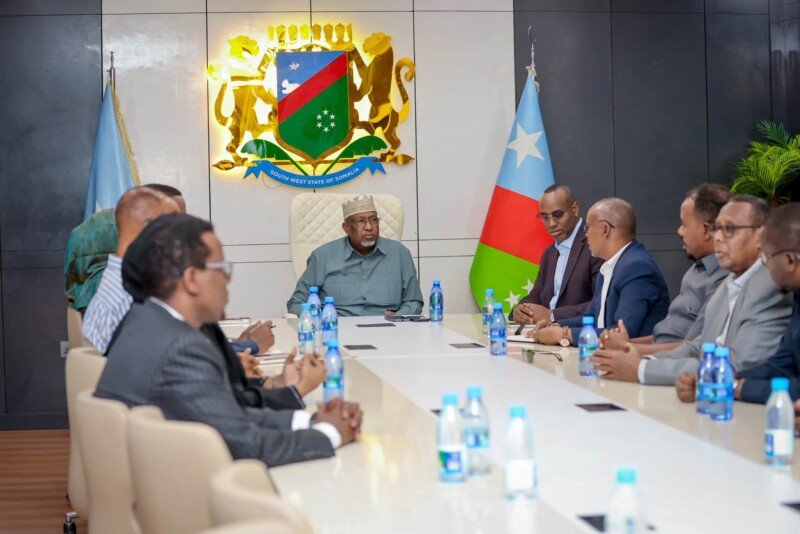
BAIDOA — South West State authorities announced on Tuesday that they had placed their forces on high alert and vowed to confront any attack on the regional administrative capital, following days of intense clashes that displaced thousands of civilians in Baidoa.
South West State President Aadan Madoobe said in a statement that his administration would defend civilians and would not allow what he described as “Al-Shabaab elements” to disrupt peace in the region. “The South West State government stands for the defense of its people, who understand the deceit of Al-Shabaab that opposes peace and stability in their areas,” Madoobe said.
The security mobilization follows repeated outbreaks of violence in Baidoa, the administrative capital of the Bay region, which have drawn mounting concern from humanitarian organizations. At least 148 wounded people were treated at four hospitals following the most recent clashes on 28 September, marking the third major outbreak of fighting in the city since 17 August.
Security Forces Deployed Outside Baidoa
South West State Security Minister Isaaq Mohamed Isaaq (Korsaar), who visited front-line positions on Tuesday, said government forces had been deployed outside the city to prevent further fighting from spilling into residential areas. He urged civilians to stop fleeing their homes, insisting that the city was stable and that there was no reason for displacement.
“From now on, fighting will not occur inside the city. The forces are positioned outside the city, and we call on the people to stop displacement and remain in their homes,” the security minister said.
The minister’s appeal followed a pattern of previous warnings to civilians to avoid areas where military operations were expected. As reported in FTL Somalia’s coverage of the South West State security meeting, authorities had already been coordinating security arrangements amid the ongoing constitutional dispute. The administration had also moved to tighten security in the city, as detailed in FTL Somalia’s report on Baidoa security measures, and the federal government imposed a curfew and arms ban in the city, covered in FTL Somalia’s coverage of the curfew.
Background to the Violence
The clashes in Baidoa involve forces loyal to Laftagareen, who was removed from office after opposing federal constitutional reforms. Federal forces took control of the city on 30 March 2026, and Laftagareen subsequently left the country. However, militias aligned with him have continued to launch attacks on the city from multiple directions, most recently on 28 September.
Federal and regional authorities have accused Laftagareen-aligned forces of fighting alongside Al-Shabaab, while Laftagareen’s group denies links to the militant group and says its forces are fighting to restore what it considers the legitimate South West State administration.
The fighting has also drawn in international actors. Türkiye, a major security partner of Somalia’s federal government, has carried out airstrikes in areas on the outskirts of Baidoa, according to Somali officials and local sources. Ethiopian troops, who have been based in Baidoa and forward operating bases across the Bay and Bakool regions for years, have played a critical role in defending the city against Al-Shabaab attacks. The prospect of an Ethiopian withdrawal has raised further concerns, as reported in FTL Somalia’s coverage of the UK’s call for restraint.
Humanitarian Impact
The repeated violence has taken a severe toll on civilians. Médecins Sans Frontières reported that 94 wounded people were treated after clashes on 17 August, including 29 women and 20 children, with four deaths recorded. Another round of fighting on 3 September sent 71 wounded people to Bay Regional Hospital, including 15 women and 12 children.
The 28 September clashes killed three people and injured 69 others, according to MSF, while a health facility was severely damaged and access to medical care was disrupted. The city hosts hundreds of thousands of displaced people, and one in four children at displacement sites are severely malnourished, according to a July survey by MSF.
An estimated 45,000 people fled Baidoa following clashes between 19 and 20 March, most moving to various locations across the Bay and Bakool regions, as well as Mogadishu. Humanitarian partners reported cases of Acute Watery Diarrhea among the displaced.
Critical Note
The South West State government’s decision to place its forces on high alert reflects the precarious security situation in Baidoa, where multiple armed actors operate with overlapping and competing agendas. The administration’s public assurances that the city is stable sit uneasily alongside the documented pattern of repeated clashes and the humanitarian toll on civilians.
The claim that Al-Shabaab is behind the attacks is contested. Laftagareen’s forces deny any connection to the militant group, and the competing battlefield claims have not been independently verified. The federal government has previously alleged that Laftagareen and former parliamentary speaker Ali Said Faqi maintain direct ties with Al-Shabaab, but has not provided public evidence to substantiate those claims.
The deployment of forces outside the city may reduce the immediate risk of urban combat, but it does not address the underlying political dispute that continues to drive the violence. Until the competing claims to legitimate authority in South West State are resolved through a credible political process, Baidoa will remain vulnerable to renewed fighting, and civilians will continue to bear the cost.