MOGADISHU — The Swedish Embassy in Somalia joined government representatives, international partners, and businesses at the EU-Somalia Business Forum 2026 in Mogadishu this week, as Sweden reaffirmed its commitment to strengthening economic ties and exploring investment opportunities across Somali sectors.
In a statement posted on social media, the Swedish Embassy said it had joined the forum to explore new investment opportunities and strengthen economic ties. “Together, we can help unlock Somalia’s potential across sectors, from agriculture and trade to innovation and digitalisation,” the embassy said.
The Forum’s Focus
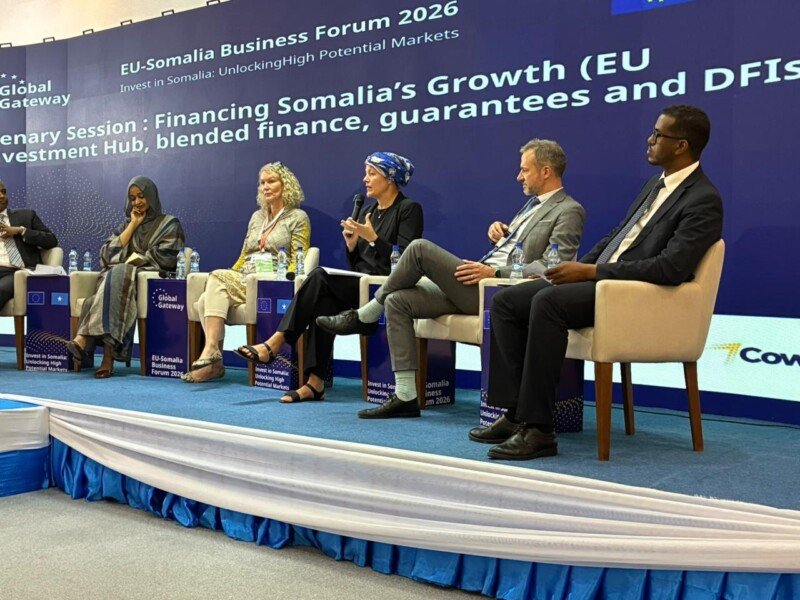
The two-day forum, held on October 5 and 6, was organized jointly by Somalia’s Ministry of Commerce and Industry and the European Union Delegation to Somalia. It brought together traders, investors, financial institutions, and officials from Somalia and Europe, including EU Ambassador to Somalia László Eduárd Máthé.
As detailed in FTL Somalia’s coverage of the forum opening, Deputy Prime Minister Salah Ahmed Jama emphasized the importance of transforming progress in economic and institutional reforms into investment opportunities that boost domestic production, job creation, and income for citizens.
According to the European Commission, the forum aimed to showcase investment opportunities in sectors including agriculture, energy, digital services, and trade logistics. It also sought to connect EU companies with Somali firms, sector associations, and government institutions, and to identify financing pathways including blended finance and guarantees from European development finance institutions.
The event was held under the theme “#InvestInSomalia: Unlocking High-Potential Markets,” with a focus on strengthening Somalia’s investment ecosystem, fostering regional trade integration, and catalysing sector transformation. Discussions centred on agricultural value chains, renewable energy, fintech and digital payments, and port infrastructure and logistics.
Sweden’s Broader Engagement
Sweden’s participation in the forum reflects a broader partnership that extends beyond the event itself. In September 2026, Business Sweden Nairobi, together with the Embassy of Sweden, convened the inaugural Sweden-Somalia Business Breakfast in Nairobi, bringing together Swedish companies and stakeholders to discuss opportunities in renewable energy, digital services, financial services, blue economy, and food processing.
Sweden’s development cooperation with Somalia is guided by a new strategy covering the period 2026 to 2028, with a total budget of 630 million Swedish kronor (approximately US$60 million). As reported in FTL Somalia’s coverage of Sweden’s strategy, Ambassador Hans Henric Lundquist said Sweden will maintain its strategic focus on state-building, economic development, and resilience, with a long-term vision of supporting a peaceful, secure Somalia where citizens have greater economic opportunities.
Swedish Minister for International Development Cooperation and Foreign Trade Benjamin Dousa visited Mogadishu in December 2025 for meetings with Somali officials and business leaders aimed at advancing investment and development discussions. As detailed in FTL Somalia’s coverage of the visit, Finance Minister Bihi Iman Egeh welcomed Dousa, with both sides highlighting the value of a mutually beneficial partnership and discussing investment prospects.
Sweden has also continued to support Somalia’s private sector through initiatives like the Financial Institutions for Growth programme, which has unlocked financing for more than 13,700 businesses across the country. As reported in FTL Somalia’s coverage of the FIG-Somalia Learning Event, entrepreneurs who once struggled to secure modest loans are now hiring staff, buying equipment, and widening their markets, with women and youth increasingly steering new business models.
Critical Note
The EU-Somalia Business Forum represents a structured effort to move Somalia’s relationship with international partners beyond humanitarian assistance and toward commercial engagement. The presence of Swedish companies and the Swedish Embassy’s active participation signal that European businesses are beginning to view Somalia as a market with potential, not only a recipient of aid.
However, the gap between forum declarations and actual investment flows remains substantial. Somalia’s business environment continues to face significant constraints: limited access to finance, fragmented markets, security challenges, and weak regulatory institutions. The forum’s emphasis on matchmaking and financing pathways is necessary, but these mechanisms depend on a foundation of legal certainty and enforceable contracts that Somalia is still building.
Sweden’s dual approach, combining development cooperation with trade promotion, reflects a broader shift among European partners toward linking aid with economic engagement. Whether this approach delivers tangible results for Somali businesses and citizens, rather than primarily benefiting European companies seeking new markets, will depend on the terms of the partnerships that emerge and the extent to which Somali firms can access the financing and technical support on offer.