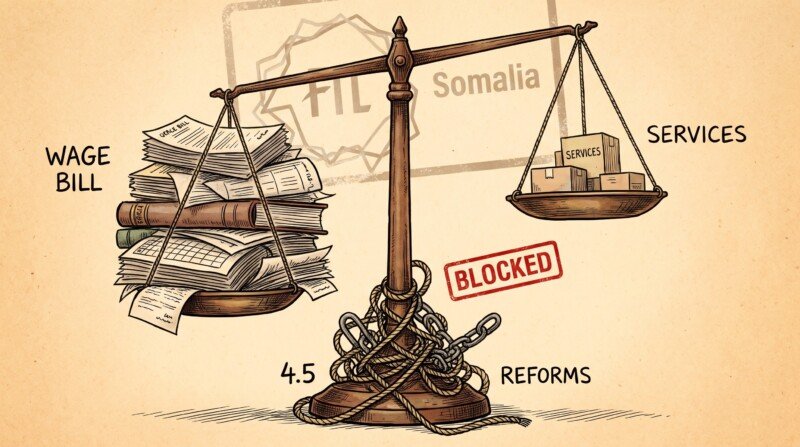
MOGADISHU, Somalia’s civilian public administration is small by international standards, but it consumes a disproportionate share of the country’s limited fiscal resources. The civilian wage bill, excluding security forces, was estimated at 2.4 percent of GDP in 2024, or roughly 20 percent of total government expenditure. The federal government alone spent 1.3 percent of GDP on civilian wages, representing 17 percent of its total spending, according to the World Bank’s 2026 Public Finance Review.
The figures reveal a paradox. Somalia has fewer civil servants per capita than most post-conflict peers, yet the wage bill absorbs a large share of domestic revenue because the revenue base is so narrow. The World Bank notes that this crowding-out effect leaves non-wage operational and service delivery expenditures underfunded, constraining the effectiveness of public institutions.
The One-in-Four Problem
The most striking feature of Somalia’s civil service is not its size, but its fragmentation. Only about one in four employees at the federal level, and one in five at the state level, is a formal civil servant, subject to established legal frameworks, pay scales, and payroll processing through the government’s financial management system. The remaining workforce operates under temporary, project-funded, or externally financed arrangements, often outside standardized human resource systems.
This hybrid structure blurs accountability, weakens workforce planning, and reduces transparency in compensation practices. It also makes it difficult to determine the true size, cost, and function of the public sector. As the World Bank notes, a significant number of public employees, including teachers, health workers, and project staff, remain outside the formal civil service envelope. In 2024, project-financed and non-project advisory positions exceeded formal federal civil service posts by about 26 percent.
The consequences are fiscal and institutional. When projects wind down, the government cannot absorb these positions at current pay and staffing levels without an unsustainable expansion of recurrent spending. The World Bank warns that this creates a choice between abrupt disruptions in service delivery and an unaffordable wage bill.
The Meritocracy Battle: A Reform Blocked
The fragmentation of the civil service is compounded by the political economy in which it operates, and by a reform agenda that has collided with parliamentary resistance. In September 2026, Prime Minister Hamza Abdi Barre issued a directive requiring all government ministries and agencies to implement merit-based recruitment and appointments, citing Article 161(1) of the Constitution and the Civil Service Law, as reported in FTL Somalia’s coverage of the Prime Minister’s call for a merit-driven society. The Prime Minister described directors general as the backbone of state administration and said the purpose was to establish a professional and permanent administrative leadership capable of implementing government policy.
The National Civil Service Commission (NCSC) followed with a directive implementing the order, signed by Commission Chairperson Mohamed Bashiir Ali. The directive established that all Director General positions would be filled through internal merit-based recruitment, with vacant positions filled through open competition. It included a special note emphasizing that women working in government ministries who meet the requirements should be given priority.
But the reform was blocked. On September 22, 2026, the House of the People voted 136 to revoke the proposed civil service regulations, dealing a significant blow to the plan. The parliamentary vote followed a challenge from the House Committee on Social Services Development, chaired by MP Nadra Salah Abdi, which argued that the existing Civil Service Commission, composed of 14 members under a 2006 law, does not comply with Article 158(3) of the Constitution, which requires 15 members. The committee also challenged a 2023 resolution that transferred recruitment powers to the Prime Minister’s Office, stating that it contravenes the Constitution and the Commission’s authority, as reported in FTL Somalia’s coverage of the parliamentary block.
The dispute exposed conflicting positions within the government itself. Deputy Prime Minister Salah Jama had previously described the Civil Service Commission as the “backbone of the government’s administrative system,” emphasizing its role in ensuring transparency, efficiency, and professionalism, as reported in FTL Somalia’s coverage of the Deputy Prime Minister’s visit to the Commission. Yet Parliament, citing constitutional technicalities, blocked the very reform the Commission was tasked to implement.
The practical effect is visible in the appointments themselves. In September 2026, Prime Minister Barre appointed new Directors General for the Ministries of Energy and Communications, citing the need to accelerate government operations, as reported in FTL Somalia’s coverage of the appointments. The statement did not clarify whether these appointments were made through the competitive process the Prime Minister had mandated, or through direct appointment. The ambiguity is telling: the reform was announced, the process was blocked, and the appointments continued.
The 4.5 Formula and the Meritocracy Deficit
The fragmentation of the civil service is further compounded by the 4.5 clan power-sharing formula. Established as a transitional mechanism in the 1990s and formalized through successive political agreements, the formula divides representation among major clan families and has been extended into the allocation of public positions, as reported in FTL Somalia’s coverage of the 4.5 system’s origins.
The World Bank does not directly attribute the wage bill’s inefficiencies to the 4.5 formula, but its analysis of recruitment and career management points to governance and political economy constraints that limit meritocracy. The Heritage Institute has found that nearly one-quarter of appointments occur outside open competition, while 73 percent of respondents reported challenges during recruitment. Temporary recruitment channels allow senior officials to make direct appointments without vacancy notices, job descriptions, or standardized pay, increasing risks of nepotism, patronage, and political influence.
The result is a system in which qualifications, experience, and performance are often secondary to clan affiliation and political loyalty. The World Bank describes this as a factor that “reduces the effectiveness of the formal civil service and increases reliance on temporary staff and consultants to perform core functions.” This duplication raises recurrent costs without commensurate improvements in service delivery.
The government has acknowledged the problem. A new Pay and Grading Policy was approved by the Cabinet in December 2022, and the World Bank’s Somalia Enhancing Public Resource Management Project is supporting a comprehensive job analysis across approximately 63 ministries, departments, and agencies, covering a workforce of around 20,000 employees. The objective is to develop a logical and consistent job classification system aligned with the new policy.
But the reform faces a fundamental obstacle. As the World Bank notes, the adoption of sensitive civil service reforms takes time, and it requires identifying reform champions who can expedite the process. In a system where appointment and promotion are shaped by clan and political calculations, the technical work of job evaluation is necessary but not sufficient. Without a political commitment to merit-based recruitment, the new pay and grading system risks becoming another layer of formalism on top of a patronage structure.
Critical Note
The World Bank’s findings describe a civil service that is caught between two imperatives. It must be small enough to be affordable, given Somalia’s narrow revenue base, but it must also be capable enough to deliver the services that citizens expect and that state-building requires. The current system achieves neither. It is fragmented, with a large share of its workforce outside formal structures, and it is costly, with a wage bill that crowds out the operational spending needed to make those workers effective.
The 4.5 formula is often defended as a necessary stabilizer in a divided society. That defense has merit. But the formula was designed to allocate political representation, not to govern the recruitment and promotion of teachers, health workers, and civil servants. When it extends into the civil service, it becomes a mechanism for patronage rather than a safeguard against exclusion. The result is a bureaucracy that reflects clan balances rather than professional competence, and a wage bill that pays for positions rather than performance.
The parliamentary block on the Prime Minister’s merit-based hiring directive complicates the picture further. The committee’s objections were framed in constitutional terms, but the effect was to preserve a system in which direct appointments remain possible. The Prime Minister’s subsequent appointments of Directors General, without public clarification of whether they followed the competitive process he mandated, suggest that the reform remains contested and incompletely implemented. A civil service can be inclusive without being captured. The question is whether Somalia’s leaders are prepared to make that distinction, or whether the 4.5 formula will continue to define not just who sits in parliament, but who teaches in classrooms and who manages the ministries.
Recommended Reading On ftlsomalia.com
- PM Barre Encourages Youth to Build a Merit-Driven, Post-Tribal Society
- Civil Service Commission Defends Merit-Based Hiring as Parliament Blocks Reform
- Prime Minister Hamza Appoints New Directors General for Energy and Telecommunications Ministries
- Salah Jama Hails Civil Service Commission as Backbone of Government Reform
- Somali Leaders to Allocate Parliamentary Seats Based on Clan System