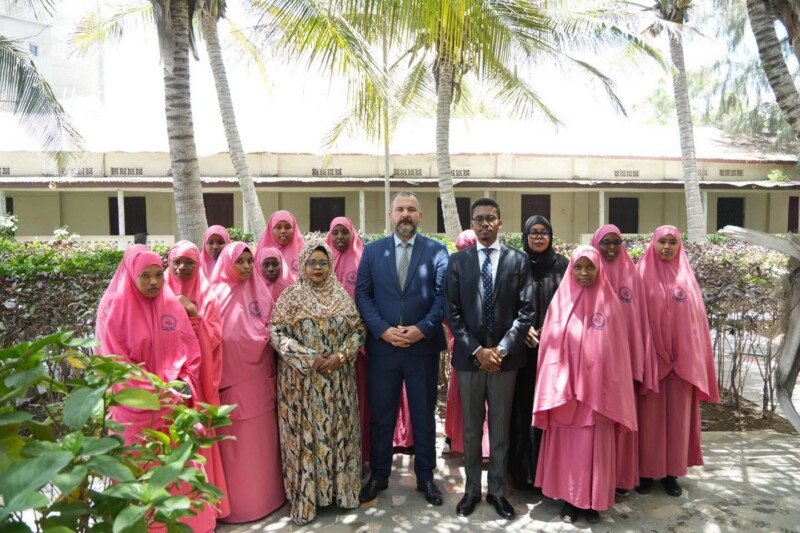
MOGADISHU — The Turkish Cooperation and Coordination Agency (TİKA) has donated medical equipment to Somalia’s National Midwifery Institute to strengthen practical training for students in maternal and newborn healthcare.
The equipment is intended to provide trainee midwives with hands-on experience in the skills required to care for women during pregnancy and childbirth, and to deliver essential care for newborns.
Somalia’s State Minister for Health and Social Welfare, Dr. Maryama Mohamed Hussein, attended the handover ceremony and said the assistance was part of efforts to improve institutions responsible for training the country’s healthcare workforce, particularly midwives. She thanked TİKA for its continued support to the Ministry of Health and for responding to the Ministry’s request to provide adequate training facilities and medical equipment needed to strengthen practical education at the institute.
The ceremony was also attended by TİKA Coordinator Zafer Eski and officials from the institute.
The Critical Role of Midwifery Training
Practical training is considered a critical component of preparing midwives to manage pregnancies and deliveries safely before they begin providing services in healthcare facilities. The National Midwifery Institute plays a central role in training professionals who are subsequently deployed to health facilities across Somalia.
Strengthening the institute’s training capacity could help increase the availability of qualified midwives and improve maternal and newborn healthcare services. Somalia continues to face significant challenges in maternal and child healthcare, including shortages of trained health professionals and limited access to quality healthcare services, particularly outside major urban centres.
TİKA’s assistance forms part of broader health cooperation between Somalia and Türkiye, which has included training healthcare workers, equipping medical facilities, and supporting the development of health services. The two countries have previously held high-level discussions on enhancing medical partnerships, training, and healthcare infrastructure.
TİKA’s Broader Health Engagement in Somalia
The midwifery institute donation is the latest in a series of TİKA health projects in Somalia. In May 2026, TİKA provided comprehensive medical equipment support to Warsheikh Hospital, strengthening the hospital’s maternity ward, laboratory, and general health infrastructure.
In July 2024, TİKA provided an intensive care unit to Mogadishu’s Deynile Hospital, enhancing the hospital’s capacity to provide critical care to patients. The new ICU helped address urgent medical needs and improve overall healthcare services in the capital.
Beyond health, TİKA has donated equipment to Somalia’s Ministry of Agriculture and Irrigation to improve operational capacity and advance agricultural development. The agency has also installed greenhouses at Mogadishu University and the Mogadishu Central Prison to boost agricultural production.
Critical Note
TİKA’s donation to the National Midwifery Institute reflects a focus on capacity building that goes beyond immediate relief. By equipping training institutions rather than only hospitals, the support targets the long-term development of Somalia’s healthcare workforce. For a country where maternal and infant mortality rates remain among the highest in the world, strengthening midwifery training is a direct investment in saving lives.
The specific types, quantities, and value of the equipment transferred were not disclosed, nor was the number of students who will benefit from the donation. This absence of detail makes it difficult to assess the scale of the impact or to track whether the equipment is being used effectively. Greater transparency from both TİKA and the Somali Ministry of Health would allow for better monitoring and accountability.
The broader challenge for Somalia’s health system extends beyond equipment. Even with improved training facilities, the country faces a severe shortage of qualified health professionals, particularly in rural areas. The deployment of trained midwives to underserved communities requires sustained investment in recruitment, retention, and support systems that go beyond the provision of equipment. TİKA’s contribution is a necessary piece of the puzzle, but it must be accompanied by comprehensive health system strengthening led by Somali institutions.
Recommended Reading On ftlsomalia.com
- Somalia Pursues Enhanced Medical Partnerships with Türkiye
- Mogadishu’s Deynile Hospital Receives New ICU from TIKA
- Turkey Donates Equipment to Boost Somalia’s Farm Ministry
- Somali Auditors Complete Financial Audit Training in Ankara
- Somalia and Türkiye Leaders Meet in Doha, Pledge Deeper Cooperation