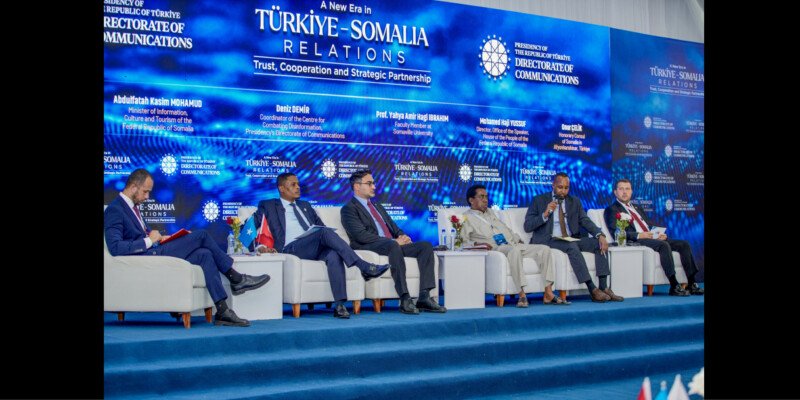
MOGADISHU — A program titled “A New Era in Türkiye-Somalia Relations: Trust, Cooperation and Strategic Partnership” was held at Aden Adde International Airport in Mogadishu, bringing together senior Somali officials and Turkish representatives to celebrate what both sides described as an unprecedented level of bilateral cooperation.
The event was attended by Speaker of the House of the People Abdulkadir Mohamed Nur, Minister of Information, Culture and Tourism Abdulfatah Kasim Mohamud, and Coordinator of the Center for Combating Disinformation of the Turkish Presidency’s Directorate of Communications, Deniz Demir, among other officials.
Speaker Nur highlighted that the relationship between Turkey and Somalia began with humanitarian assistance and has since evolved into a strategic partnership encompassing diplomacy, the economy, and defense. He called for enhanced efforts to counter disinformation, warning that misleading information could undermine trust between the Somali and Turkish peoples.
Minister Mohamud emphasized that the partnership extends across security, energy, fisheries, infrastructure, aviation, and education, stating that “the sovereignty and territorial integrity of the Federal Republic of Somalia are not open to negotiation.”
The Speaker and His Turkish Ties
The presence of Speaker Abdulkadir Mohamed Nur at the center of this event is significant, given his longstanding and well-documented ties to Ankara. He spent eight years at Somalia’s embassy in Ankara, first as second secretary and later as first secretary, and graduated from Ankara University’s Faculty of Political Sciences in 2015. His political career is said to have begun at the Somali embassy in Ankara, and he is widely considered to have a very close relationship with the Turkish government, with some political observers describing him as a key proxy for Turkish interests in Somalia.
As Minister of Defence from December 2021 to March 2025, Nur personally signed the February 2024 Defence and Economic Cooperation Framework Agreement with Turkey, an arrangement giving Turkey responsibility for protecting Somalia’s entire maritime territory and a 30 percent share of marine revenue from Somalia’s Exclusive Economic Zone. The agreement was not merely a bilateral security arrangement, it embedded a foreign military institution’s commercial interests in Somalia’s maritime economy, giving Turkey structural leverage that would outlast any individual minister or government.
Following his election as Speaker on August 10, 2026, Nur’s first phone call was not to Washington or the African Union, but to the Speaker of Turkey’s Grand National Assembly, to discuss advancing parliamentary cooperation between Somalia and Turkey. This was not surprising to anyone who has followed his career, his first act as Speaker signaled where his loyalties lie.
A Partnership Under Scrutiny
While the forum celebrated the deepening of Turkey-Somalia relations, the event’s focus on countering disinformation raises questions about the broader media environment in both countries. The Somali government has faced allegations of state-sponsored digital censorship, with independent media outlets and political analysts appealing to Western embassies over what they describe as an unprecedented electronic warfare campaign designed to eliminate political dissent from the internet.
According to diplomatic briefs reviewed in Mogadishu, the Federal Government has allegedly contracted an Italy-based marketing firm to systematically dismantle the online presence of leading independent broadcasters. The operation reportedly exploits automated copyright enforcement systems to scrub critical content from social media platforms. Somalia’s intelligence agencies have been accused of intimidating, detaining, and silencing journalists, with reporters facing arrest without warrant, interrogation over their reporting, and forced exile.
In one documented case, freelance journalist Mohamed Bulbul was abducted by masked men, beaten, and threatened with death after co-authoring an article about the prosecution of an activist. The Somali Media Women Association has characterized the situation as a “highly organized wave of online subversion”, noting that journalists now face pressure on multiple fronts, including harassment, arrests, and organized online campaigns.
Turkey’s Own Press Freedom Record
Turkey, which was celebrated at the forum as Somalia’s most important strategic partner, has itself faced significant criticism over its treatment of journalists. In the 2026 World Press Freedom Index published by Reporters Without Borders, Turkey ranked 163rd out of 180 countries, down from 159th the previous year. The report noted that approximately 90 percent of national outlets are under direct or indirect government control.
RSF cited the frequent use of charges such as “disinformation,” “insulting the president,” and “denigrating state institutions” to prosecute journalists. Turkey’s controversial disinformation law, Article 217/A of the Turkish Penal Code, has been widely used, with at least 83 journalists facing charges in 114 separate cases.
In the second quarter of 2026 alone, Turkish courts sentenced six journalists to a combined seven and a half years in prison on charges including spreading misleading information and insulting judicial institutions. At least five journalists were detained during the quarter, including three who were taken into custody while covering Pride Week events.
Ahead of the NATO Summit in Ankara in July 2026, Turkish authorities launched a coordinated crackdown on critical voices, with 11 journalists and media workers detained under vague or unjustified pretexts. The International Federation of Journalists expressed “profound alarm” at the wave of detentions and arrests.
Critical Note
The Turkey-Somalia forum showcased a partnership that has delivered tangible benefits for Somalia, including security training, infrastructure development, and economic investment. However, the event’s focus on countering “disinformation” must be viewed critically against the backdrop of press freedom challenges in both countries.
The speaker’s own history illustrates the depth of Turkey’s influence in Somalia’s political system. His career was built in Ankara, he signed the most significant military agreement in Somalia’s history with Turkish officials, and his first act as Speaker was to call his Turkish counterpart. This level of alignment raises legitimate questions about the extent to which Somalia’s parliamentary leadership operates independently of Turkish interests.
The alignment between Mogadishu and Ankara on countering disinformation is concerning when both governments have records of using such language to justify restrictions on press freedom. As the partnership deepens, the international community should monitor whether the shared focus on “strategic communication” becomes a vehicle for suppressing dissent rather than a legitimate effort to combat false information.
For Somalia, which has made progress in rebuilding its institutions and democratic processes, the trajectory of its media environment will be a key indicator of its commitment to accountability and good governance. A partnership with Turkey should not come at the cost of the fundamental rights that Somalia’s constitution guarantees to its citizens.