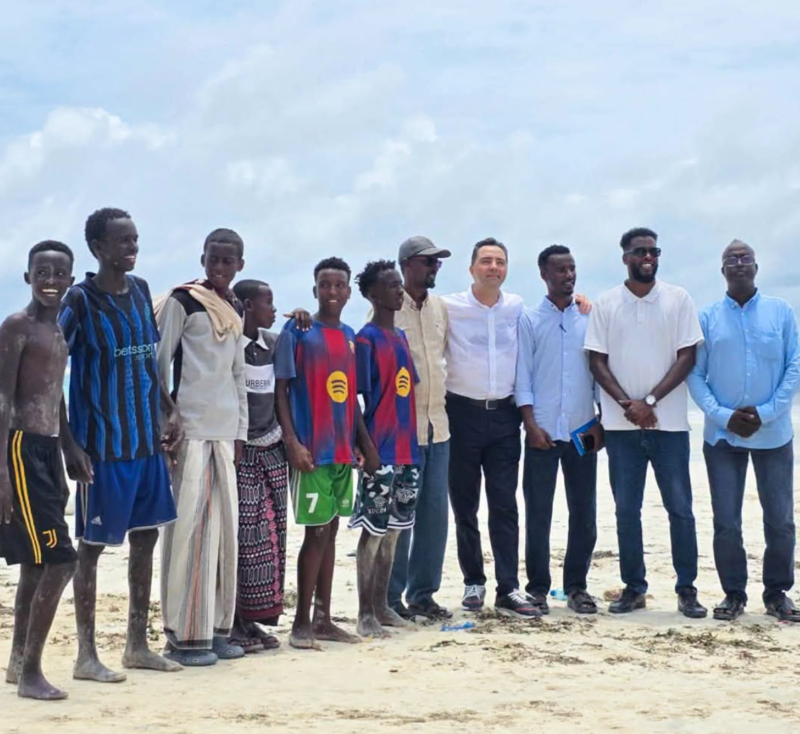
WARSHEEKH — Türkiye’s Ambassador to Somalia, Ferhat Alkan, visited the spaceport facility under construction in Warsheikh district, Middle Shabelle region, to inspect the progress of the project and meet with the team managing the site.
The Ambassador was accompanied by other officials and inspected various sections of the facility where construction work is ongoing. He held discussions with the project management and engineers, receiving briefings on the status of the construction and the plans for completing the facility.
The visit came hours after Turkish President Recep Tayyip Erdogan publicly announced that construction of the spaceport in Somalia had begun, describing it as a “historic” cooperation that would strengthen Türkiye’s access to space and contribute to the development of Africa’s space ecosystem.
Speaking at the opening of the 77th International Astronautical Congress in Antalya, Erdogan said: “In today’s world, producing satellites alone is not enough to have a presence in space; one must also be able to access space. For this reason, we have given a special place in our National Space Programme to the objectives of access to space and a spaceport”.
A $350 Million Strategic Investment
The spaceport project represents one of the largest foreign investments in Somalia’s recent history. Türkiye plans to construct the facility at an estimated cost of $350 million, with the site chosen for its strategic location near the equator. Somalia’s position along the Indian Ocean provides optimal conditions for rocket launches due to Earth’s rotational speed, reducing fuel requirements and improving payload capacity.
Türkiye has completed the design phase of its next-generation Turksat 7A communications satellite, and Somalia is expected to serve as the launch site for the project. As reported in FTL Somalia’s coverage of the satellite launch plans, the first satellite launch from Somali soil is planned for 2027, marking a historic milestone for a country still rebuilding after decades of conflict.
Turkish Industry and Technology Minister Mehmet Fatih Kacır said Türkiye plans to launch its lunar spacecraft in the first months of 2027, powered by a domestically developed hybrid propulsion system. The approximately 3.5-tonne spacecraft has a domestic production rate of more than 80 percent [citation:3].
Dual-Use Facility and Regional Implications
According to reporting by French newspaper Le Monde, the facility is designed as a dual-use installation combining a satellite launch base for Türkiye’s space programme with a testing site for long-range ballistic missiles. An investigation by the Middle East Forum found that a missile test facility at this location would place most of Africa and the Middle East within range for ballistic missile strikes.
The project has generated significant attention in Israeli media, with The Jerusalem Post noting that the Warsheikh site could give Ankara greater capacity to project power in the Red Sea, the Horn of Africa, and the Indian Ocean. The reported missile range would not place Israeli territory within reach from that position, but would include Somaliland, which has deepened its political and military ties with Israel.
Türkiye has deployed M48 and M60 Patton battle tanks to Mogadishu to protect Turkish installations in the Warsheikh district, where the aerospace project is advancing. As reported in FTL Somalia’s coverage of the spaceport cooperation, the tanks are positioned to defend Turkish personnel and facilities.
Broader Türkiye-Somalia Cooperation
The spaceport is part of a broader expansion of Türkiye’s relationship with Somalia, which has developed substantially over the past decade. Ankara operates its largest overseas military base, TURKSOM, in Mogadishu, where it has trained thousands of Somali soldiers since 2017.
Türkiye and Somalia signed a defence and economic cooperation framework agreement in February 2024, under which Türkiye provides security for Somalia’s territorial waters for a decade. The agreement gives Türkiye authority over Somali waters and rights to exploit marine resources in exchange for providing security against illegal fishing and piracy.
Beyond security, Türkiye has expanded cooperation into education, energy, telecommunications, and other sectors. As reported in FTL Somalia’s coverage of the telecommunications MoU, the two countries signed a memorandum of understanding on telecommunications regulation in June 2026, covering satellite communications regulation, cybersecurity, spectrum management, and broadband infrastructure development.
Critical Note
The Warsheikh spaceport project represents a significant escalation in Türkiye’s strategic footprint in Somalia, moving beyond security and development cooperation into aerospace and potentially missile technology. For Somalia, hosting a spaceport could mark a major step into the space sector and bring new opportunities in technology, infrastructure, and skills development.
However, the project raises serious questions about Somalia’s sovereignty and long-term interests. The facility is dual-use, serving both civilian satellite launches and ballistic missile testing, according to Le Monde’s reporting. This places Somalia at the centre of regional military competition, particularly between Türkiye and Israel, which has deepened its ties with Somaliland.
The reported missile range would place Somaliland within reach from Warsheikh, a fact that Israeli media has highlighted. Whether the project remains primarily civilian or develops into a significant military installation will determine its impact on regional stability. Somalia’s government has not publicly addressed these concerns or provided details on the financial and security arrangements governing the facility. The absence of transparency around a project of this magnitude, in a country with limited institutional oversight, is a matter that deserves greater public scrutiny.