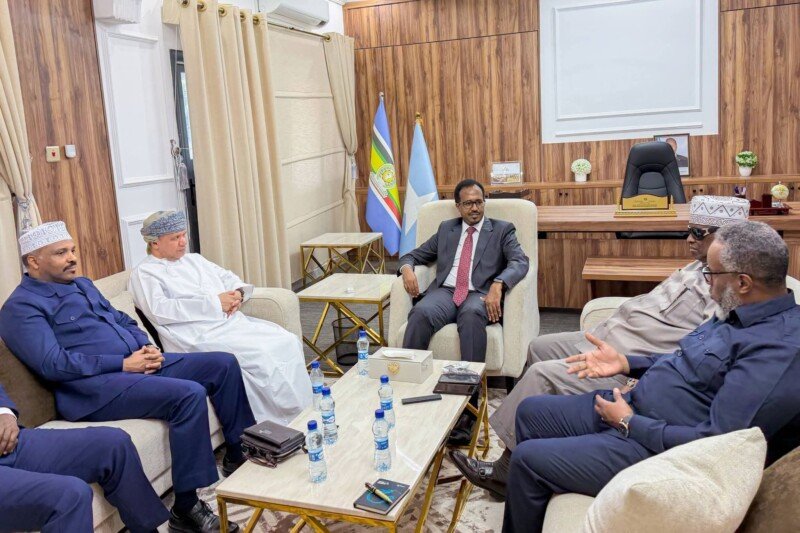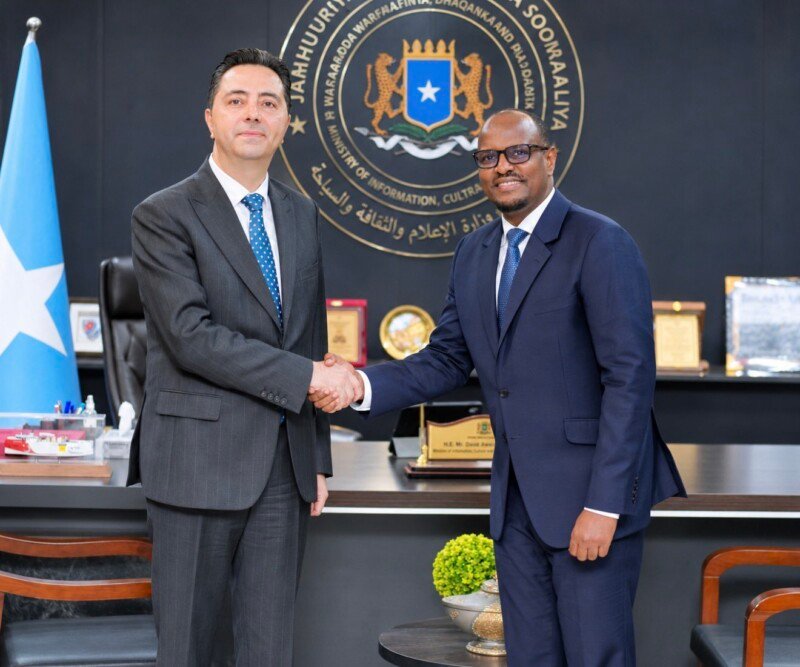
MOGADISHU, Türkiye’s Ambassador to Somalia, Ferhat Alkan, met with Minister of Petroleum and Mineral Resources Dahir Shire Mohamed this week to discuss the ongoing operations of the Çağrı Bey drillship and the future of energy cooperation between the two countries.
According to a statement from the Turkish embassy, the meeting covered joint projects aimed at harnessing Somalia’s energy resources for the country’s economy and the welfare of the Somali people, as well as opportunities for technical capacity development. The two sides also exchanged views on the Çağrı Bey Ultra Deepwater Drilling Platform, which continues hydrocarbon exploration activities offshore Somalia.
The meeting comes as the drilling operation at the Curad-1 well enters a critical phase. Abdulkadir Aden Mohamed, head of the Somali Petroleum Authority, said in a television interview last week that drilling had entered Early Cretaceous formations where signs of oil began to appear, and that approximately 2,000 meters remained to the target depth. He expressed hope that the target would be reached in December.
The Scale of the Operation
The Çağrı Bey departed from Mersin, Türkiye, on February 15 and reached Mogadishu in April after a 53-day voyage around the African continent. The vessel is operating at the Curad-1 well, approximately 370 kilometers offshore from Mogadishu, at a water depth of about 3,500 meters. If the target depth of 7,500 meters is reached, Curad-1 would become the world’s second-deepest offshore well.
The drilling campaign is the culmination of a partnership that began with seismic surveys conducted by the Turkish vessel Oruç Reis, which collected 3D seismic data across 4,464 square kilometers in three offshore blocks over 234 days. Under a 2024 agreement, Turkey’s state-owned Turkish Petroleum Corporation secured exploration rights for three offshore blocks, with terms allowing the company to recover up to 90 percent of production after royalties capped at 5 percent.
Somali officials have framed the drilling campaign as a national project. President Hassan Sheikh Mohamud said at the launch ceremony in April that “natural resources are national wealth and will benefit all Somalis,” adding that there was “no concept” that a well drilled in one region belonged only to that region.
A Timeline Gap That Matters
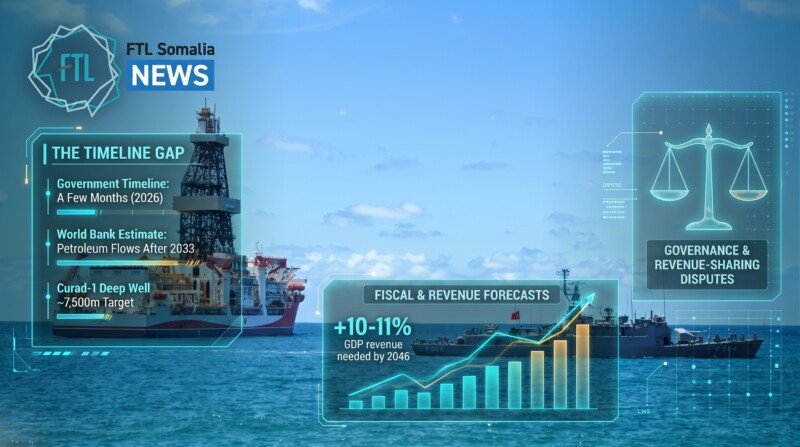
While the technical progress at Curad-1 is real, the timeline for actual production remains contested. Prime Minister Hamza Abdi Barre stated at the vessel’s arrival ceremony in April that “God willing, in a few months we will celebrate the first oil extraction.” Turkish Energy Minister Alparslan Bayraktar suggested production could begin within six to nine months, contingent on maritime and weather conditions.
But the World Bank’s 2026 Public Finance Review offers a more sober assessment. As FTL Somalia reported on the gap between the government’s rhetoric and the Bank’s modeling, the report assumes oil revenues begin flowing only after 2033, based on comparator country experience. Even if Curad-1 confirms a commercial discovery, the path to revenue requires appraisal drilling to determine the size of the reservoir, development planning to design production infrastructure, export logistics to move the oil to market, and a fiscal and regulatory framework that can withstand political scrutiny. None of these steps can be compressed into months.
The World Bank’s caution is reinforced by the exploration history. Only two exploration wells have ever been drilled along Somalia’s roughly 1,000-kilometer offshore margin, and none have produced a commercial discovery. The Curad-1 well is a single test in a vast, underexplored basin.
The Governance Gap
The governance framework for managing any future oil revenues remains contested and incomplete. The 2018 Baidoa Agreement and 2020 Petroleum Law establish a derivation-based revenue-sharing formula that allocates substantial shares to producing federal member states, with smaller portions to non-producing states. But the 2026 constitutional amendments have not yet been operationalized, and Puntland has rejected the federal process entirely.
Transparency watchdogs have already raised concerns and called on federal authorities to immediately disclose oil contracts, warning that severe risks stem from improper resource management. Opposition figures have characterized the exploration pact with Turkey as “profoundly imbalanced,” and Senator Abdi Ismail Samatar has alleged that the agreements have not been scrutinized or endorsed by Parliament.
The Turkish embassy’s statement emphasized that Türkiye would continue supporting Somalia’s efforts to develop its natural resources, strengthen its institutional and technical capacity in the energy sector, and achieve its sustainable development goals. The statement thanked Minister Shire for his strong support of Türkiye-Somalia energy cooperation.
Critical Note
The meeting between Ambassador Alkan and Minister Shire is normal one and does not raise any questions, and it should be reported as such. But it comes at a moment when the gap between the promise of Somali oil and the reality of Somali fiscal capacity is widening, not narrowing. The Çağrı Bey is drilling. The Early Cretaceous formations may hold hydrocarbons. The target depth may be reached in December. All of this is technically significant.
What is not technically significant, but politically decisive, is the timeline. The Prime Minister said “a few months.” The Turkish Energy Minister said six to nine months. The World Bank says after 2033. These are not minor discrepancies. They are competing narratives about when Somalia can expect salvation from its fiscal crisis, and they have real consequences. If the public is told that oil is imminent, the pressure to reform domestic tax collection weakens. If the public expects salvation in months, the case for austerity and expenditure discipline becomes harder to sell.
The Curad-1 well may find nothing. The revenue-sharing framework may collapse under political pressure. The contracts may be challenged or renegotiated. None of these outcomes would be surprising. What is certain is that Somalia cannot wait until 2033 to fix its fiscal problems. The drilling is a gamble, and it is a gamble worth taking. But it is not a plan. The government’s insistence that oil will arrive soon has not been matched by a public accounting of what happens if it does not, or if it takes a decade longer than promised.