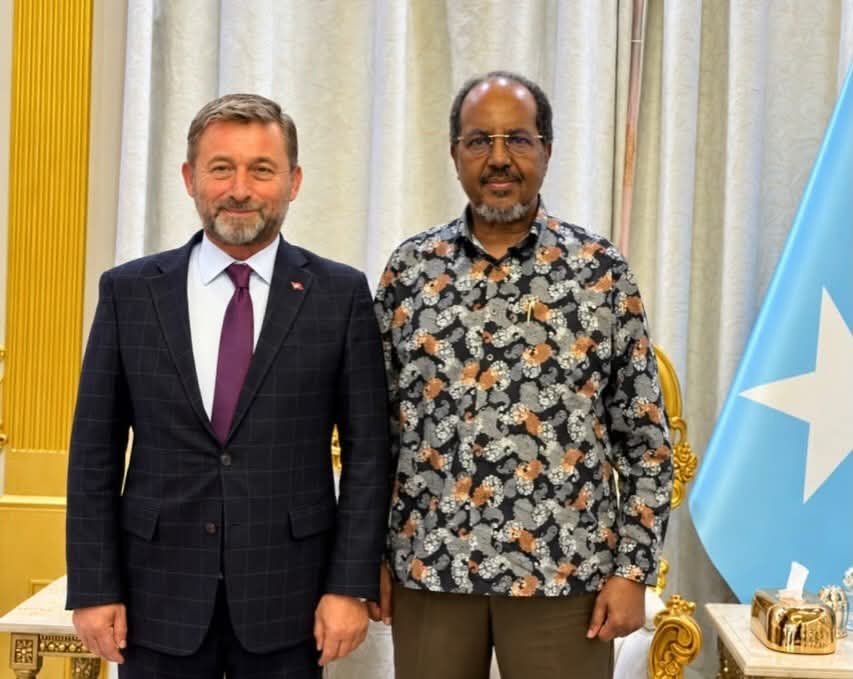
MOGADISHU — President Hassan Sheikh Mohamud received a delegation of Turkish business leaders at the presidential palace in Mogadishu this week, led by Süleyman Kozuva, chairman of the Kozuva Group, a Turkish conglomerate whose subsidiaries operate Aden Adde International Airport and the Décalé Airport Hotel.
Kozuva said in a post on X that the discussions focused on “the ongoing efforts in Somalia and the initiatives we aim to implement.” He thanked the President for the “kind hospitality” extended during a meeting he described as positive and efficient.
In Somalia, the Kozuva Group is best known for Favori LLC, which has operated Aden Adde International Airport since 2013 under a concession agreement, as well as the Décalé Airport Hotel. The meeting comes as Somalia seeks to attract Turkish investment into a planned new port in Mogadishu, which Prime Minister Hamza Abdi Barre said earlier this week would be developed through a public-private partnership involving Turkish and Somali investors.
A Pattern of Unverified Revenue and Missing Audits
The Kozuva Group’s flagship Somali operation, Favori LLC, has been the subject of repeated findings by Somalia’s Office of the Auditor General (OAG) regarding financial transparency and contract compliance.
In a meeting held in June 2026, Auditor General Ahmed Isse Gutale pressed Favori’s Somali representative, Mustafa Durgut, on the company’s failure to submit independently audited financial statements, as required by its concession agreement. As reported in FTL Somalia’s coverage of the Auditor General’s meeting with Favori LLC, the OAG noted that neither Favori LLC nor Albayrak-Somalia, which manages Mogadishu Port, had provided audited statements, making it impossible to confirm the government’s full share of revenues from airport and port operations. The Auditor General was unable to verify concession fees amounting to $34.26 million owed to the federal government.
A subsequent audit report published in August 2026 confirmed the same finding for the 2024 fiscal year. As detailed in FTL Somalia’s coverage of the audit report, the government recorded $32.2 million in revenue from the two concessions, but the OAG concluded the amount “could not be independently verified as fairly determined” due to the companies’ continued failure to provide audited statements.
A special audit covering 2021 and 2022 found that Favori LLC had paid only 13 percent of its gross revenue to the federal government, in violation of the agreed 25 percent revenue-sharing formula. The audit also found that Favori was operating a security service, Golden Horn Security K9 Explosive Detector Dogs, without a legitimate contract and deducting $197,500 per month from the government’s revenue share to cover its costs.
Parliamentary Exclusion and Contract Secrecy
The lack of financial transparency at Favori and Albayrak is part of a broader pattern in Somalia’s agreements with Turkish firms. Somali legislators have been systematically excluded from reviewing major bilateral agreements with Türkiye.
In July 2026, Türkiye’s parliament openly debated and approved a two-year extension of its military mission in Somalia. As reported in FTL Somalia’s coverage of the Turkish parliamentary vote, the decision was made transparently in Ankara, while in Somalia, legislators have been denied access to the texts of key bilateral deals. Senator Professor Abdi Ismail Samatar has publicly accused Ankara of operating on the basis of “fraudulent” agreements that the Somali Parliament has never seen.
A leaked oil and gas deal between Somalia and Türkiye, reportedly signed in secret by only two Somali ministries, grants Türkiye exclusive control over exploration, refining and marketing operations, with Somalia entitled to just 5 percent in royalties. As reported in FTL Somalia’s coverage of the oil deal, the agreement was never disclosed to the Somali Parliament.
Member of Parliament Abdirahman Abdishakur Warsame has described the oil deal as “profoundly imbalanced,” warning that it grants more than 90 percent of the advantages to one party and leaves Somalia with minimal earnings from its own natural resources. He has also criticized the absence of a well-defined structure for corporate taxation or social investment initiatives for the Somali population.
The Somalia Transparency Initiative has called on the federal government to maintain absolute transparency through the immediate public disclosure of oil contracts, clarification of corporate ownership structures, and implementation of accountable revenue management systems.
New Port Project Raises Same Concerns
The planned new Mogadishu port, which the Kozuva delegation discussed with the President, is being structured through the New Mogadishu Development Corporation. Phase One is estimated at about $718 million, and Prime Minister Barre has confirmed plans for Turkish investors to develop the project at nearly $4 billion.
If the new port follows the pattern of the existing airport and port concessions, it will be governed by agreements that are not submitted to Parliament, managed by companies that do not provide audited financial statements, and structured in ways that limit the government’s ability to verify its own revenue share.
Critical Note
The meeting between President Hassan Sheikh Mohamud and the Kozuva Group delegation is a routine diplomatic and business engagement, but it carries significant weight in the context of Somalia’s infrastructure development and its reliance on Turkish investment.
Favori’s track record in Somalia presents a mixed picture. The company has modernised Aden Adde International Airport, transforming a facility that had been destroyed by decades of conflict into a functional gateway to the country. That achievement is real and visible. But the same company has been the subject of a UN Monitoring Group report questioning the terms of its concession, an Auditor General’s audit finding revenue-sharing violations, and repeated findings that it has failed to provide the audited financial statements required by its own contract.
The Auditor General’s findings are not allegations from political opponents. They are the conclusions of the government’s own supreme audit institution, documented in official reports and communicated directly to Favori’s representatives. The failure to submit audited statements makes it impossible for the Somali government to know whether it is receiving the revenue it is owed from its most important infrastructure assets.
As Somalia seeks to expand this partnership into a $4 billion port project, the government faces a choice. It can continue to prioritise speed and political convenience over transparency and accountability, or it can insist that Turkish investment, however welcome, meets the same standards of transparency, labour rights and revenue-sharing that any public-private partnership should require. The former path is easier. The latter is more sustainable.
Share your story. FTL Somalia continues to cover the Turkish investments in Somalia and the governance of public-private partnerships. If you have information or insights to share, contact us at info@ftlsomalia.com. Your identity will be protected.