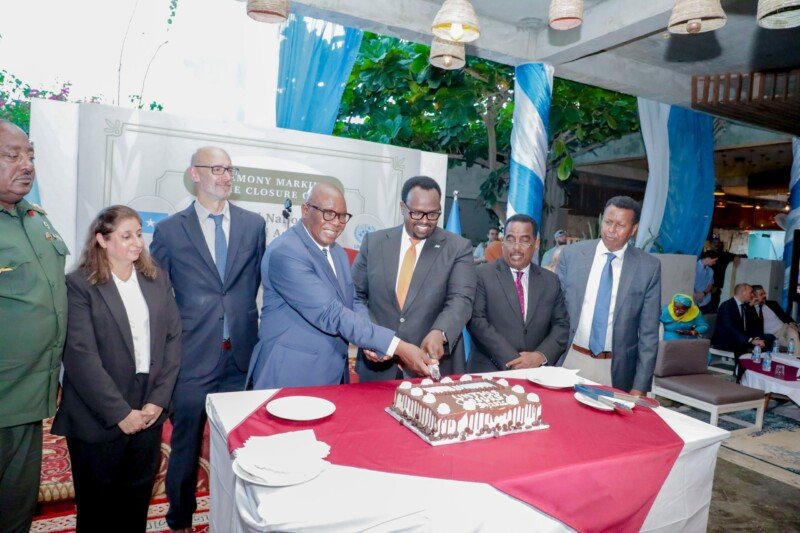
MOGADISHU, Deputy Prime Minister Salah Ahmed Jama attended a formal ceremony in Mogadishu on Monday marking the closure of the United Nations Transitional Assistance Mission in Somalia (UNTMIS), ending more than three decades of UN political missions in the country.
The ceremony was led by UNTMIS Deputy Special Representative of the Secretary-General for Somalia, Officer-in-Charge Raisedon Zenenga and the Deputy Prime Minister, and was attended by senior government officials, former President Sheikh Sharif Sheikh Ahmed, former Prime Minister Mohamed Hussein Roble, civil society representatives, and diplomats from the United States, Italy, Türkiye, Sudan and other international partners.
UNTMIS will formally cease operations on October 31, completing a two-year transition carried out pursuant to Security Council resolutions 2753 (2024) and 2809 (2025), and in line with a request from the Federal Government of Somalia. As reported in FTL Somalia’s coverage of the decision, the closure moves the country away from a “guardian-led” model toward a “Somali-managed, Somali-directed” framework.
A Transition Requested by Mogadishu
UNTMIS was established in November 2024 to succeed the United Nations Assistance Mission in Somalia (UNSOM), which had operated since 2013. The transition was structured in two phases. Phase One, from November 2024 to October 2025, prioritized capacity building in state-building, human rights, rule of law, security sector support, and countering violent extremism. Phase Two, from November 2025 to October 2026, involved the progressive transfer of remaining functions to the Federal Government and the UN Country Team, as detailed in FTL Somalia’s coverage of the transition roadmap.
key handovers have already taken place. In August, the Minister of Justice commended UNTMIS as the mission concluded 13 years of UN rule-of-law support, as reported in FTL Somalia’s coverage of the justice sector handover. In September, the Federal Government completed the handover of the UN Human Rights Office, transferring full responsibility for human rights monitoring to national institutions, as detailed in FTL Somalia’s coverage of the human rights handover.
Addressing the ceremony, Deputy Prime Minister Jama reflected on the transformation Somalia has undergone since the UN mission was first established. “You are leaving a Somalia that is drastically different from the one that you arrived in,” he told UN officials. He pointed to the development of constitutional and federal institutions, improvements in national security capabilities, and economic reforms, including Somalia’s completion of the Heavily Indebted Poor Countries debt relief process.
He acknowledged, however, that the mission’s departure would place greater responsibility on Somali institutions. “For us as the government, we are mindful that the mission has come to an end, but a lot of the work that the mission used to carry out falls on our shoulders,” he said.
Guterres: Progress Made, But Challenges Remain
In a statement issued by his Spokesperson, UN Secretary-General António Guterres commended the progress achieved over the past decades towards building peace and security in Somalia. He praised “the determination and resilience of the Somali people despite the many challenges they face,” and acknowledged the tremendous efforts made on the country’s journey from conflict to recovery.
But the Secretary-General also recognized “the significant political, security, humanitarian and development challenges that remain.” He called for sustained international support to consolidate progress, advance inclusive political dialogue and reconciliation, strengthen institutions, and promote and protect human rights. He specifically underscored the importance of continued support to address the threat posed by Al-Shabaab and enable a gradual and sustainable security transition.
Zenenga described the closure as the culmination of a carefully coordinated two-year transition. “The closure of UNTMIS does not signal the end of UN support, nor does it diminish Somalia’s partners’ commitment. Instead, it opens a new chapter in the UN’s partnership with Somalia,” he said.
The United Nations will continue to support Somalia through its resident agencies, funds and programmes, working with Somali authorities, the African Union and other international partners.
Critical Note
The closure of UNTMIS is a milestone that the Somali government has sought and now celebrates. It represents a formal recognition that the country has moved beyond the phase of direct international political stewardship that began in the 1990s. The Deputy Prime Minister’s remarks captured the significance of the moment: the Somalia that the UN is leaving is not the Somalia it found.
But the transfer of responsibilities also transfers risk. The UN mission supported the constitutional review, electoral processes, political dialogue, reconciliation, human rights, and security sector reform. These are not minor functions, and they are not functions that Somali institutions have consistently demonstrated the capacity to perform without external support. The government’s decision to request the closure was an act of confidence, but confidence is not the same as readiness.
The Secretary-General’s statement is notable for what it acknowledges. He does not declare Somalia’s challenges resolved. He explicitly cites the remaining political, security, and humanitarian challenges, and he calls for continued international support to address Al-Shabaab and advance inclusive political dialogue. That is a more sober assessment than the celebratory framing offered by the government.
The timing is particularly delicate. Somalia is in the midst of a contested electoral transition, with the opposition rejecting the federal government’s timetable and the constitutional amendments that extended the president’s term. The UN mission’s departure removes a neutral broker that, however imperfectly, provided a channel for dialogue and a check on unilateral action. The November National Consultative Forum, which the government has convened, will now proceed without the UN’s direct political presence.
The UN’s statement that it will continue to support Somalia through its resident agencies is accurate but incomplete. The agencies will continue their humanitarian and development work. They will not replace the political good offices that UNTMIS provided. Whether Somalia’s institutions are ready to fill that gap is the question that the ceremony in Mogadishu did not answer.
Recommended Reading On ftlsomalia.com
- UN to Close Somalia Political Office, Extend AU Mission Until 2026
- Federal Government Completes Handover of UN Human Rights Office, Pledges Stronger National Oversight
- Minister of Justice Commends UNTMIS Support as Mission Concludes Justice Sector Assistance
- Foreign Affairs Minister Meets UNTMIS Delegation