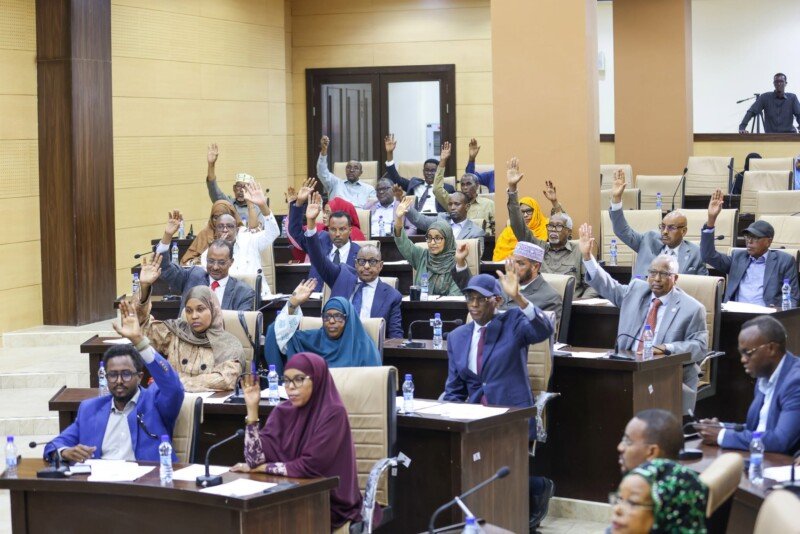
MOGADISHU — Somalia’s Upper House of Parliament approved the bill establishing the National Revenue Authority on Sunday, clearing a key legislative hurdle for the creation of a dedicated institution to manage and develop domestic revenue.
The bill had previously passed through the legislative procedures of the House of the People. Its approval paves the way for the establishment of a national body responsible for the collection, management, and growth of domestic revenue, strengthening the tax system and other sources of government income.
The creation of the authority is expected to support efforts to improve public financial management, enhance revenue transparency, and establish a unified system for managing national revenue sources. It also aligns with the government’s broader objectives of increasing domestic revenue and reducing dependence on external financial support.
The specific details of the law and the institutional structure of the National Revenue Authority will be clarified once the legislation completes all constitutional stages required for implementation.
A Long-Standing Reform Priority
The legislation builds on years of efforts to strengthen domestic revenue mobilisation. In November 2024, Finance Minister Bihi Egeh launched a high-level forum focused on establishing a social contract and enhancing domestic revenue mobilisation, as reported in FTL Somalia’s coverage of the initiative.
In November 2025, Minister Egeh stated that domestic revenue had increased by 80 percent over three years, attributing the rise to stronger collection efforts and a reduced reliance on foreign aid, as detailed in FTL Somalia’s report on the revenue increase.
The 2024 Annual Financial Report recorded a 12 percent increase in domestic revenue compared to the previous year, citing revised revenue laws, digitalised tax and customs systems, and improved public trust as contributing factors.
Fiscal Context
The new authority comes as Somalia’s fiscal performance shows modest improvements in domestic revenue alongside declining external grants. During the first quarter of 2026, the Federal Government collected US$153.9 million in total revenue and grants, of which domestic revenue contributed US$100.6 million, or approximately 65 percent. Domestic revenue increased by 7 percent compared to the same quarter in 2025, while external grants declined by 18 percent, with no bilateral grants disbursed during the quarter.
The 2026 budget projects domestic revenue of US$470.6 million against total expenditure of US$1,363.8 million, leaving a financing gap of US$65.1 million. External grants remain the largest single source of budget financing at US$828.1 million.
Critical Note
The establishment of a National Revenue Authority is a structural reform that Somalia has needed for years. The country’s tax-to-GDP ratio remains among the lowest in the world, and the government’s reliance on external grants for more than 60 percent of its budget is a vulnerability that has been exposed repeatedly when donor disbursements slow or halt.
However, the creation of a new institution does not automatically translate into increased revenue. The challenges are well documented: a narrow tax base, widespread informality, limited enforcement capacity, and a federal system in which revenue collection responsibilities are shared and sometimes contested with Federal Member States.
The Upper House’s approval is a procedural step, not an outcome. The authority’s effectiveness will depend on its operational independence, its funding, the quality of its leadership, and the political will to enforce tax compliance across powerful commercial interests. Somalia has passed many laws in recent years. The test is whether this one changes the fiscal trajectory in a measurable way.
Recommended Reading On ftlsomalia.com
- Egeh Launches Forum on Enhancing Mobilization of Domestic Revenue in Somalia
- Somalia Reports 80% Increase in Domestic Revenue Over Three Years Through Reform Efforts
- Somalia’s Domestic Revenue Rises 12% in 2024 Amid Reforms and Public Trust
- Somalia’s Bihi Egeh Named Africa’s Finance Minister of the Year
- Prime Minister Unveils Historic Education Reform Funded by Domestic Revenue
- Finance Minister Meets Partners on Investment and Economy