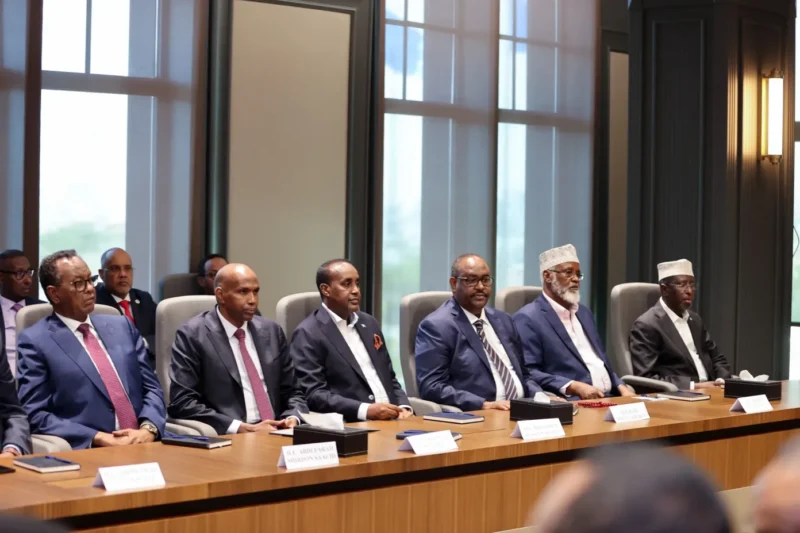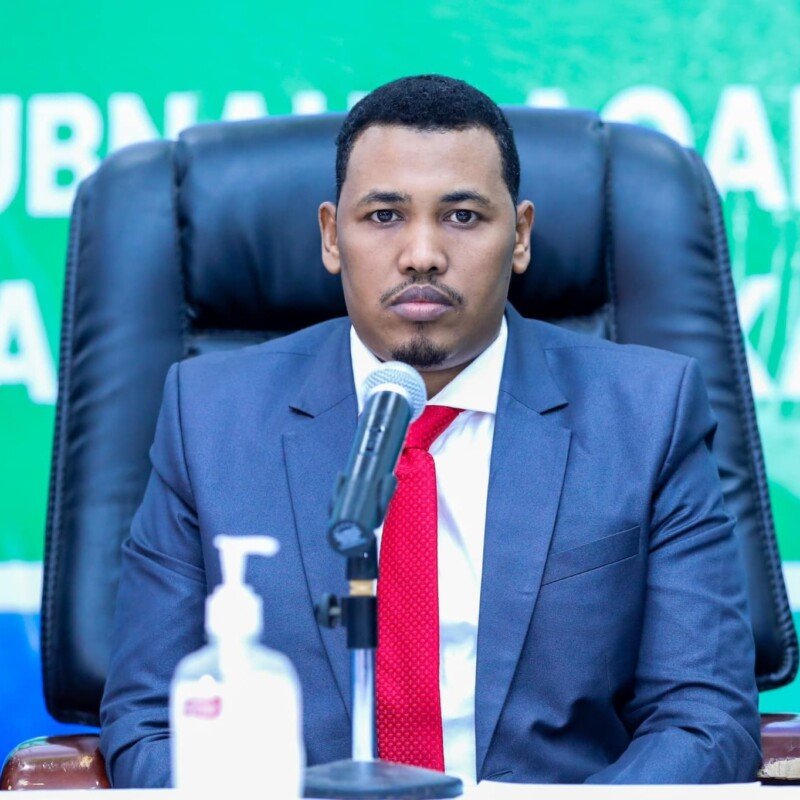
MOGADISHU, President Hassan Sheikh Mohamud and Speaker of the House of the People Abdulkadir Mohamed Nur (Jaamac) have both congratulated the newly elected leadership of the Hirshabelle State House of the People, following the election of the regional parliament’s speaker and deputies.
The new leadership comprises Speaker Abdiqani Lukman Haji Abdi, First Deputy Speaker Abdirahman Abdi Iidow, and Second Deputy Speaker Jama Ali Mohamud. They were elected during a parliamentary session in Jowhar, completing the formation of the legislative leadership ahead of the regional presidential vote scheduled for tomorrow, October 24.
Federal Congratulations and Calls for Diligence
President Mohamud extended his congratulations to the new leadership, commending them for the confidence placed in them by the lawmakers. He urged them to fulfill their constitutional duties with diligence and integrity, and to work toward strengthening governance, consolidating democracy, and accelerating the work of the regional parliament. The president also emphasized the importance of inter-institutional cooperation, social unity, and reinforcing peace and development in Hirshabelle.
Speaker Nur, in a separate statement, similarly praised the new leadership and called on them to serve the people of Hirshabelle with transparency and accountability. He urged the new speaker and his deputies to focus on enhancing cooperation between government institutions, improving public representation, and prioritizing the general interests of the people of Hirshabelle and Somalia as a whole.
The congratulatory messages from the federal leadership underscore the political significance of the Hirshabelle transition. The regional parliament was elected in a direct vote on September 30, with the Justice and Solidarity Party (JSP) securing 78 of the 99 seats, as reported in FTL Somalia’s coverage of the electoral timetable. That overwhelming majority means the JSP effectively controls the selection of the new speakership and, by extension, the upcoming presidential vote.
The Road to the Presidency
The election of the parliamentary leadership clears the way for the regional presidential vote on Saturday. As reported in FTL Somalia’s coverage of the schedule, candidates for the presidency and vice-presidency are expected to submit their applications on Friday, October 23, with speeches and the final vote taking place the following day.
The JSP has nominated incumbent President Ali Abdullahi Hussein Guudlaawe for another term, a decision that has sharpened a long-running power-sharing dispute between the Hawadle community of Hiiraan and the Abgaal community of Middle Shabelle. As reported in FTL Somalia’s coverage of the Beledweyne protests, residents and traditional elders warned that they would not accept elections without a prior political agreement on the region’s leadership.
Hirshabelle Vice President Yusuf Ahmed Hagar Dabageed, a Hawadle politician, has publicly accused President Hassan Sheikh Mohamud of reneging on a promise to return the regional presidency to the Hawadle clan. The JSP has selected former Hiiraan governor Abdifatah Hassan Afrah as its vice-presidential candidate in an attempt to balance the ticket.
Critical Note
The congratulatory messages from President Mohamud and Speaker Nur are standard diplomatic and political courtesies, but they carry a particular weight in the Hirshabelle context. The regional parliament’s election was a significant step toward direct representation, replacing the indirect clan-based selection system that had governed the state since its formation.
But the federal leadership’s praise for the new speakership cannot obscure the unresolved political tensions in the region. The JSP’s 78-seat majority in the regional assembly means that the new speaker and his deputies were elected by a chamber that the ruling party dominates. The Hawadle community’s demand for the presidency remains unaddressed, and the selection of a former Hiiraan governor as the JSP’s vice-presidential candidate has not resolved the underlying dispute over power-sharing.
The new parliamentary leadership now faces the task of presiding over a presidential election that is expected to return Guudlaawe to office, but whose legitimacy is contested by significant constituencies in Hiiraan. A parliament elected directly is a step forward. A parliament that elects a president without addressing the grievances of its region’s second-largest community is a step that may produce a government but not the political trust that Hirshabelle has lacked since its formation. The federal congratulations are a starting point. They are not a resolution.
Recommended Reading On ftlsomalia.com
- Hirshabelle Parliament to Elect Speaker and President in Coming Days
- Beledweyne Protests Erupt as Residents Reject Hirshabelle Election Without Political Agreement
- Hirshabelle Election Results: JSP Wins Landslide in First Direct Vote
- FGS President Mohamud Backs JSP Candidate as Hirshabelle Electoral Tensions Escalate