BORAMA — A viral video circulating on Somali social media has renewed attention on the deepening divide between Somaliland’s government and the Samaroon (Gadabuursi) community in the Awdal region, after a local politician was filmed refusing to voice support for Palestine.
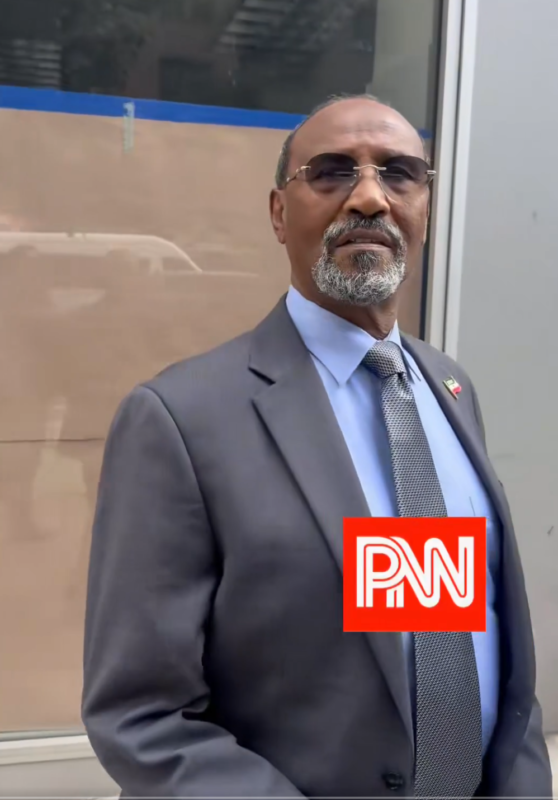
The clip, shows a man identified as “former Minister of Finance, Mr.Bayle” dismissing the slogan “Free Palestine.” The post quickly drew thousands of views and hundreds of replies, with several commenters accusing him of being a “fake Muslim” and questioning his faith.
The incident is the latest flashpoint in a broader backlash against Somaliland’s alignment with Israel, a policy that has proven deeply unpopular in Awdal and other non-Isaaq communities. The video’s virality underscores how the Israel alliance has become a lightning rod for internal opposition, amplifying long-standing grievances about Hargeisa’s political dominance.
Awdal’s Resistance to the Israel Alliance
The Samaroon community’s opposition to Israel’s recognition of Somaliland is not new. When Israel became the first country to formally recognize Somaliland in December 2025, protests erupted in Borama and other parts of Awdal. Demonstrators raised Palestinian flags and chanted slogans rejecting what they described as a “one-clan secessionist enclave”.
Analysts noted at the time that the Samaroon clan, which resides in the Borama region, was “not particularly keen on secession,” and that “Israel’s intervention brought them to the streets”. The protests were seen as an early indicator of the fragility of Somaliland’s internal cohesion, exposing the limits of Hargeisa’s authority in the western periphery.
The Awdal region has its own complex political history. The Gadabuursi (Samaroon) and Issa clans have long felt marginalized by the Isaaq-dominated political structure in Hargeisa, despite the Borama Conference of 1993 which sought to broaden governance. The Israel recognition has provided a new rallying point for that discontent, linking local grievances about political exclusion with broader solidarity with the Palestinian cause.
The Broader Regional Backlash
The backlash against Israel’s recognition was not limited to Awdal. Massive demonstrations took place across Somalia, with large crowds gathering in Mogadishu’s main stadium and other cities. More than 20 Arab and Islamic countries issued a joint statement rejecting the recognition as a “grave violation of the principles of international law” and a “serious precedent” that threatens regional stability.
The African Union, Arab League, Organisation of Islamic Cooperation, and IGAD all condemned the move. China explicitly warned against “unwarranted interference” and called for Somaliland to “immediately stop their separatist activities”.
Within Somaliland itself, the recognition sparked protests in Borama that left at least 18 people dead and more than 100 wounded in related clan clashes, according to reports. The violence exposed the fragility of the region’s internal stability and the declining capacity of Hargeisa to manage peripheral disputes.
Critical Note
The viral clip of a Samaroon politician refusing to endorse Palestine is a symptom of a deeper problem for Somaliland’s recognition campaign. The Israel alliance was presented as a pragmatic diplomatic move, a way to break the decades-long deadlock by seizing an opening that others had refused. But the evidence from Awdal suggests the opposite has occurred: rather than strengthening Somaliland’s internal cohesion and international standing, the alliance has deepened domestic divisions and isolated Hargeisa from the very regional bodies it needs to win over.
The Samaroon community’s resistance is not merely about Palestine. It is about a political system that has concentrated power in Hargeisa and left non-Isaaq groups feeling excluded. The Israel recognition gave that discontent a new focus and a new vocabulary. When a local politician refuses to say “Free Palestine,” he is not just rejecting a slogan. He is signaling alignment with a government whose foreign policy has become a liability in his own community.
For Somaliland’s recognition pitch, this is a serious problem. The campaign rests on the argument that Somaliland is a stable, cohesive state with uncontested authority over its territory. The protests in Borama, the Samaroon clan’s opposition to secession, and the viral backlash against Israel’s alliance all undermine that narrative. If Hargeisa cannot bring its own western periphery along on its most important diplomatic initiative, the question of whether it can be a reliable international partner becomes harder to answer.