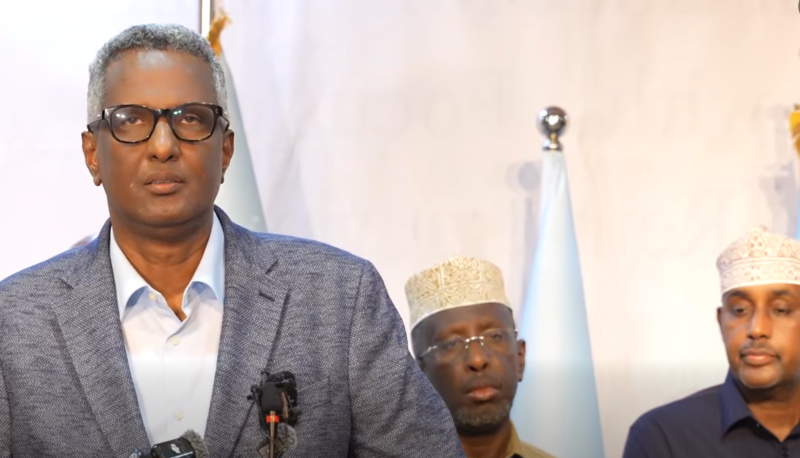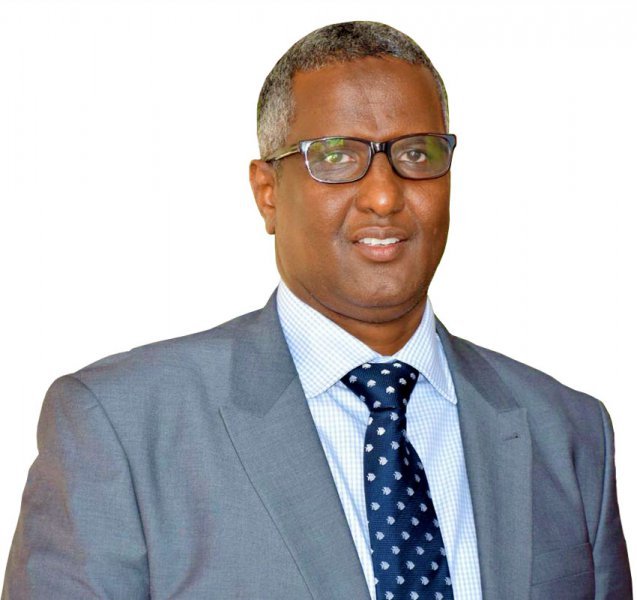
MOGADISHU, Somali opposition lawmaker and Wadajir Party leader Abdirahman Abdishakur Warsame has published a detailed critique of the federal government’s political strategy, arguing that Somalia’s political crisis, the Al-Shabaab insurgency, and regional geopolitical rivalry are converging into a single, mutually reinforcing threat to the state.
In an essay published on his Substack on Monday, Warsame, a member of the Somali Future Council opposition coalition, wrote that “the greatest danger is not simply the number of crises we face” but that “decisions made in pursuit of political power are connecting those crises and diminishing our collective capacity to overcome them.”
The essay traces the current impasse to President Hassan Sheikh Mohamud’s decision to proceed with constitutional amendments extending the presidential term to five years, applying the extension to his own mandate despite its expiration on May 15, 2026. Warsame argues that the electoral model introduced by the administration, featuring a single nationwide constituency, closed party lists, and an electoral commission whose members the president selected, creates a fundamental conflict of interest.
The South West Precedent
Warsame points to South West State as evidence of what he describes as a predetermined electoral process. He claims the Justice and Solidarity Party (JSP) candidate secured 99 percent of the vote there, and warns that similar arrangements are being pursued in Galmudug and Hirshabelle. Independent reporting corroborates the broader pattern: the JSP has formally endorsed Hirshabelle President Ali Gudlawe for reelection, prompting protests in Beledweyne and rejection from Hiiraan stakeholders who demand a political agreement before any vote. As reported in FTL Somalia’s coverage of the Beledweyne protests, the Xawaadle clan declared it would not accept any election held without a prior political agreement, and armed Macawisley fighters seized voter registration centres in early September.
On South West specifically, Warsame acknowledges that ousted President Abdiaziz Laftagareen “bears responsibility for his participation in the disputed arrangements,” but argues the federal leadership must also answer for pursuing political outcomes through coercive means. He calls for independent investigation into allegations that Laftagareen-aligned forces coordinated with Al-Shabaab, while cautioning that “military activity in the same area does not, by itself, establish an operational alliance.”
International analysis supports the gravity of the confrontation. Chatham House reported that recent fighting around Baidoa between government forces and Laftagareen loyalists “involved thousands of fighters and the use of drones and fighter jets,” and warned that foreign rivalries risk turning Somalia’s political crisis into a protracted war.
Counterterrorism as a Political Weapon
Warsame raises concerns about the reported use of terrorism-related financial sanctions against Laftagareen and associates, arguing that “when counterterrorism powers are perceived as instruments of political competition, public confidence declines, cooperation becomes more difficult, and legitimate investigations risk losing credibility.” He applies the same principle to military force, including drones, warning that security institutions “must protect the country and its citizens, not become instruments for settling political disagreements.”
This critique intersects with a documented escalation: the federal government has used drones and fighter jets in domestic political confrontations, and Turkish fighter jets were reportedly involved in the fighting near Baidoa, though Ankara has not confirmed this.
Regional Rivalry and “Strategic Partition”
The essay’s most analytically ambitious section connects domestic fragmentation to regional geopolitics. Warsame warns of “strategic partition by accumulation,” defined as “the gradual emergence, through successive security partnerships, port arrangements, investments and diplomatic relationships, of distinct political spaces increasingly oriented toward different external centres of power.”
This is not abstract speculation. Chatham House documents two competing external blocs in the Horn: Turkey, Egypt, and Saudi Arabia broadly aligned with the federal government, and the UAE and Israel broadly aligned with Ethiopia and Somalia’s opposition state administrations. The UAE has maintained direct relations with Somaliland, Puntland, and Jubaland, and Mogadishu annulled its defense agreements with Abu Dhabi in January 2026, accusing it of undermining Somali sovereignty. Warsame’s warning that Somalia could retain “one flag, one internationally recognised territory and one seat at the United Nations while progressively losing the capacity to determine its security relationships” is a precise description of the trajectory he fears.
The essay’s critique of the electoral process is reinforced by the opposition’s broader rejection of the NIEBC timetable. Former President Sharif Sheikh Ahmed has warned that the unilateral process could lead to “parallel elections, political instability, civil unrest, and a threat to the existence of the Somali state,” and has filed a Supreme Court petition challenging the constitutional amendments, as reported in FTL Somalia’s coverage of the electoral dispute.
Former President Mohamed Abdullahi Farmaajo has also accused President Mohamud of sabotaging internationally mediated talks, calling on international partners not to “again endorse the agenda of the term-expired President,” as reported in FTL Somalia’s coverage of Farmaajo’s statement.
The federal-state dimension of the crisis is equally stark. Jubaland has declared itself an independent government and withdrawn from the federal structure, while Puntland has severed ties with Mogadishu. As reported in FTL Somalia’s coverage of the federal-state rift, Jubaland has formally backed Puntland against the federal government, and both states are members of the Somali Future Council, the opposition coalition to which Warsame belongs.
Critical Note
Warsame’s essay is a serious contribution to Somalia’s political debate, and its central argument, that the political crisis is eroding the state’s capacity to confront Al-Shabaab and navigate regional rivalries, is difficult to dispute. The convergence he describes is real: the South West fighting diverted security resources, the electoral disputes have alienated federal member states, and the government’s reliance on external partners has deepened as domestic legitimacy has weakened.
But the essay must be read as what it is: a political intervention by a potential presidential candidate and leader of the Wadajir Party, published on his own platform, framing the incumbent’s record in the terms most damaging to the incumbent. Warsame’s account of the South West conflict is careful to assign responsibility to both Laftagareen and the federal leadership, but his broader narrative consistently positions the president as the primary author of the crisis. The essay offers no acknowledgment that the opposition coalition, which includes Puntland and Jubaland leaders with their own external alignments and territorial ambitions, has also contributed to the fragmentation he decries.
The claim that the JSP candidate secured 99 percent in South West is presented without verification. The Hirshabelle example is corroborated by independent reporting, but the South West figure requires scrutiny. Similarly, Warsame’s call for investigation into Laftagareen’s alleged Al-Shabaab coordination is appropriately cautious, but it functions rhetorically to associate the ousted president with the insurgency while preserving the appearance of neutrality.
None of this invalidates the essay’s core diagnosis. The most troubling feature of Somali politics in 2026 is not that any single actor is solely responsible for the crisis, but that every major actor, the president, the opposition, the federal member states, and the international partners who enable them, has contributed to a dynamic in which political competition is conducted through institutions that were supposed to transcend it. Warsame’s essay is a warning from one competitor to another. Whether it is heard as statesmanship or as campaign literature will depend on what happens next.
Recommended Reading On ftlsomalia.com
- President Hassan Sheikh Mohamud Meets JSP Parliamentarians as Electoral Dispute Deepens
- Farmaajo Accuses President Mohamud of Sabotaging Talks and Risking Civil Conflict
- Jubaland Backs Puntland as Federal-State Tensions Reach Boiling Point
- Beledweyne Protests Erupt as Residents Reject Hirshabelle Election Without Political Agreement