

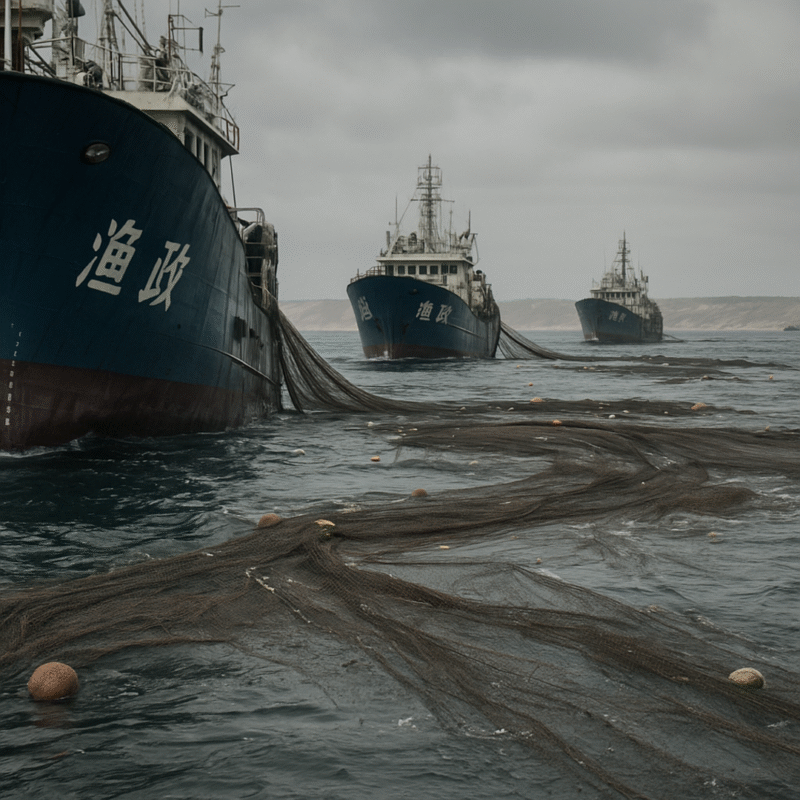
Mogadishu, Somalia – China faces allegations of conducting widespread illegal, unreported and unregulated (IUU) fishing off Somalia’s coastline, accelerating depletion of vital marine resources while simultaneously broadening its commercial, military and geopolitical influence in the Horn of Africa, according to analysts and local reports.
Chinese distant-water fishing fleets, particularly those connected to the Liao Dong Yu fleet, have operated in Somali waters frequently exceeding legal boundaries and employing destructive fishing methods that stress valuable species such as yellowfin tuna. Recent investigations indicate these activities have significantly impacted marine stocks and local livelihoods, with illegal fishing reportedly costing Somalia up to $300 million annually.
Local fishermen and environmental specialists have expressed concerns that Chinese trawlers are overexploiting Somalia’s extensive 3,333 km coastline, jeopardizing the sustainability of tuna populations essential to both Somalia’s economy and global seafood markets. Experts warn that without enhanced enforcement measures, fish stocks could diminish dramatically in the near future.
The presence of Chinese fishing vessels has also created ground-level tensions. In late 2024, a Chinese-owned trawler registered in Puntland was seized off Somalia’s northeast coast by armed individuals who accused foreign fleets of exhausting fish supplies and endangering coastal communities’ livelihoods, reflecting mounting local dissatisfaction with unregulated fishing activities.
Beijing’s growing engagement in Somalia extends beyond fisheries. China has been strengthening trade relations and infrastructure investments throughout Africa, while maintaining a strategic naval presence in the region, utilizing its Djibouti base to extend influence and counter adversaries such as Taiwan. Taipei maintains strong connections with Somaliland, a self-governing region in northern Somalia, which Beijing perceives as a challenge to its sovereignty claims over Taiwan.
Somali authorities have encountered difficulties effectively monitoring their extensive maritime territories, constrained by limited enforcement capabilities and fragmented governance structures. International partners, including the United Nations and regional organizations, have backed initiatives to enhance maritime security, yet experts assert that more substantial mechanisms are required to curb IUU fishing and protect Somalia’s marine resources.
China’s activities in Somali waters underscore broader tensions regarding natural resource access and influence in East Africa, as small coastal states confront powerful distant-water fleets while striving to preserve their economic and environmental future.