

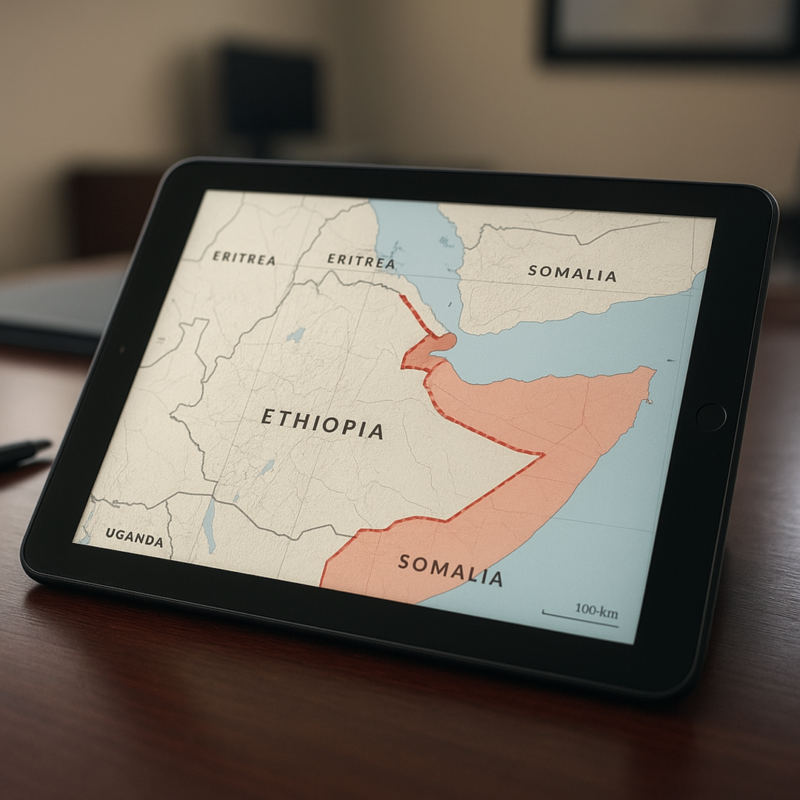
ADDIS ABABA – Ethiopian Prime Minister Abiy Ahmed is encountering substantial condemnation and regional fury throughout the Horn of Africa following a map shared on social media, reportedly from his official office that seemed to encompass territories belonging to Somalia, Eritrea, and Djibouti, especially Red Sea coastal areas.
The contentious map appeared in a video posted on the official Facebook page of the Ethiopian Prime Minister’s Office during his meeting with the Indian Prime Minister in Addis Ababa last Wednesday.
The broadcast has provoked intense responses, with numerous analysts, scholars, and engaged social media users across the Horn of Africa characterizing the action as reflecting expansive territorial designs and an effort to resurrect Ethiopia’s pursuit of sea access.
Several analysts have noted that presenting such a map constitutes a perilous political statement, directly undermining the sovereignty and internationally acknowledged boundaries of Ethiopia’s neighboring nations.
They have also cautioned that this matter could reignite political and security tensions in an area already confronting existing conflicts and precarious security conditions.
Moreover, many have described this action as “unambiguous provocation,” urging the international community and regional bodies to closely observe such developments to prevent a potential major conflict in the Horn of Africa.
FTL and regional specialists have stressed that revisiting border and maritime access questions in this fashion offers no advantage to regional stability. Instead, it might obstruct the cooperative and economic integration initiatives that regional countries urgently require at this crucial juncture.
The incident straddles the boundary between a calculated strategic gesture and a disastrous communication error. If deliberate, it signifies Abiy Ahmed’s most bold initiative to date to openly assert Ethiopia’s claim to Red Sea access, simultaneously confronting three neighboring countries’ sovereignty. If a subordinate’s error reveals a distressing deficiency of supervision and awareness within the Prime Minister’s Office, it compromises Ethiopia’s diplomatic standing at a pivotal moment.
Abiy Ahmed’s public focus on Ethiopia’s “historical entitlement” to sea access functions mainly as a domestic political instrument. By portraying himself as the advocate of a national objective, he shifts attention from substantial internal challenges: post-war reconstruction in Tigray, economic crisis, and ethnic divisions. This map incident elevates that rhetoric into a visual, concrete assertion, potentially mobilizing nationalist sentiment, but at the considerable expense of foreign relations.
The map has the unexpected consequence of uniting Somalia, Eritrea, and Djibouti. This unified stance significantly escalates the diplomatic and possible security expense for Ethiopia. It draws these nations closer together and toward other external partners (such as Turkey, the UAE, or Egypt) who might be prepared to support them as a counterbalance to Ethiopian ambitions.
This action targets the core of IGAD-facilitated diplomacy and the delicate economic interdependence in the Horn. It demolishes any trust required for resolving existing disagreements (like the Ethiopia-Somaliland MoU) and threatens essential infrastructure projects and commerce. Specialists are justified in warning that it reverses advancement toward the very cooperation necessary for regional prosperity.