
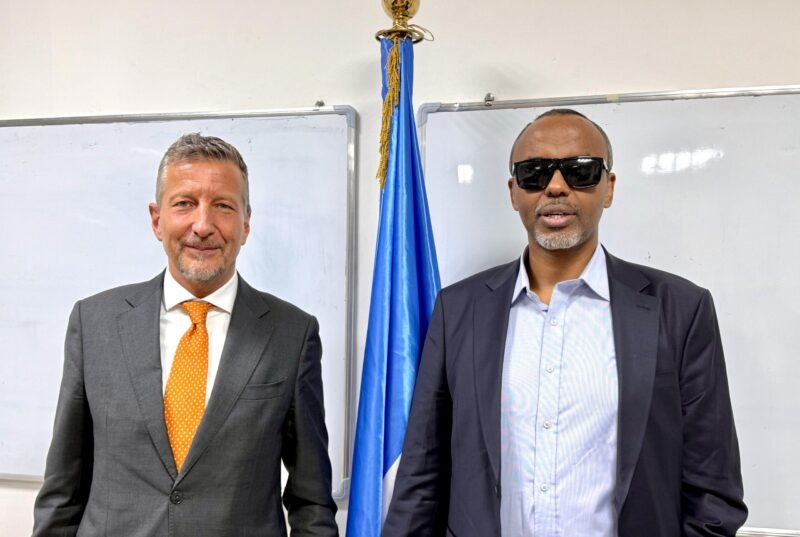
MOGADISHU — The Deputy Chairperson of the National Independent Human Rights Commission (NIHRC), Mohamed Harun Mohamud, has held a high-level strategic meeting with Switzerland’s Ambassador to Somalia, Mirko Giulietti, in the capital to advance the institutional framework for human rights protection in Somalia.
The executive dialogue focused on the current operational landscape of human rights within the republic, assessing challenges and identifying developmental opportunities, according to officials familiar with the proceedings. The consultation aimed to strengthen bilateral cooperation and develop mechanisms to protect and promote human rights standards across Somalia.
Commission’s Commitment to Independence and Neutrality
During the briefing, Deputy Chairperson Mohamed Harun outlined the Commission’s current developmental phase, noting that the institution is actively implementing foundational and capacity-building operations.
He assured the Swiss delegation that the Commission will operate with complete independence and strict neutrality, confirming the institution’s alignment with international human rights frameworks — specifically adhering to the Paris Principles.
“The Commission will operate with complete independence and strict neutrality,” Mohamud said, stressing the importance of building an institution that commands public trust and has the capacity to execute its mandate with transparency and efficiency.
Switzerland’s Continued Engagement in Somalia
In response, Ambassador Giulietti expressed interest in the Commission’s strategic roadmap and long-term institutional vision. He reaffirmed Switzerland’s commitment to supporting governance, the rule of law, and human rights initiatives in Somalia.
Both delegations agreed on the need for a sustained, high-level partnership based on continuous technical support, capacity building, and collaboration to strengthen the national human rights architecture.
The meeting with NIHRC officials is part of Switzerland’s broader diplomatic engagement with Somalia. In February 2026, Minister of Interior, Federal Affairs and Reconciliation Ali Yusuf Ali Hosh held high-level talks with a Swiss delegation led by Ambassador Patricia Danzi, Director General of the Swiss Agency for Development and Cooperation. Ambassador Giulietti was also part of that delegation, which focused on strengthening bilateral cooperation in federalism, stabilization, national reconciliation, and local governance [citation:4].
In June 2025, Puntland’s Acting President and Vice President Ilyas Osman Lugatoor met with Martina Durrer, Head of International Cooperation at the Swiss Embassy in Somalia, in Garowe to enhance bilateral cooperation and fast-track Swiss-supported development initiatives in the northern Somali region [citation:7].
NIHRC: A Milestone for National Healing
The National Independent Human Rights Commission, established to protect and promote human rights across the country, is expected to play a pivotal role in ensuring accountability, monitoring abuses, and giving voice to victims long silenced by conflict. Commissioner Farhan Jimale has described the creation of the body as a milestone that transcends bureaucracy, calling it “an act of national healing”.
“It affirms that Somalia is ready to govern itself not only by strength, but by justice. Not only by power, but by principle,” Jimale said, underscoring the moral weight of the institution’s mission [citation:1].
The NIHRC’s creation is part of Somalia’s broader democratic transition, where the rule of law and the protection of rights are increasingly viewed as essential to lasting peace. For many Somalis, the Commission represents more than a legal mechanism — it is a promise that the wounds of the past will be acknowledged, and that the nation’s future will be guided by justice and humanity.
Human Rights Challenges Remain
The commission’s work comes amid ongoing human rights challenges in the country. The U.S. State Department’s 2024 Country Report on Human Rights Practices raised alarm over the scale of violence and rights violations in Somalia, documenting abuses by government forces, regional authorities, and armed groups. According to the report, Somali government security personnel were implicated in the deaths of at least 72 civilians between January and September 2024 [citation:3].
Somalia recorded at least 41 violations against media freedom between January and June 2025, according to data compiled by media rights groups and journalist unions. The violations, which include arrests, assaults, and prosecutions of journalists, were concentrated in Mogadishu and parts of Somaliland, reflecting growing concerns over the erosion of press freedom in the country [citation:6].
Both delegations at the NIHRC-Switzerland meeting agreed that sustained international partnership is essential to address these challenges and strengthen Somalia’s national human rights architecture.