
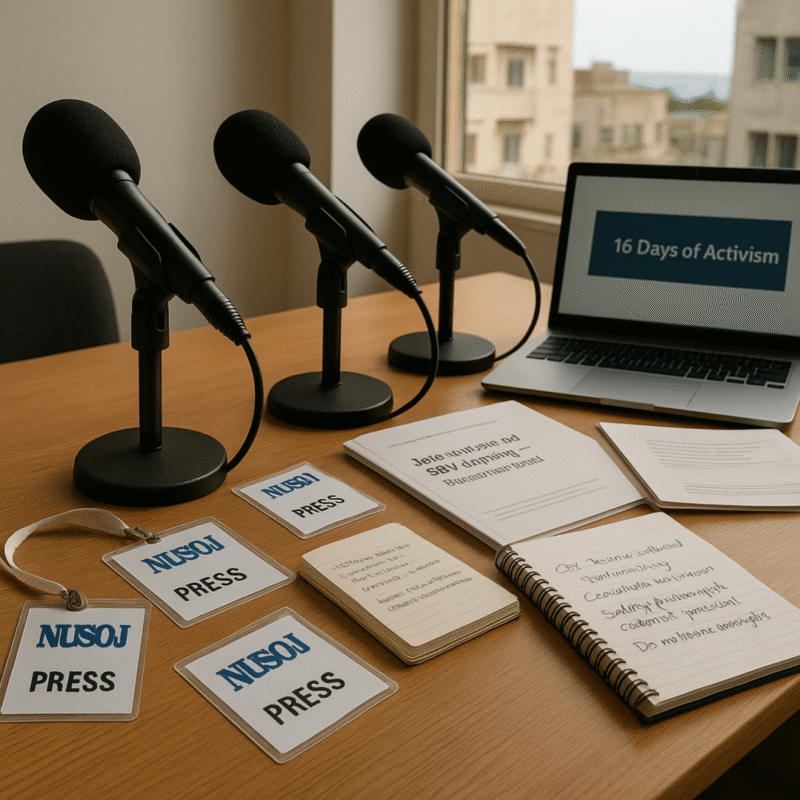
Mogadishu, Somalia – The National Union of Somali Journalists (NUSOJ) has completed a nationwide initiative commemorating the global “16 Days of Activism against Gender-Based Violence.”
Running from November 25 to December 10, the campaign concluded with a significant Human Rights Colloquium in Mogadishu on International Human Rights Day.
Backed by the Canada Fund for Local Initiatives (CFLI), the effort marks substantial progress in advancing gender equality within Somalia’s media landscape.
Through training sessions and protective measures, NUSOJ equipped journalists nationwide to cover gender-based violence (GBV) responsibly while promoting safer and fairer workplace environments.
Beginning on November 25, International Day for the Elimination of Violence Against Women, the initiative kicked off with the launch of the “National Safeguarding Initiative for Women Journalists” in Mogadishu.
This innovative program assembled more than 150 attendees, comprising female journalists and male colleagues, to tackle pressing safety issues.
Attendees gained practical skills in personal security, online protection, and methods to address workplace and digital harassment.
Nima Hassan Abdi, NUSOJ’s Organizing Secretary, emphasized the significance of these discussions.
“Liberating and supporting women journalists, while involving male counterparts to challenge previously overlooked workplace mistreatment, has been crucial in revealing harmful practices that need removal from our media sector,” stated Abdi.
She indicated that these open dialogues are creating pathways for tangible measures to safeguard female journalists.
During the 16-day campaign, NUSOJ extended its activities beyond the capital by organizing training in Garowe, Puntland, and Kismayo, Jubbaland. These workshops concentrated on trauma-sensitive narrative techniques and reporting approaches centered on survivors.
The sessions acted as a springboard for media initiatives across Federal Member States, igniting conversations led by youth and women that gained notable momentum both in person and across digital platforms.
The initiative peaked on December 10 with an elevated Human Rights Colloquium in Mogadishu. This gathering coincided with the commencement of a three-day training for local journalists, offering a dedicated forum to examine coverage approaches concerning sexual violence and workplace harassment.
Omar Faruk Osman, NUSOJ Secretary General, stressed the media’s obligation to society.
“Journalism serves the public interest by safeguarding communities through exposing misconduct and ensuring accountability. Our activities throughout these 16 days have demonstrated the influential capacity of media in revealing gender-based violence, confronting detrimental conventions, and advancing solutions that prioritize survivors and their rights,” Omar commented.
The program produced quantifiable outcomes for Somalia’s media environment. NUSOJ reports indicate that more than 150 journalists directly gained from professional advancement opportunities, while 62 media organizations pledged to enhance workplace environments and capabilities for gender-conscious reporting.
The drive also secured extensive public interaction, with news coverage reaching approximately 2.5 million audience members and generating over 1.1 million interactions on social networks.
These statistics reflect accelerating progress toward transformative change and human rights protection within the profession.