

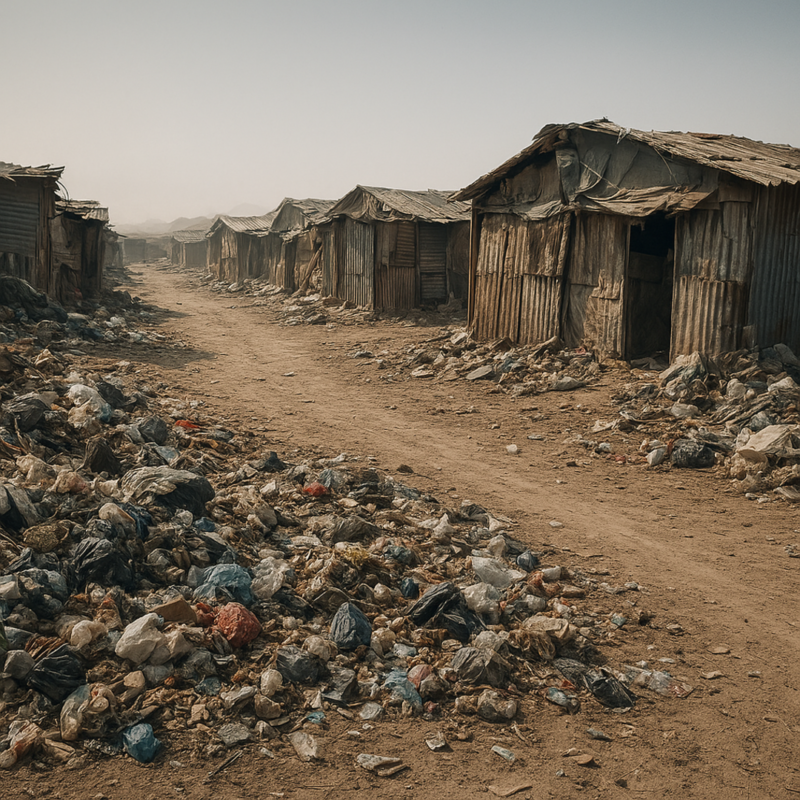
Mogadishu, Somalia – In makeshift homes lacking basic necessities, surrounded by rubbish piles and dirt roads, thousands of Somalis endure crushing poverty in Aden’s Little Mogadishu.
Yemen, the Arabian Peninsula’s poorest nation, serves not as a final destination for migrants but as a transit point for those fleeing East Africa toward oil-rich Gulf states for construction or domestic work.
Tight border security prevents many from leaving Yemen.
During the day, men spread across the city, lining roads in search of jobs in Yemen’s de facto capital under government control, where over a decade of war has caused mass unemployment and food shortages.
To get by, many take odd jobs or scour rubbish heaps for salvageable food to feed their families.
Some days we eat, some days it is up to God. That is life, said Abdullah Omar, a 29-year-old Somali father of four in Aden.
Over a year ago, Omar paid traffickers $500 to board a boat with his family, hoping to escape Somalia’s instability for a better life abroad.
In Yemen, it has brought only misery.
To survive, Omar washed cars for just a few dollars a day.
After years in construction in Mogadishu, Omar hoped for better pay and conditions in Yemen, where he had transited as a teenager heading to Saudi Arabia.
That was before civil war killed hundreds of thousands, destroyed infrastructure, and partitioned the country between Houthis and the internationally recognized government.
“Here I have nothing,” he said, explaining his enrollment in a UN program facilitating repatriation to Somalia.
There is no work, no money, and no schooling for the children.
Despite harsh conditions, roughly 17,000 Africans arrived in Yemen in October, mostly from Djibouti and Somalia, a 99 percent increase from the prior month, per UN figures.
Somalis comprise about 63 percent of the 61,000 registered refugees and asylum seekers in Yemen, UN data indicates.
In Aden, where unemployment is already sky-high among locals, African migrants struggle to establish themselves.
Nearly 19.5 million Yemenis, over half the population, require humanitarian aid, including 4.8 million displaced, according to early 2025 UN data.
The economy has deteriorated further with currency depreciation, halted oil exports, and limited international funding.
Somalia continues to suffer from civil war, with Al-Shabaab controlling large areas.
Relative peace in Mogadishu has brought some stability and a construction boom in parts of the city, though the situation remains precarious.
If peace returns
A UN Refugee Agency survey found 56 percent of repatriated Somalis cited lack of income opportunities in Yemen as their primary reason for returning.
Many refugees want to return to Somalia but cannot afford smugglers or flights, said Oweis Al-Wazzan, who leads the UN voluntary return program aiding migrants.
The program offers free transport and cash assistance for reintegration.
The UN has repatriated over 500 Somalis this year and plans three more flights by year-end for about 450 others.
Among returnees is Somali contractor Ahmed Abu Bakr Marzouk, who arrived in Yemen 25 years ago, married twice, and built a family.
For years, he thrived, sending money home and funding two homes in Mogadishu.
Then war struck.
For the past three or four years, there has been no work, said the 58-year-old.
With no improvement in Yemen, Marzouk views Somalia’s conditions as better now.
My brothers farm there. If peace returns, I will come back, he said.
If not, I will not.