
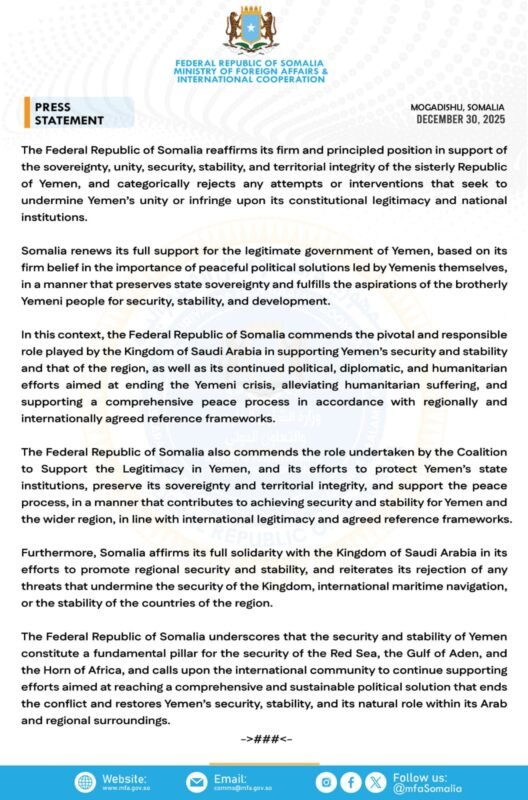
MOGADISHU, Somalia — The Federal Republic of Somalia has issued a formal declaration reaffirming its commitment to the sovereignty, unity, and territorial integrity of Yemen. The statement, released by the Ministry of Foreign Affairs and International Cooperation, marks a significant diplomatic stance as internal divisions and regional friction intensify in the Arabian Peninsula.
Rejection of External Interference
The Somali government explicitly rejected any external interventions that could undermine Yemen’s stability. The Ministry emphasized its unwavering support for Yemen’s legitimate government and called for a peaceful, Yemeni-led political solution. Somalia’s position highlights the need for resolutions that preserve state sovereignty while addressing the Yemeni people’s needs for security and development.
Endorsement of Saudi Diplomatic Efforts
Somalia commended the Kingdom of Saudi Arabia for its role in bolstering regional stability. The government praised Saudi Arabia’s ongoing political and humanitarian efforts aimed at resolving the crisis and expressed appreciation for the Saudi-led Coalition’s contributions to protecting Yemen’s national institutions.
Maritime Security and the Horn of Africa
A key element of the declaration focused on the strategic link between Yemen and Somalia. The Ministry noted that Yemen’s security is a “fundamental pillar” for the safety of the Red Sea and the Gulf of Aden. Somalia urged the international community to sustain efforts toward a sustainable political solution, as stability in these waterways is vital for the economic and national security of the Horn of Africa.
Regional Response and Official Statements
Somalia’s declaration aligns with a series of official statements issued by several regional neighbors following the recent escalation in southern Yemen. As of December 30, 2025, the following countries have issued formal statements:
| Country | Summary of Official Position |
| Saudi Arabia | Labeled recent separatist advances a threat to national security; called for the withdrawal of foreign-backed forces. |
| United Arab Emirates (UAE) | Denied allegations of fueling conflict; reaffirmed commitment to Saudi security but announced a withdrawal of remaining units. |
| Qatar | Affirmed full support for the legitimate Yemeni government and the unity of Yemen; emphasized that GCC security is indivisible. |
| Kuwait | Reiterated support for Yemen’s sovereignty and the Saudi-led efforts to reach a comprehensive political settlement. |
| Oman | Called for “self-restraint” and a return to political dialogue; expressed support for Yemeni unity and the policy of good neighborliness. |
| Bahrain | Expressed confidence in the leadership of Saudi Arabia and the UAE to contain differences within the GCC framework. |
| Egypt | Reaffirmed its steadfast position in support of Yemen’s legitimacy, unity, and territorial integrity. |
Strategic Implications
Analysts suggest that Somalia’s statement reflects its own national interests. By siding with the push for Yemeni unity and supporting Saudi Arabia’s role, Mogadishu positions itself against separatist movements that could set a precedent for the Horn of Africa. The move is also seen as a safeguard for Somali trade routes, which are directly impacted by any instability in the adjacent Yemeni waters.