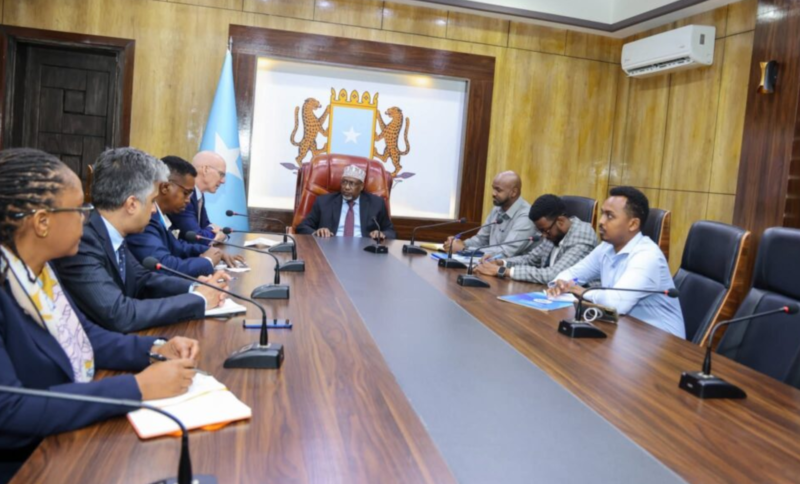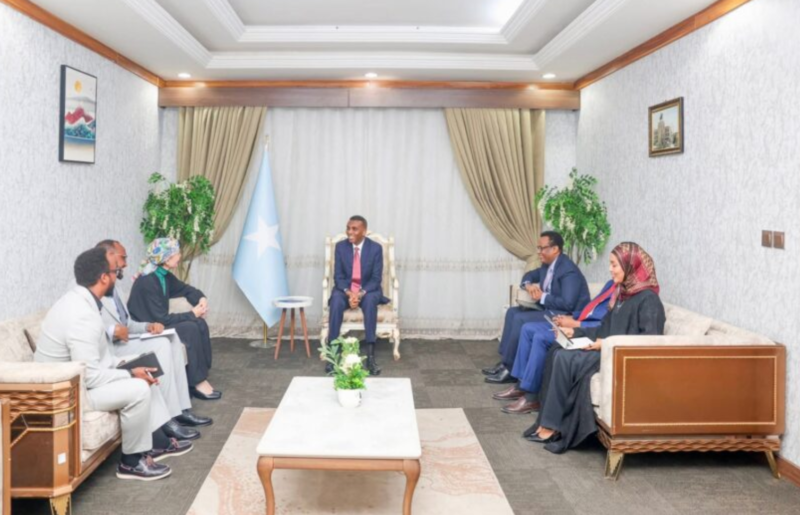

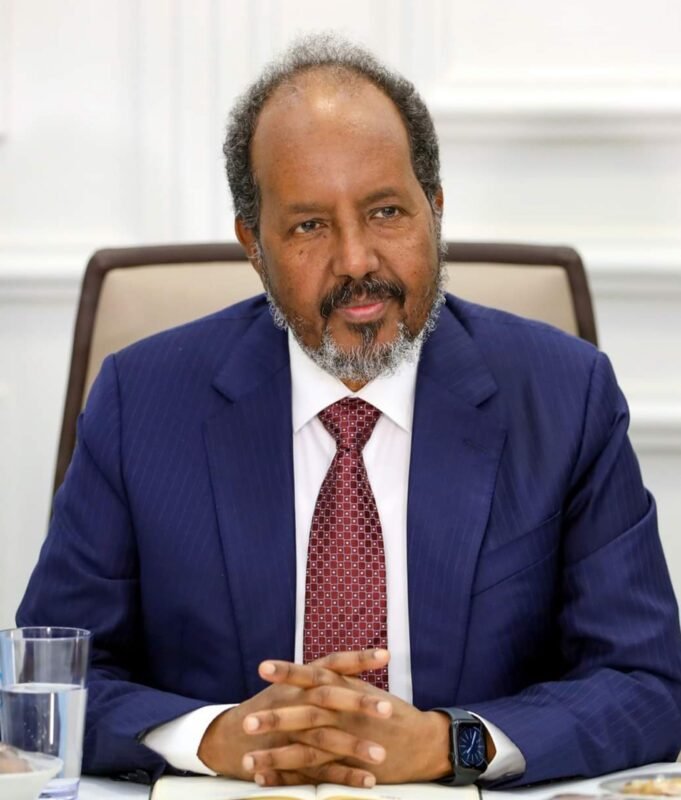
MOGADISHU, Somalia — In a move that has caught the Somali political establishment by surprise, President Hassan Sheikh Mohamud paid an unannounced visit to the residence of former President Sharif Sheikh Ahmed on Saturday night. The meeting, confirmed by sources close to the former president, comes at a critical juncture for the nation as it grapples with a deepening constitutional crisis and a fractured electoral landscape.
The visit, which was not on the official presidential schedule, is being viewed as an attempt by Villa Somalia to bridge the widening gap between the federal government and a powerful coalition of opposition leaders. President Hassan Sheikh reportedly spent several hours in private discussion with Sheikh Sharif, a leader who has become one of the most vocal critics of the current administration’s reform agenda and according to sources on the ground, the meeting is still ongoing.
A Climate of Political Deadlock
The meeting takes place against a backdrop of intense friction over the 2024 constitutional amendments. These changes, pushed through by President Hassan Sheikh’s administration, have fundamentally altered Somalia’s political structure by:
-
Moving toward a “one-person, one-vote” direct electoral system.
-
Granting the President the power to appoint and dismiss the Prime Minister without a parliamentary vote of confidence.
-
Limiting the country to a three-party system.
While the federal government frames these as necessary steps toward modernization, opposition figures—including Sheikh Sharif and former President Farmaajo—denounce them as a “power grab” that sidelines federal member states and undermines the fragile power-sharing agreements that have held the country together for decades.
The “Kismayo Defiance” and Regional Tensions
The Mogadishu meeting is also overshadowed by the ongoing standoff with Jubaland and Puntland. In late 2024, Jubaland President Ahmed Madobe explicitly rejected the federal government’s electoral model, leading to a complete suspension of ties between Kismayo and Mogadishu.
The tension reached a boiling point when the federal government issued an arrest warrant for Madobe, and small-scale skirmishes broke out between federal and regional forces in the Lower Juba region. Opposition leaders, led by the Somalia Future Council (a coalition including Sheikh Sharif, Hassan Ali Khaire, and Roble), have largely backed the regional states’ right to autonomy, accusing Hassan Sheikh of “authoritarian ambitions.”
The Somaliland Factor
Adding to the complexity is the stalled dialogue with Somaliland. Relations have deteriorated significantly following Ethiopia’s controversial MoU with Hargeisa and subsequent rhetoric from Mogadishu. Opposition groups have criticized the federal government for failing to maintain a diplomatic path with the northern region, arguing that the focus on internal constitutional battles has weakened Somalia’s hand on the international stage.
Will the “Surprise Visit” Work?
Analysts suggest this face-to-face meeting may be an effort to prevent the opposition from forming a unified “parallel election” bloc. “Sharif Sheikh Ahmed is a gatekeeper for the opposition,” said one Mogadishu-based political consultant. “If Hassan Sheikh can convince him to accept even a modified version of the reform plan, it could break the current deadlock.”
However, previous attempts at reconciliation, including a high-profile meeting in Nairobi last April, ended in a stalemate. Sheikh Sharif has consistently maintained that he will not negotiate unless the controversial constitutional changes are rescinded or subjected to a broader national dialogue.
As the 2026 national election cycle draws closer, the results of tonight’s private talks could determine whether Somalia moves toward its first direct vote in decades or slips back into the familiar cycle of parallel processes and political fragmentation.