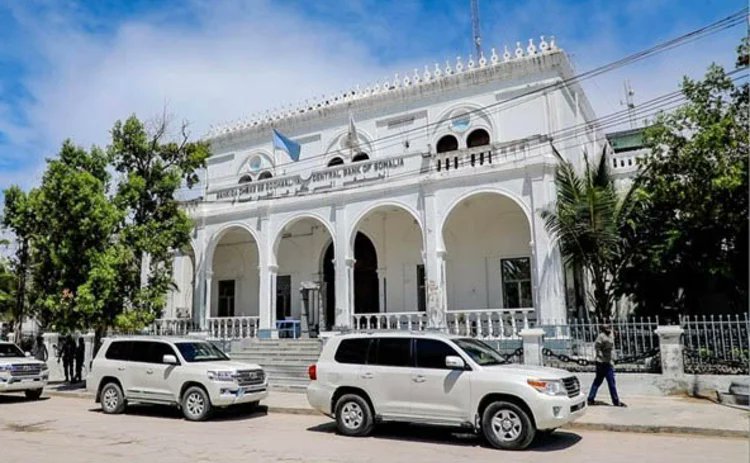

The Central Bank of Somalia’s (CBS) June 2025 policy brief, issued a stark warning: the nation must not succumb to the danger of premature borrowing against unproven resource income.
This fiscal temptation poses the most significant threat to Somalia’s hard-won financial stability, which reduced external debt from 64 percent of GDP to under 6 percent. Incorporating the latest financial data from the CBS’s Q2 2025 Economic Review, the threat of speculative borrowing is now underscored by an alarming fiscal reality.
Somalia’s Fiscal Collapse and the Resource Trap
The political and historical risks associated with Somalia’s oil potential are profound, rooted in a governance deficit stretching back decades. The World Bank’s 1988 Project Completion Report confirms that former dictator Siad Barre presided over an administration plagued by poor internal organization, reliance on external funding for local costs, and a failure to compensate local farmers affected by oil surveys. More recently, opposition leaders accused former President Mohamed Abdullahi Farmaajo of attempting to secretly auction oil blocks to secure financing for political advantage and manipulate the electoral process, an action severe enough to trigger a private warning from the IMF about rescinding debt relief. This demonstrated how oil assets immediately become a tool for autocratic power grabs and electoral manipulation, exacerbating conflict over fiscal federalism. The risk now is that the current administration, under President Hassan Sheikh Mohamud, faces the same structural temptations ahead of the 2026 elections, where immediate financial needs, institutional fragility, and the unresolved demands of Federal Member States could pressure him toward short-term resource deals for political gain, potentially repeating a dangerous historical pattern that links ‘resource speculation’ directly to political instability and democratic backsliding.
Despite the monumental achievement of debt relief, Somalia’s financial framework is profoundly exposed. As articulated in the FGS’s FY 2026 budget consultations, domestic revenue currently stands at a meager 2.6 percent of GDP, contrasting sharply with the African average of 15 percent. This weakness is becomes more visible, when taken into account the recurrent obligations, with security expenditures consuming approximately 64 percent of this revenue. The IMF-World Bank Debt Sustainability Analysis classifies Somalia’s capacity to absorb shocks as “weak.”
The ongoing concentration of tax collection authority solely within the Benadir Regional Administration (BRA) , excluding full fiscal federalization with Federal Member States (FMS), poses a critical threat to the Federal Government of Somalia’s (FGS) stability and legitimacy. The government has focused electronic tax collection systems, such as the sales tax, only on Mogadishu (which is under the BRA), largely because the federal system is not yet fully functioning and there is a lack of fiscal federalism agreement among all states. This uneven application of taxation means the economic burden falls disproportionately on the Benadir business community, while FMS retain and use their local tax revenues to cover their own recurring costs, a fact noted by the Ministry of Finance. The severe fiscal imbalance is evidenced by mid-year reports showing the BRA contributed significant funding to the FGS budget, executing a domestic revenue rate of 32.1% at the mid-year mark, confirming its role as the primary revenue engine for the Federal Government. This disparity creates a profound political risk: the business community and local clan groups in Benadir, seeing their revenues funding the majority of the FGS’s operations without equitable resource sharing or services, could rise up in protest. Such a rejection, driven by perceptions of unfair taxation and lack of accountability, risks delegitimizing the FGS’s authority in the capital, potentially exacerbating clan tensions and further undermining the fragile political consensus necessary for national stability.
The reliance on external financing, covering nearly 65 percent of the budget, proved catastrophically volatile in early 2025. According to the CBS Q2 2025 Review, total external grants significantly underperformed, declining by 51 percent from $166 million in 2024Q2 to just $82 million in 2025Q2. This sudden shortfall drove the FGS to a fiscal deficit of $25 million in the second quarter alone, deteriorating sharply from a near-balanced position the previous year. This collapse of external funding provides urgent, undeniable proof of the volatility risk the FGS must navigate.
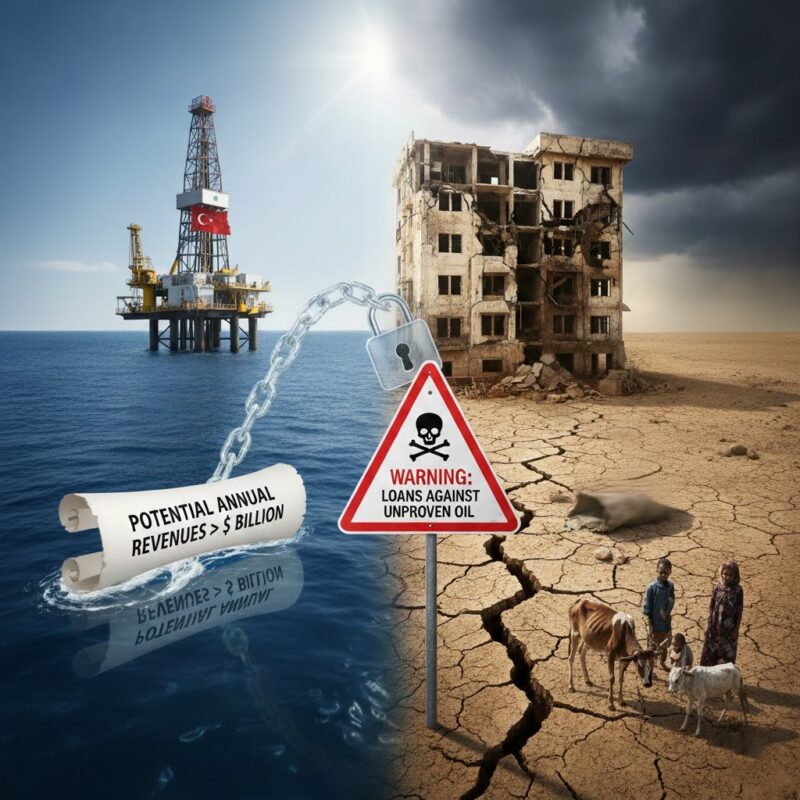
Against this backdrop of confirmed financial fragility, the allure of the oil sector grows, with sixteen Production Sharing Agreements signed since 2022, including co-operation with Türkiye, aiming for potential drilling as early as January 2026. The potential resource wealth is vast, but entirely speculative. Premature borrowing against unproven income traps the government:
if revenues are delayed or underperform, the FGS, already unable to manage its recurrent costs domestically, would face an instant repayment crisis.
Structural Vulnerability and the Economic Trap
The vulnerability to borrowing is compounded by the economy’s structural imbalance, as shown by the latest trade data. The nation recorded a persistent quarterly trade deficit of $1.575 billion in 2025Q2. This immense import reliance requires constant foreign currency inflows, predominantly remittances, and makes the country highly sensitive to external price shocks.
The economic backbone, livestock, remains dominant, comprising 65 percent of total exports. However, despite a seasonal surge in Hajj pilgrimage demand in 2025Q2, exports still recorded a 12 percent decline compared to the same period in 2024. This volatility in the primary export sector reinforces the CBS warning that relying on any one sector, proven or unproven, creates dangerous instability. Focusing on non-oil tax mobilization, which the FGS aims to raise to 4 percent of GDP by 2027, is paramount to generating predictable, internal stability.
Lessons Learned from Other Countries
Examining global examples reveals recurring patterns that necessitate prudence and institutional discipline.
In Venezuela, the government borrowed heavily against future oil revenues in the 2000s. When oil prices crashed and mismanagement took hold, the country defaulted, triggering hyperinflation and a humanitarian crisis. The lesson here is explicit: commodity price volatility demands robust fiscal buffers, as over-optimism on revenues quickly leads to unsustainable debt and social unrest.
Angola secured billions in oil-backed loans from China, only to see its debt balloon to 120 percent of GDP after the 2014 price drop. Despite its immense oil wealth, poverty persists at over 40 percent. This demonstrates that resource-backed financing amplifies risks without economic diversification, and weak governance invites boom-bust cycles and pervasive corruption.
Mozambique offers a contemporary warning. The country borrowed against future natural gas revenues, leading to the infamous 2016 hidden debt scandal that triggered an IMF withdrawal and currency collapse. Secretive borrowing and over-optimistic projections erode trust, making due diligence and conflict mitigation crucial.
A Path of Prudence and Institutional Strength
To avert these historical pitfalls, Somalia must prioritize sustainable reforms over speculative borrowing. The government has strategically committed to modernizing its fiscal tools, including initiating the Program-Based Budgeting (PBB) system for the FY 2026 Budget, which aims to link ministerial expenditures directly to national outcomes.
Specific policy mandates, aligned with the CBS’s consistent warnings, must be enforced:
The FGS must expedite dialogue and consensus on fiscal federalism to allow for equitable tax collection and resource sharing across all regions, mitigating the severe political risk posed by tax concentration in Benadir. The government must finalize petroleum laws and immediately establish a sovereign wealth or stabilization fund, expressly prohibiting resource-backed loans until production is proven and a transparent revenue stream is secured. The Ministry of Finance must double down on its strategy to aggressively mobilize non-oil domestic revenue, aiming to raise the tax-to-GDP ratio to 4 percent by 2027, notwithstanding the extreme concentration of tax collection on the Benadir business community. Furthermore, it must institutionalize a comprehensive Medium-Term Debt Management Strategy (MTDS) and commit to only acquiring highly concessional financing, rejecting unfavorable loans or those tied to political motivations.
Finally, explicitly integrating climate risks into development planning and budgeting will avoid crisis-driven borrowing caused by recurring natural disasters.
The stark reality of the 2025 grants shortfall and fiscal deficit underscores that Somalia cannot afford to trade its hard-won debt relief for a speculative gamble on oil. Only through rules-based stewardship can the nation transform its potential into a foundation for sustainable and inclusive growth.