
AWDHEEGLE, Lower Shabelle — The National Independent Electoral and Boundaries Commission (NIEBC) has commenced voter registration in Awdheegle, Lower Shabelle, as Somalia accelerates preparations for planned direct elections.
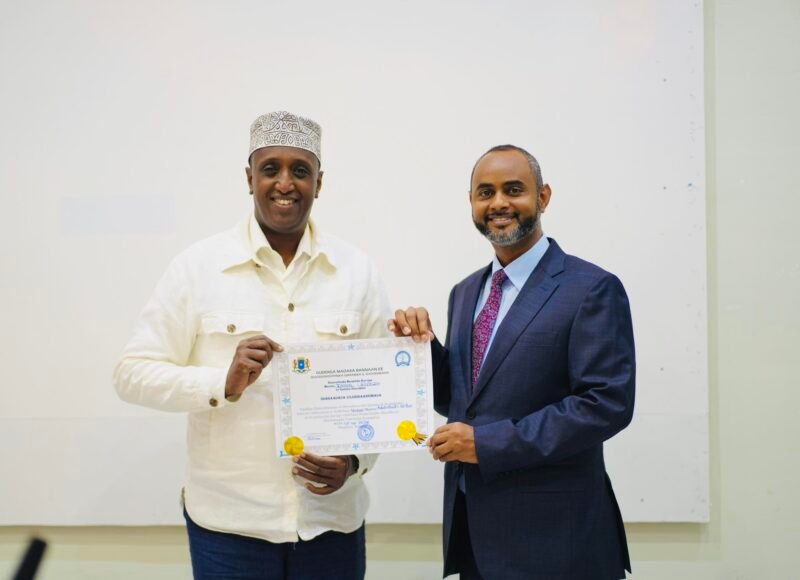
The initiative was officially launched by District Commissioner Mohamed Ibrahim Abukar, who joined other officials in registering at designated centers. Residents participated in significant numbers, indicating increasing public enthusiasm for direct electoral participation following decades of indirect voting systems.
Officials Urge Public Participation
Electoral official Dahir Muse Osman called on citizens to engage in the registration process, emphasizing its importance for inclusive political involvement.
The call for widespread participation has been echoed by senior government officials. Defence Minister Ahmed Moallim Fiqi has urged citizens across the country to register for the upcoming elections, emphasizing that widespread participation is vital to reclaiming the nation’s long-withheld democratic rights.
“Elections are a constitutional right that have been absent from the hands of the people for 56 years. Today that right has been restored to the citizens of Somalia. I encourage every Somali, wherever they live, to go out and register so they can decide their own future,” Fiqi said after receiving his voter card at an NIEBC centre in Galkayo.
Historic Shift to Direct Elections
This development occurs as Somalia expedites its shift from a clan-based, indirect electoral model to a universal suffrage system, a fundamental aspect of current political reforms.
“Those advocating for indirect elections are individuals pursuing their own agendas. The public interest is what truly matters,” the president stated.
Referencing over twenty signed agreements that establish the frameworks for direct elections, President Mohamud asserted that reverting to the clan-based indirect voting model is highly impractical. “Indirect elections are a relic of the past; they are no longer relevant,” he declared.
Recent constitutional amendments have established a one-person, one-vote framework and extended presidential terms to five years, while the federal government has ramped up preparations for nationwide voting.
Federal Support for Electoral Commission
Prime Minister Hamza Abdi Barre has visited the headquarters of the NIEBC, assuring the commission of the full support of the federal government. His assurances aimed to address concerns raised by opposition groups and stakeholders regarding the commission’s neutrality and credibility in managing the electoral process.
By pledging to ensure that elections are fair, peaceful, inclusive, and credible, the Prime Minister signaled an intention to foster public confidence in Somalia’s democratic processes.
Minister of Interior, Federal Affairs, and Reconciliation Ali Yusuf Ali Hosh has also paid an inspection visit to NIEBC offices, where he praised the institution’s leadership and staff for their ongoing efforts to advance the country’s democratic process.
“The momentum must continue. Somalia’s future depends on timely and transparent elections that give every citizen a voice in shaping the country’s direction,” Hosh noted.
Political Friction and Opposition Concerns
Nevertheless, the process has encountered political friction, with some regional authorities voicing apprehension regarding the pace and format of the reforms, alongside persistent security threats in areas impacted by Al-Shabaab.
High-level negotiations between Somalia’s Federal Government and the opposition alliance, the Somali Future Council (Kutlada Mustaqbal), have concluded without a resolution, revealing deep, ongoing disagreements regarding the nation’s electoral trajectory.
The primary source of conflict centers on the proposed electoral models. The federal administration maintains steadfast support for a nationwide “one-person, one-vote” system. Conversely, the Somali Future Council — comprising key opposition figures and regional leaders — has rejected this plan, endorsing an alternative indirect electoral approach.
The core of the political deadlock centers on the nation’s proposed electoral model, with the opposition arguing that enforcing an unagreed system without sufficient preparation time could intensify political divisions and destabilize the fragile federal structure.
Security Preparations for Elections
Police Commissioner Gen. Asad Osman Abdullahi has emphasized the police force’s readiness to safeguard the upcoming one-person, one-vote elections, underscoring the force’s commitment to maintaining security and upholding democratic principles during this crucial process.
Progress Across the Country
The federal government indicates that extending voter registration to districts like Awdheegle is essential for establishing a trustworthy electorate and ensuring wider participation, particularly in regions where state authority has been progressively reestablished following military operations.
Federal Minister of Ports and Marine Transport, Abdulkadir Mohamed Nur, launched voter registration in Waajid district of the Bakool region, where residents received the opportunity to vote directly for the first time in 56 years.
“This is more than a registration exercise — it is a symbol of hope, unity, and progress for our nation. Every citizen’s voice matters, and every vote will shape the future of Somalia,” Nur said at the launch.
Somalia’s NIEBC has also engaged in international cooperation to enhance electoral systems, with a high-level delegation led by Chairman Abdikarim Hassan traveling to Turkey for bilateral talks on voter registration mechanisms, electoral frameworks, and diaspora engagement strategies.
Critical Test for Somalia’s Democracy
Commentators suggest that the effectiveness of this registration campaign will serve as a critical assessment of Somalia’s capability to conduct its first comprehensive universal suffrage elections in many years.
The planned April elections in South West State present a significant gamble for the federal administration. If successful, they would signal an uncommon shift from negotiated power-sharing arrangements to direct electoral processes in one of Somalia’s most strategically important regions.
The scheduled polls will be closely watched as a critical test of Somalia’s efforts to institutionalize democratic processes and expand direct voting across federal member states. The federal government has indicated that extending voter registration to districts like Awdheegle is essential for establishing a trustworthy electorate and ensuring wider participation, particularly in areas where state authority has been progressively reestablished following military operations.