
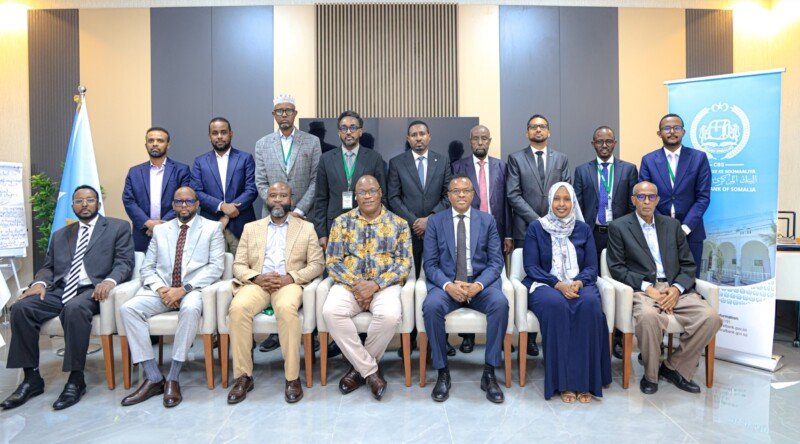
MOGADISHU – Somalia’s Central Bank has completed a week-long strategic leadership workshop designed to build institutional capacity and support continued modernisation of the country’s financial sector, as the bank presses ahead with reforms aimed at strengthening governance and regulatory oversight.
The programme, led by experts from the Macroeconomic and Financial Management Institute of Eastern and Southern Africa (MEFMI), brought together senior officials from the Central Bank of Somalia to improve leadership skills, strategic decision-making and organisational effectiveness. The bank said the workshop addressed strategic leadership, critical thinking, organisational culture and execution discipline, with participants examining how to turn long-term institutional goals into measurable results.
The training took place as Somalia’s financial institutions continue to pursue reforms intended to strengthen governance, improve regulatory oversight and restore confidence in the country’s banking system after decades of conflict and institutional fragility. The Central Bank has previously held consultations on its 2025-2029 Strategic Plan, with the board expected to endorse the finalised plan in November 2024.
Building Institutional Capacity
Officials said carrying out strategy effectively remains vital to meeting the Central Bank’s wider objectives, including strengthening financial stability, expanding access to financial services and improving monetary and regulatory frameworks. Somalia’s Central Bank has officially joined the World Bank’s Reserve Advisory and Management Partnership (RAMP), becoming the 79th member of a global network that includes central banks, financial institutions, and pension funds. The membership aims to enhance the capacity of Somalia’s Central Bank in reserve management, promoting better financial stability and investment strategies.
The workshop also highlights increasing efforts by Somali institutions to invest in leadership development and technical expertise as the country seeks to consolidate recent economic gains and deepen its integration into regional and global financial systems.
Financial Sector Reforms Accelerate
In recent years, Somalia has accelerated financial-sector reforms, including steps to improve banking supervision, fight money laundering and strengthen public financial management. The Central Bank has officially authorised 15 commercial banks to operate within the country, comprising 14 domestic institutions and one foreign bank that have met the CBS’s stringent compliance and licensing requirements.
The Ministry of Finance has launched its Public Finance Management Digitalisation Programme, introducing a secure digital signature system to phase out paper-based financial transactions. The reform is expected to streamline government processes, reduce fraud risks, and build greater trust in state institutions.
The Third Somali Banking and Finance Conference brought together central bank representatives and financial sector leaders to examine progress in rebuilding trust in the financial sector, with officials reaffirming the government’s commitment to financial stability and modernisation through recent reforms in banking supervision, anti-money laundering frameworks, and monetary policy alignment.
These efforts have been backed by international financial institutions and regional partners as Somalia works to attract investment and sustain economic recovery. The Central Bank was commended for the remarkable progress it has made in rebuilding Somalia’s financial infrastructure, winning the nation’s Excellence in Banking Award at a ceremony held in June 2024.
Way Forward
The Central Bank said stronger institutional execution and leadership capacity will be essential to advancing its strategic priorities and building a modern, resilient and effective central banking system that can support Somalia’s long-term economic development. The passage of the Payment System Bill provides a robust legal framework for the Central Bank’s modernisation efforts, which have included the adoption of IBAN and the integration of commercial lenders into a unified clearing system.
Recommended Reading On ftlsomalia.com:
- Central Bank of Somalia Board Discuss 2025-2029 Strategic Plan
- Central Bank of Somalia Joins World Bank’s RAMP
- Central Bank Grants 15 Banking Licenses
- Somalia Launches Digital Public Finance System to Boost Transparency
- Somali Banking Leaders Chart Course for Economic Transformation
- Central Bank Wins Somalia’s Excellence in Banking Award
- Senate Approves Payment System Bill