

MOGADISHU – Somalia’s opposition-aligned Future Council has unveiled a fresh electoral roadmap that it says could break the country’s prolonged political deadlock over the next federal elections, offering an alternative to the Federal Government’s push for a one-person-one-vote system through political parties.
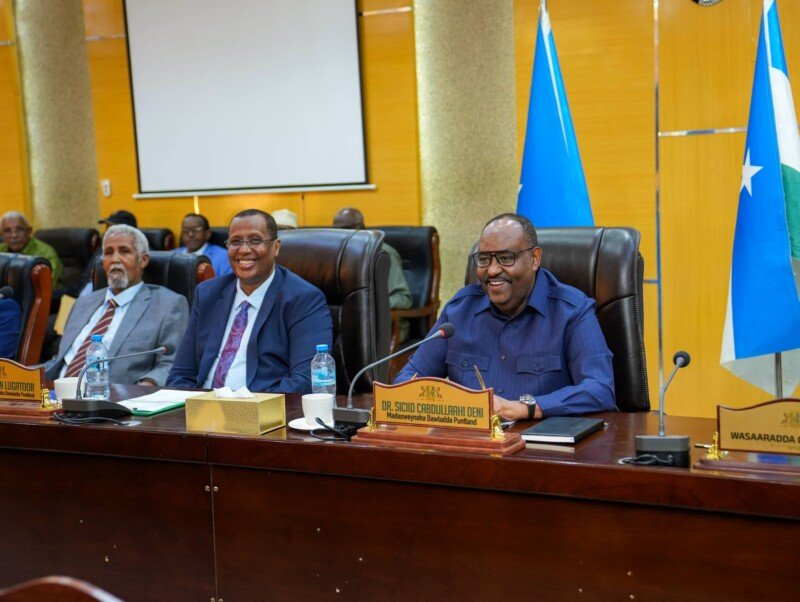
The plan was introduced after a meeting attended by leaders from Puntland, Jubbaland and the opposition’s Salvation Forum, all part of the Future Council, alongside representatives of the international community, including the United Nations, European Union, United States and United Kingdom.
The Expanded Indirect Election Model
The proposal, described by its authors as an “Expanded Indirect Election” model, blends direct voting by citizens with Somalia’s traditional 4.5 clan power-sharing system. Instead of relying on clan delegates as in previous elections, registered voters would directly elect members of parliament in constituency-based electoral areas known as SEEJO. The plan retains the 4.5 power-sharing arrangement, with parliamentary seats continuing to be allocated according to clan representation.
The opposition bloc calls for excluding political associations and parties registered under the current electoral framework promoted by President Hassan Sheikh Mohamud’s administration. A national electoral commission made up of representatives from both the Federal Government and Federal Member States would oversee the electoral process. Voting would use paper ballots and ballot boxes, while biometric registration would be applied to prevent duplicate registrations and electoral fraud.
Each Federal Member State would hold elections in four selected districts, mostly in regional capitals. The proposed timetable includes voter registration, candidate verification, campaigning, voting and dispute settlement within 42 days. The Supreme Court would be the final authority on electoral disputes and would be required to issue rulings within 72 hours.
The opposition bloc proposes using the model to conduct delayed elections in Hirshabelle and Galmudug within three months before implementing it at the federal level within six months.
Bridging the Divide Between Indirect and Direct Systems
The proposal aims to bridge the gap between Somalia’s earlier indirect election models and the government’s push for universal suffrage[reference:3]. Members of parliament were previously elected by about 14,000 clan-selected delegates across the country, while ordinary citizens did not vote directly. That indirect system was expanded so that approximately 101 delegates elected each parliamentary seat, with the process managed through agreements between the Federal Government and Federal Member States.
The new framework would greatly broaden participation by allowing ordinary registered citizens to vote directly in constituency-based areas while preserving the 4.5 clan-sharing formula and avoiding a fully party-based election. If adopted, the proposal would mark the largest expansion of voter participation in Somalia’s electoral process since the collapse of the central government in 1991.
Political Hurdles and International Reaction
However, major political hurdles remain. The Federal Government has consistently supported a party-based one-person-one-vote system, while opposition leaders argue that the country lacks the political consensus, constitutional framework and security conditions necessary for such a transition.
International partners have repeatedly urged dialogue and agreement among Somali stakeholders, warning that broad political consensus is essential for the legitimacy and stability of any future election process. The Federal Government has not yet issued a public response to the proposal.
The proposal therefore sets the scene for what is likely to be a sharp political debate over Somalia’s democratic transition, with consensus among key stakeholders expected to determine whether the plan gains traction.
Alignment with FTL Somalia’s 2020 Electoral Framework
The “Expanded Indirect Election” model closely mirrors the electoral framework that FTL Somalia advocated in 2020, when the country was debating the best path forward after abandoning the one-person-one-vote system. At that time, FTL Somalia reported on the “constituency caucuses” model agreed in Dhusamareb, which also sought to expand participation while preserving clan representation. The model recommended by the Future Council follows the same logic: broadening the electorate by allowing ordinary citizens to vote directly in constituency-based areas, while maintaining the 4.5 formula and avoiding the logistical and security challenges of nationwide universal suffrage. By proposing a gradual, consensus-driven transition, the opposition’s roadmap echoes the approach FTL Somalia identified as both practical and achievable in the context of Somalia’s political and security realities.