
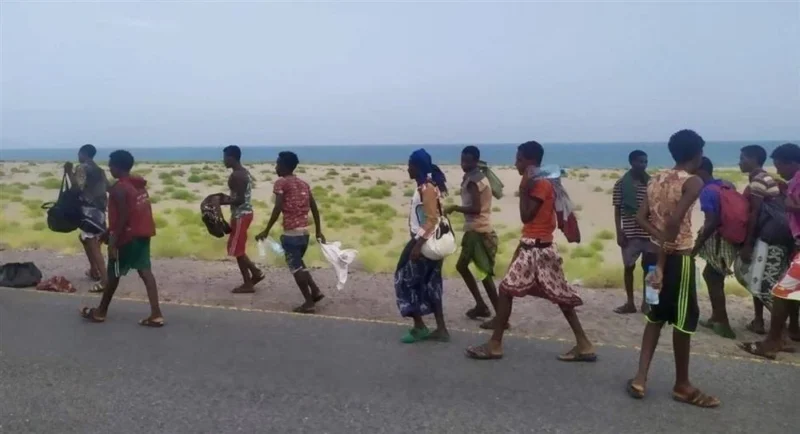
ADEN, Yemen — The International Organization for Migration has reported that more than 17,000 migrants from the Horn of Africa arrived in Yemen in March, marking the lowest monthly level recorded since the beginning of the year and indicating a significant decline in the pace of migration to the country.
The organization stated in its “Migration Tracking” report released on Thursday that it recorded 17,027 African migrants entering Yemen in March, which represents a 12 percent decrease compared to February, when 19,337 migrants were recorded.
Main Departure Points
The report indicated that Djibouti was the main departure point for migrants, representing 74 percent of total arrivals, followed by Somalia at 22 percent, while the Sultanate of Oman accounted for 4 percent of the origins.
According to the IOM’s Displacement Tracking Matrix, most migrants coming from Djibouti entered through the Abyan Governorate, which received 72 percent of the total, followed by the Taiz Governorate at 28 percent. Those arriving from Somalia landed entirely in the Shabwah Governorate, while Omani authorities returned 595 migrants to the Shahan District in the Al Mahrah Governorate.
Deadly Risks on the Eastern Route
The migration corridor from the Horn of Africa to Yemen remains one of the most treacherous maritime crossings in the world. In August 2025, the IOM confirmed that seven Ethiopian migrants, including vulnerable individuals, lost their lives from hunger and thirst during a perilous sea crossing from Somalia to Yemen. An overcrowded boat carrying 250 people, among them 82 children, broke down mid-journey, leaving those on board stranded for seven days without adequate food or water [citation:2].
Somali Migrants Stranded in Yemen
For many Somali migrants who reach Yemen, the destination has brought only hardship rather than opportunity. In makeshift homes lacking basic necessities, thousands of Somalis endure crushing poverty in Aden’s “Little Mogadishu”, according to a December 2025 report.
“Some days we eat, some days it is up to God. That is life,” said Abdullah Omar, a 29-year-old Somali father of four in Aden. Over a year ago, Omar paid traffickers $500 to board a boat with his family, hoping to escape Somalia’s instability for a better life abroad. “Here I have nothing,” he said, explaining his enrollment in a UN program facilitating repatriation to Somalia. “There is no work, no money, and no schooling for the children.”
Yemen, the Arabian Peninsula’s poorest nation, serves not as a final destination for migrants but as a transit point for those fleeing East Africa toward oil-rich Gulf states. However, tight border security prevents many from leaving.
Repatriation Efforts
The Federal Government of Somalia has been actively working to repatriate citizens stranded in Yemen. In October 2025, Somalia successfully repatriated 148 of its citizens from war-torn Yemen, with returnees arriving in Mogadishu where they were received by Minister of Foreign Affairs Abdulsalam Abdali. The operation was carried out in collaboration with the Somali National Commission for Refugees and Internally Displaced Persons, UNHCR, and the IOM.
Speaking at the reception ceremony, Minister Abdali described the mission as “a new chapter of hope,” noting that many of those brought home had spent years trapped in Yemen due to the protracted conflict.
In December 2024, the Somali government, in collaboration with the IOM and UNHCR, successfully repatriated 109 Somali nationals from Yemen, marking another step in efforts to assist citizens stranded abroad.
Yemen-Somalia Security Cooperation
Addressing the root causes of irregular migration has also prompted renewed security dialogue between the two nations. In October 2025, Yemen’s Defense Minister Major General Mohsen al-Daari hosted Somalia’s Ambassador Abdulhakim Mohamed in Aden, signaling a renewed push for closer security collaboration. The meeting focused heavily on combating illegal migration routes and coordinated efforts against terrorism.
Ambassador Mohamed expressed Somalia’s readiness to deepen intelligence sharing and operational coordination with Yemeni authorities, underscoring Mogadishu’s efforts to break cycles of instability at home and prevent militant groups from exploiting regional loopholes.
Continued Migration Despite Dangers
Despite the documented dangers, thousands continue to make the journey each year. More than 60,000 migrants arrived in Yemen in 2024 alone, according to IOM figures. Since 2014, the IOM’s Missing Migrants Project has recorded over 3,400 deaths and disappearances along the Eastern Route, including more than 580 women and 100 children, with approximately 1,400 of these deaths caused by drowning.
The IOM continues to provide lifesaving assistance to migrants in Yemen, including food, medical care, protection services, and voluntary humanitarian return. However, the scale of needs far surpasses available resources, and the organization has warned that funding cuts severely impact humanitarian efforts.