
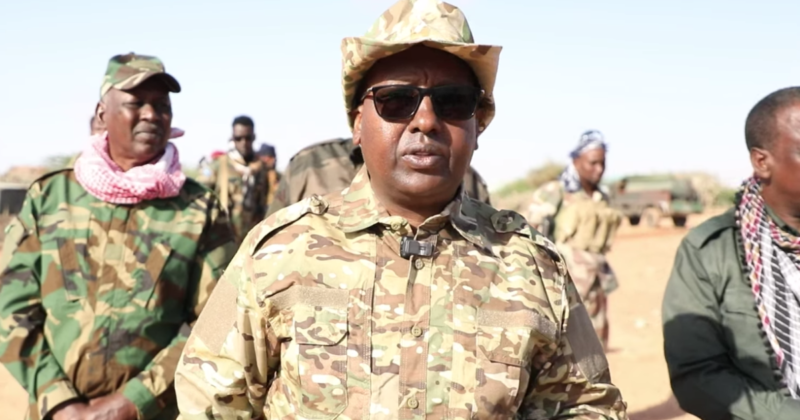
MOGADISHU — Somalia’s Defence Minister Ahmed Moallim Fiqi has warned that the federal government could use military force against federal member states opposing national plans, stating that the army would extend its authority across all parts of the country.
In remarks delivered during a recent address, Fiqi criticized leaders of some federal member states for what he described as hostility toward the deployment of national forces.
“We have reached a point where grown men, leaders of administrations, claim they are being attacked when they see the Somali military. That is a mindset we must move past,” he said, adding that the army’s presence should be welcomed across Somalia.
The minister said the Somali National Army had been tasked with securing both internal and external borders and taking action against any group or authority challenging the federal government.
Federal System and National Unity
Fiqi argued that Somalia’s federal system does not grant regional administrations the right to block national forces or cut ties with Mogadishu, warning that such moves undermine national unity.
“The federal system does not mean a regional state can say, ‘No one can enter,’ or that its doors are closed. There is no greater crime than a Somali leader announcing they have cut ties with the Somali government,” he said, adding that the military would intervene if necessary.
The minister’s warning echoed similar remarks made by President Hassan Sheikh Mohamud. Addressing an event commemorating the 66th anniversary of the Somali National Army, President Mohamud indicated that government forces are ready to conduct special operations anywhere in Somalia when authorized by federal command. His comments were largely seen as a message to regional authorities amid escalating tensions.
Recent Federal Intervention in South West State
The comments come amid heightened political tensions between the federal government in Mogadishu and several federal member states over constitutional reforms and security arrangements.
His remarks come weeks after the federal government launched an offensive against the South West State administration, ousting President Abdiaziz Laftagareen, who had opposed President Mohamud’s “one-person, one-vote” election plan.
The federal government’s intervention in South West State followed the March 29 resignation of Laftagareen, who fled to Kenya after heavily armed Somali National Army troops and allied clan militias seized control of Baidoa. Speaker of the House of the People, Sheikh Adan Mohamed Nur Madoobe, arrived in Baidoa shortly after to oversee preparations for regional presidential and local council elections.
Political Escalation Before Baidoa Takeover
Prior to the federal takeover, political relations between Baidoa and Mogadishu had deteriorated significantly. An unprecedented political escalation unfolded between the Federal Government and the South West State administration in March 2026, marked by retaliatory appointments of local district commissioners across rival jurisdictions.
The standoff intensified when the Federal Ministry of Interior formally established a new local administration for the Waajid district in the Bakool region of South West State. In direct retaliation, the South West State administration issued a stunning counter-decree appointing four new district commissioners for districts located entirely within the Banaadir Region—the federal capital territory of Mogadishu.
The extraordinary exchange of administrative overreach represented a massive breakdown in the constitutional order between the central government and the regional administration.
South West State Severs Ties with Mogadishu
The South West State administration announced it was suspending all cooperation with the federal government, accusing Mogadishu of arming militias and attempting to oust the regional leader. The decision followed the federal government’s rejection of Laftagareen’s re-election, which Mogadishu described as “a clear act of illegality and premeditated self-appointment.”
The crisis spread rapidly, engulfing the security sector with rival directives issued to military and police commanders, leading to clashes in Baidoa and its outskirts.
Defense Minister’s Previous Remarks on National Unity
Minister Fiqi has consistently emphasized the importance of national unity and the protection of Somalia’s territorial integrity. In January 2026, while addressing a combined formation of the Somali National Army and regional security forces in Las Anod, Fiqi issued directives regarding the protection of territorial integrity, describing the security climate as a critical moment for the defense of the Somali Republic.
“I call upon you to enhance stability, defend the nation’s togetherness, and block any external interference attempting to fragment Somalia,” the Defense Minister stated at that time.
Commitment to One-Person, One-Vote System
The federal government maintains that the transition to a “one-person, one-vote” electoral system is a national priority. President Mohamud has firmly advocated for a transition to direct elections, declaring that the country has advanced beyond the traditional indirect voting system.
“Those advocating for indirect elections are individuals pursuing their own agendas. The public interest is what truly matters,” the president stated.
Referencing over twenty signed agreements that establish the frameworks for direct elections, President Mohamud asserted that reverting to the clan-based indirect voting model is highly impractical. “Indirect elections are a relic of the past; they are no longer relevant,” he declared.
Opposition and Regional Backlash
The Somali Future Council, a powerful political alliance comprising Jubbaland, Puntland, and the Salvation Forum, has issued a formal statement endorsing Laftagareen’s challenge to federal authority. The council declared complete support for South West State’s decision to conduct independent regional elections, demonstrating a united front against Mogadishu’s proposed electoral framework.
The core dispute centers on federal constitutional amendments passed without regional consensus and the central government’s push for a “one-person, one-vote” system — a model that regional states deem currently impractical.
Heightened Tensions with Jubaland and Puntland
Minister Fiqi’s warning about potential military action extends beyond South West State to other federal member states. With Laftagareen out of power in Baidoa and Mogadishu fully in charge in South West State, other states that have opposed federal policies, including Puntland and Jubaland, remain on high alert.
The federal government has consistently maintained that the Somali National Army has regained strong, independent operational capabilities and is now fully capable of conducting targeted, high-intensity offensives in any area of the country when authorized by federal command.
As political tensions continue to escalate between Mogadishu and regional administrations, the coming weeks will be critical in determining whether dialogue or further confrontation defines Somalia’s political future.