
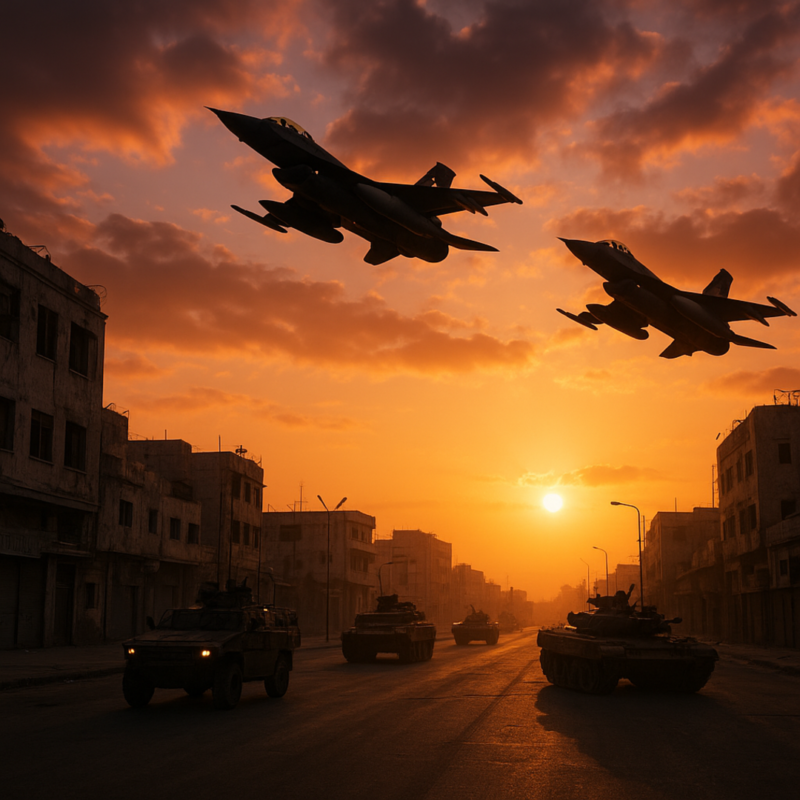
MOGADISHU: Turkey deployed two F‑16 fighter jets over the Somali capital on Sunday, coinciding with the start of planned opposition demonstrations and the opening of “one person, one vote” elections in South West State. The low‑altitude flights and the overnight positioning of dozens of Turkish‑supplied armored vehicles at major Mogadishu intersections marked one of Ankara’s most overt shows of support for President Hassan Sheikh Mohamud just days before his term expires on May 15.
Eyewitnesses reported heavily armed security personnel deployed at critical thoroughfares, official buildings, and strategic crossroads throughout the city. Security forces also encircled the homes of opposition leaders with military vehicles and hundreds of personnel, predominantly Turkish‑trained paramilitary police and National Intelligence and Security Agency (NISA) special unit members. The conspicuous military buildup – combined with sonic booms from the F‑16s – was widely interpreted as a message to opposition figures who had called for protests against alleged state‑orchestrated land confiscations, forced civilian relocations, and what they describe as growing authoritarian practices in the capital.
Rashid Abdi, a Horn of Africa analyst with Nairobi‑based Sahan Research, said Ankara had deliberately entangled itself in Somalia’s political contest. “At dawn Sunday, Turkish F‑16 jets accelerated, breaking the sound barrier above Mogadishu on the first day of nationwide protests against state land seizures and autocratic governance. Ankara’s formidable exhibition of military strength intends to intimidate Somalia’s opposition and showcase steadfast backing for the embattled HSM administration,” he stated.
South West State Votes Amid Political Paralysis
While Mogadishu was placed under a heavy military lockdown, voting proceeded in South West State under a universal‑suffrage system for the first time in generations. The National Independent Electoral and Boundaries Commission (NIEBC) confirmed that more than 376,000 voters – 44% men and 56% women – had been registered, with 4,781 persons with special needs also enrolled. Polling opened across 13 districts in Bay, Bakool, and Lower Shabelle, with the highest registration recorded in Baydhabo (95,399), followed by Marka (42,936) and Afgooye (37,729).
A total of 394 parliamentary candidates are contesting seats in the regional House of Representatives, while 1,297 candidates are running for local council positions. The elections are being contested by 15 political organizations for parliamentary seats and 18 for local councils. Defence Minister Ahmed Moallim Fiqi, who registered as a voter himself, described the process as “historic,” noting that generations of Somalis had never been able to vote directly.
The commission reaffirmed its commitment to conducting transparent, free, and fair elections, and the voting exercise was seen as a crucial test for the federal member state’s post‑interim political trajectory. After federal forces entered Baidoa in late March, Prime Minister Hamza Abdi Barre appointed an interim leader to steer the state toward a legitimate electoral process.
Opposition Protests Thwarted by Heavy Security
Attempts to stage anti‑government rallies in Mogadishu were effectively blocked. Former President Sharif Sheikh Ahmed said security forces had sealed off roads leading to his home and prevented lawmakers and other opposition figures from reaching him ahead of the planned demonstrations. Speaking on social media, Sharif insisted the opposition was not planning an armed uprising: “We are not waging war, we are not carrying guns. We are only carrying our guards.” But he warned that the heavy security measures reflected a “system that is collapsing”.
Another former president, Mohamed Abdullahi Farmaajo, accused the government of suppressing peaceful dissent and called on security forces to protect citizens’ right to protest rather than enforce unconstitutional orders. “I call on the outgoing government … to refrain from any action to suppress Somali citizens who are peacefully demonstrating to express the immense suffering they have experienced,” Farmaajo said. Farmaajo had earlier urged President Mohamud to use his final week in office to establish an inclusive electoral framework. Opposition leaders have already declared that they will not recognize the president after May 15 unless national elections are conducted or a constitutional alternative is agreed upon.
Residents of Mogadishu woke up on Sunday under a de facto curfew, with armed troops and military vehicles blocking major roads. Public transport was disrupted, and many residents stayed indoors fearing violence. Opposition figures had vowed to hold rallies across several districts of the Banadir region to protest forced evictions, land disputes, and what they described as growing authoritarianism, but the heavy security presence effectively prevented any gathering. Forced evictions in the capital have previously triggered armed clashes between rival security factions, and the government has warned that unauthorized demonstrations will not be allowed.
Turkey’s Deepening Military Role Raises Concerns
Sunday’s deployment of F‑16s and armored vehicles represents a rapid escalation of Turkey’s military footprint in Somalia. Ankara maintains its largest overseas military training centre in Mogadishu, where it has trained thousands of Somali troops and police over the past decade. Turkey recently used its air power to help the federal government oust the president of South West State, Abdiasis Laftagareen, after his relationship with President Mohamud broke down. The show of force signals that Ankara is willing to use its military assets to shape the outcome of Somalia’s political crisis, raising the risk of deeper entanglement if the standoff continues after May 15.
The Turkish government has not issued an official statement explaining the fighter jet flights, but Somali officials described them as routine training exercises. However, analysts reject that explanation, pointing to the timing and the simultaneous ground deployment. “Turkey has become entangled in Somalia’s political contest,” Rashid Abdi reiterated. “Ankara’s robust show of military might is designed to intimidate the Somali opposition and demonstrate strong support for the beleaguered [Hassan Sheikh Mohamud] government.”
The developments follow weeks after Somali senator and academic Professor Abdi Ismail Samatar accused Turkey of exploiting Somali resources and backing what he termed an illegitimate Mogadishu administration. “Turkish ships are conducting oil exploration and drilling operations in Somali waters … These actions and conduct position Türkiye as resource pirates,” Samatar said, adding that Ankara may find comfort in its silence, “but the Somali populace will not forget Türkiye’s profound deception.”
Outlook: A Fragile Democracy Under Pressure
The convergence of events on May 10 underscores how deeply fractured Somalia’s political landscape has become. In South West State, voters turned out for a historic universal‑suffrage election that, if successful, could help rebuild trust in local governance. Yet in the capital, the rule of law has been largely displaced by military force and direct foreign intervention. The use of Turkish warplanes and armored vehicles to suppress political dissent sends a worrying message: that Somalia’s partners are willing to back an incumbent who refuses to abide by his own constitutional term limit.
With President Mohamud’s term scheduled to end on May 15 and no electoral framework in place, the political climate in Mogadishu remains highly volatile. Opposition groups have vowed to oppose any term extension, while the government – backed by Turkey’s visible military presence – has shown no sign of stepping aside. If the standoff continues, Somalia could face a prolonged period of political paralysis or even a confrontation between rival security forces. For now, the South West State elections remain a rare bright spot, but without a broader political settlement that restores public trust, respects constitutional limits, and curbs foreign militarization, even that fragile progress could be undone.
Recommended Reading on ftlsomalia.com:
- Former President Farmaajo Urges Inclusive Elections Before May 15
- Opposition Leaders Confirm May 10 Protest Will Proceed
- Evictions in Mogadishu Ignite Fierce Political Showdown
- NIEBC Confirms 376,212 Registered Voters as South West State Elections Open
- Three Journalists Detained, Allegedly Assaulted in Mogadishu