
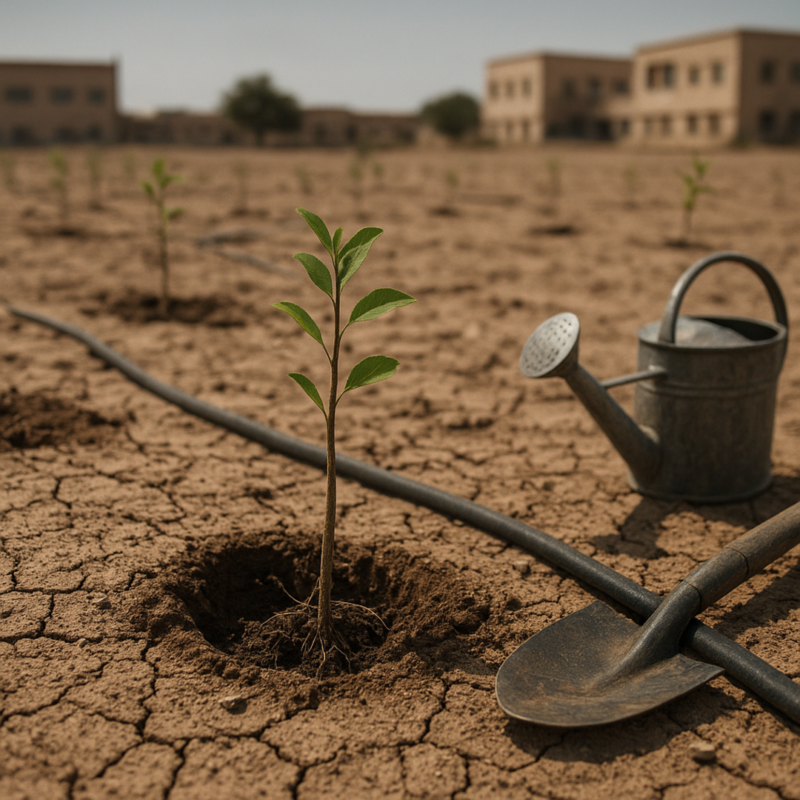
MOGADISHU — The Minister of Agriculture and Irrigation for the Federal Government of Somalia, Mohamed Abdi Hayir (Maareeye), has spearheaded a tree-planting event at the ministry’s compound as part of a nationwide initiative focused on improving environmental preservation and rehabilitating the nation’s green areas.
Minister Maareeye called upon government entities to actively participate in afforestation programs, highlighting the critical need for unified efforts to advance environmental conservation measures.
Modernizing Agricultural Practices
The tree-planting initiative aligns with the ministry’s broader efforts to modernize Somalia’s agricultural sector. In March 2026, the Director General of the Ministry of Agriculture and Irrigation, Eng. Mohamed Hassan Abdille, officially launched a crucial Training of Trainers program focused on Good Agricultural Practices (GAP) for key Somali cereal crops.
The comprehensive training program, which utilizes specialized agricultural manuals, aims to significantly enhance the capabilities of agricultural extension workers operating within the ministry, alongside other agencies providing vital extension services to local farmers. According to ministry officials, this initiative intends to provide participants with the necessary knowledge and practical skills to actively promote sustainable farming methods and improve food production nationwide.
National Agricultural Research Institute
In November 2025, Prime Minister Hamza Abdi Barre laid the foundation stone for the country’s first National Agricultural Research Institute, marking a decisive step toward strengthening Somalia’s agricultural future. The ceremony marked the beginning of an initiative long discussed in policy circles but never realized until now.
The new institute is expected to become the backbone of the nation’s efforts to modernize farming, a sector that supports millions yet remains vulnerable to climate shocks, outdated practices, and limited access to technology. Once operational, it will conduct research tailored to Somalia’s soils and climate, support livestock development, and help farmers adopt more efficient methods. It is also intended to serve as a training ground for the next generation of agricultural experts.
Empowering Farmers with New Tools
In August 2025, Minister Maareeye launched a new initiative to equip local farmers with vital farming tools and machinery, including cargo motorcycles and grain processing equipment, in collaboration with Qatar Charity. The effort aimed to enhance productivity, ease transportation of farm produce, and strengthen post-harvest handling.
“This program is part of the government’s long-term strategy to modernize agriculture and fight rural poverty. We are not only giving equipment; we are giving opportunity and hope,” Maareeye said during the distribution ceremony.
Farmers welcomed the support, saying it would improve efficiency and access to markets. The cargo motorcycles allow them to transport goods with greater ease, while the grain processors help reduce labor and post-harvest waste.
Launch of Agricultural Regulatory Service
In May 2025, Second Deputy Prime Minister Jibril Abdirashid Haji officially launched the Somali Agricultural Regulatory and Inspection Service (SARIS) in Mogadishu, an initiative led by the Ministry of Agriculture aimed at strengthening sustainable agricultural practices and improving food security across the country.
“This is a major step towards ensuring quality and safety in agricultural production, which directly impacts food security and livelihoods,” said Jibril at the launch. SARIS will play a central role in inspecting, regulating, and standardizing agricultural inputs and outputs, helping Somali farmers adapt to modern practices while safeguarding consumer health.
International Agricultural Cooperation
The Federal Government has actively sought international partnerships to revitalize the agricultural sector. In November 2025, Minister Maareeye welcomed a high-level delegation from the Republic of Iraq in Mogadishu, marking a renewed commitment between the two nations to deepen economic ties with a particular focus on agricultural development and investment.
Discussions centered on identifying strategic areas for collaboration, including potential joint ventures in crop production, irrigation systems, and agricultural technology transfer. The Iraqi delegation expressed strong interest in partnering with Somali counterparts to invest in modern farming practices, post-harvest management, and value addition.
EU Support for Agricultural Reforms
In October 2025, EU Ambassador to Somalia Francesca Di Mauro met with Minister Maareeye for constructive discussions focused on the ministry’s current priorities, from land and water management reforms to modernizing farming practices. The EU reaffirmed its resolve to stand behind Somalia’s long-term vision of food self-reliance, including continued support for climate-resilient farming, irrigation infrastructure, and efforts to open new export markets for Somali produce.
Ambassador Di Mauro commended the ministry’s reform agenda and assured that Brussels would continue working alongside Mogadishu to unlock the country’s vast agricultural potential.
Commitment to a Greener Future
Minister Maareeye’s tree-planting initiative at the Ministry of Agriculture and Irrigation compound represents one of many ongoing efforts by Somali authorities to address environmental degradation, combat the effects of climate change, and restore the country’s natural landscape.
The ministry has consistently emphasized that sustainable agriculture and environmental conservation are central to Somalia’s economic recovery and long-term food security. With most Somalis relying on farming and livestock for their livelihoods, the sector’s revival is seen as key to the country’s economic transformation and resilience against climate shocks.