
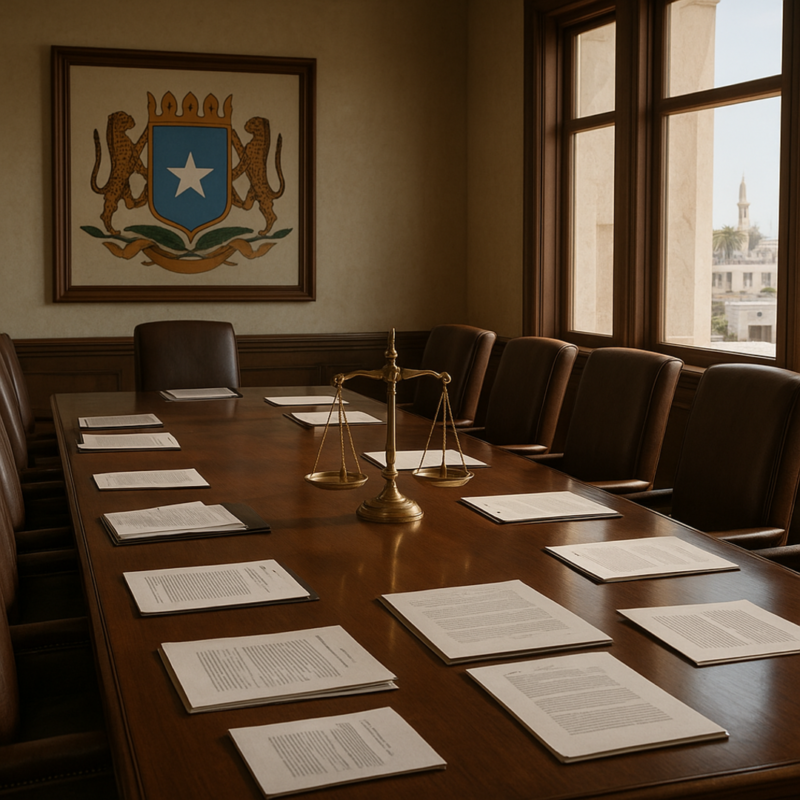
MOGADISHU – The Chairperson of the Somali Independent Human Rights Commission (SIHRC), Maryam Qasim, alongside the Deputy Chairperson, commissioners and the Director General, held a high-level joint meeting on Sunday with the Chief Justice of the Supreme Court, Bashe Yusuf Ahmed, and Attorney General Suleiman Mohamed Mahmoud to strengthen institutional cooperation on human rights, judicial independence and the rule of law.
The talks, which represent a significant step toward aligning Somalia’s human rights framework with its justice sector, focused on the critical role of judicial institutions in safeguarding constitutional rights, upholding due process, ensuring judicial independence, promoting accountability and reinforcing public trust in the nation’s legal system. Both sides emphasized the importance of effective collaboration between the judiciary, the Office of the Attorney General and the Human Rights Commission, particularly on issues related to fair trials, improving prison and detainee conditions, and protecting vulnerable groups in society.
Commitment to International Human Rights Instruments
The meeting also highlighted Somalia’s commitment to upholding the Constitution and international and regional human rights instruments to which the country is a party, including the Universal Declaration of Human Rights (UDHR), the International Covenant on Civil and Political Rights (ICCPR), the Convention Against Torture (CAT), and the African Charter on Human and Peoples’ Rights. Participants further stressed the need for continued dialogue and institutional cooperation to support accountability, strengthen the rule of law and build a credible human rights-based governance culture while respecting the independence and mandates of each institution.
Dr. Maryam Qasim was elected Chairperson of Somalia’s Independent Human Rights Commission in February 2026, bringing over forty years of expertise in public administration, health, education and humanitarian affairs to the role. The Commission was formally established in December 2025 when President Hassan Sheikh Mohamud enacted legislation creating the Independent National Human Rights Commission, following ratification by both chambers of the federal parliament, coinciding with Somalia’s observance of Human Rights Day.
Strengthening Prison Oversight and Justice Reforms
The Commission has recently engaged with the Ministry of Justice on prison conditions, detainee rights, and judicial reforms for vulnerable populations. The United Nations Special Rapporteur on human rights while countering terrorism has voiced serious concerns about Mogadishu’s Central Prison, describing it as “outdated and inhumane,” with calls for urgent investment in a modern correctional facility aligned with international standards.
The Commission also noted that it recently held a similar meeting with the leadership of the Somali Police Force and senior police officials, emphasizing the institutions’ shared responsibility in protecting human rights, maintaining public security and safeguarding fundamental freedoms. The Commission has also deepened its partnership with international partners, including the European Union, to strengthen oversight, rule of law, and protection of vulnerable communities.
Parallel Engagements with Police and Civil Society
The Human Rights Commission reiterated its constitutional mandate to monitor compliance with human rights obligations, cooperate with state institutions and promote accountability and the protection of human rights across Somalia. Earlier this month, the SIHRC met with civil society organizations to advance human rights-respecting governance and deepen cooperation for the protection of fundamental freedoms. The Commission also held talks with opposition figures to discuss the protection of civil liberties amid ongoing political tensions.
As Somalia continues its state-building process, the collaboration between the judiciary, the Attorney General’s office and the Human Rights Commission represents a critical pillar in the nation’s efforts to build accountable institutions and ensure that justice is accessible to all citizens. The meeting concluded with a commitment to regular follow-up consultations and the establishment of a technical committee to monitor the implementation of agreed-upon reforms.
Recommended Reading On ftlsomalia.com:
- Dr. Maryam Qasim Ahmed Elected Head of Somalia’s Human Rights Commission
- President Signs Law Creating National Human Rights Commission
- Justice Minister and Human Rights Commission Discuss Prison Reforms
- Somalia Pushes for Enhanced EU Support on Human Rights and Governance
- Somalia Reclaims Human Rights Oversight as Parliament Backs New Commission