
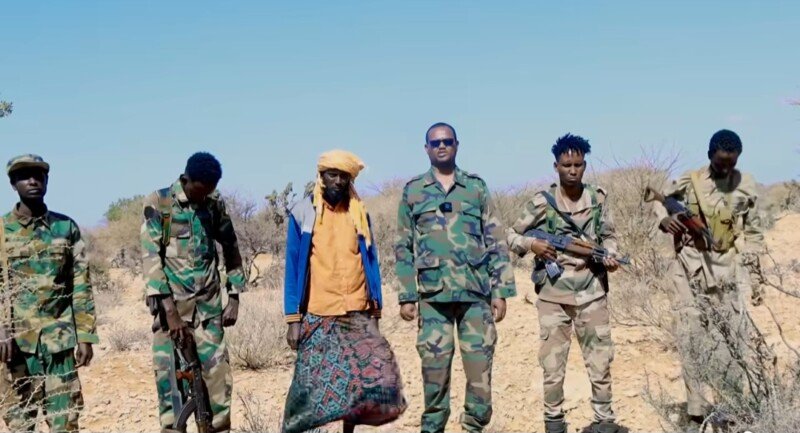
CEELGARAS — The Federal Government of Somalia has presented a man who was a member of Al-Shabaab for 11 years after he surrendered to local and government forces in the Galgaduud region.
Fiidow Hussein Daqarre, who said he had been a member of Al-Shabaab for 11 years, surrendered to local forces in Ceelgaras, Galgaduud region. Daqarre stated that he decided to leave the group after realizing that the ideology and orders he had followed for years were not the reality he had believed in.
He also said he took advantage of the amnesty offered by the Federal Government of Somalia to members and leaders of armed groups who choose to renounce violence. Daqarre revealed that during his time with the group, he was taught that the Somali government and those who support it were “infidels” deserving of attack and punishment. However, he said that after spending years in the group, he eventually came to understand the reality and realized that such thinking was misleading.
Daqarre called on other members still in Al-Shabaab to take advantage of the opportunity offered and to leave the group and surrender to the government.
President Hassan Sheikh Mohamud has repeatedly called on Al-Shabaab militants to leave the group and reintegrate into society, emphasizing that those who defect will not face humiliation or imprisonment. Instead, they will have the opportunity to live with dignity, joining various sectors such as the security forces, government, or business community [citation:1].
The Council of Ministers has approved a General Pardon Regulation, a legal framework designed to facilitate the rehabilitation and reintegration of individuals who renounce extremist ideology and surrender to government authorities [citation:2]. The government has consistently maintained that reconciliation and rehabilitation remain key components of its counter-terrorism strategy, alongside military pressure on militant strongholds [citation:2].
The government has been working with international partners to support the rehabilitation and reintegration of former Al-Shabaab members, including through the National Program for the Treatment and Handling of Disengaged Combatants.
Al-Shabaab commanders have recently surrendered to Somali National Army forces in the Lower Shabelle region, with security sources citing mounting fear of ongoing military operations and the harsh conditions of life in the bush as key factors in their decision [citation:3]. The defections come after President Mohamud renewed a government amnesty offer during Independence Week, calling on militants to abandon extremist ideology and reintegrate into society [citation:3].
The surrender comes as Somali forces continue to make gains against Al-Shabaab. Somali forces killed 22 Al-Shabaab militants, including a regional commander, during a 72-hour planned security operation across the Buulo Cabdalla corridor in Lower Shabelle [citation:4].
Minister of Defence Ahmed Moallim Fiqi has confirmed that high-ranking members of Al-Shabaab are establishing direct contact with authorities to negotiate their surrender, attributing this internal fracture to the continuous pressure exerted by the Somali National Army and international security partners [citation:5]. “Senior Al-Shabaab terrorists are approaching us, looking to surrender and seeking amnesty following the loss of their secure locations,” Minister Fiqi stated [citation:5].
Critical Note
The surrender of Fiidow Hussein Daqarre after 11 years with Al-Shabaab represents another success for the government’s amnesty and reintegration efforts. His testimony about the group’s ideological indoctrination—portraying the government and its supporters as “infidels”—offers a rare glimpse into the recruitment tactics used by the militant group [citation:13].
However, the effectiveness of the reintegration program will depend on the government’s ability to provide adequate support and protection for defectors. Without sustained investment in reintegration programs, including economic opportunities and psychological support, the risk is that former fighters may return to militant groups or remain marginalized in society [citation:9].
The government must also ensure that the amnesty program is implemented transparently and that those who surrender are treated fairly and in accordance with the law. The international community should continue to support Somalia’s reintegration efforts, recognizing that sustainable peace requires not only military victory but also the successful reintegration of those who leave armed groups [citation:2].