
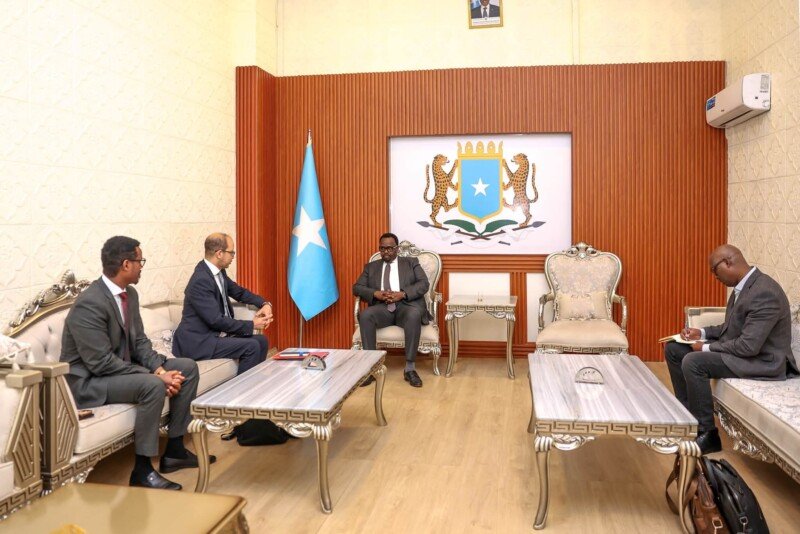
MOGADISHU — Deputy Prime Minister Salah Ahmed Jama has met with the Regional Director for the Middle East, North Africa, Europe and Central Asia of the International Fund for Agricultural Development (IFAD), Naoufel Telahigue, in Mogadishu to discuss strengthening cooperation in agricultural development and food security .
The meeting focused on enhancing Somalia-IFAD cooperation, with particular emphasis on agricultural and livestock development, food security, and adaptation to climate change impacts . The two sides also discussed support for farmers, pastoralists, and vulnerable communities, and ways to expand development projects that IFAD is implementing in Somalia .
The discussions also covered strengthening the capacity of government institutions and increasing investment in agriculture, water, and markets to create additional economic opportunities, particularly for pastoral communities .
The meeting comes as Somalia continues efforts to strengthen domestic production and reduce the vulnerability of communities to climate change and other challenges .
The meeting comes as Prime Minister Hamza Abdi Barre continues his official visit to Qatar, where he has been discussing broader bilateral cooperation, including investment in agriculture and food production . Qatar has expressed interest in supporting Somalia’s agricultural sector .
IFAD’s Role in Somalia’s Agricultural Development
The International Fund for Agricultural Development (IFAD) is a specialized agency of the United Nations dedicated to eradicating rural poverty in developing countries. It has been active in Somalia, focusing on improving agricultural productivity, strengthening resilience to climate shocks, and supporting rural livelihoods.
Somalia’s agricultural sector remains the backbone of the domestic economy, serving as a critical source of economic growth, exports, employment, and food security. Despite continued exposure to climate variability and external shocks, the sector has demonstrated moderate resilience, supported by ongoing reforms, improved market linkages, and sustained demand for agricultural exports.
According to the Central Bank of Somalia’s 2025 Annual Report, crop production showed significant seasonal divergence in 2025, with the Gu season supporting relatively favorable production in some regions, while the Deyr season was markedly poor. Livestock exports, which account for approximately 73 percent of total goods exports, declined by 3 percent to $922.9 million, reflecting short-term market and supply constraints.
Somalia and WFP have unveiled a $1.5 billion Food Security Strategy for 2026-2030, a comprehensive five-year framework aimed at strengthening food security, building resilience, and improving the livelihoods of Somali communities affected by drought, climate change, and conflict. The strategy marks a shift from project-based interventions to integrated, people-centred programming.
The Federal Government has launched a climate resilience initiative named “Activating Climate Resilient Agricultural Livelihoods in Somalia” (ACALS) to support farmers and pastoralists as the country faces persistent droughts and extreme weather conditions. The program will deliver climate-adapted technologies and livelihood support to vulnerable communities in Hirshabelle and Puntland states, supported by the African Development Bank.
Somalia has also launched a World Bank-backed Catastrophe Deferred Drawdown Option (Cat DDO) project to strengthen the nation’s ability to respond to natural and climate-induced disasters, with tech-driven early warning systems to protect communities from recurring natural disasters.
The country is facing a deepening hunger crisis, with approximately six million people, or one third of Somalia’s population, facing acute hunger or worse. The WFP has warned that it can only assist one in ten of those in need, making agricultural development and resilience-building increasingly important.
Critical Note
The meeting with IFAD reflects Somalia’s continued reliance on international partners to support its agricultural sector and build resilience to climate shocks. While IFAD’s focus on farmers, pastoralists, and vulnerable communities is welcome, the scale of investment needed to transform Somalia’s agricultural sector far exceeds what international partners can provide.
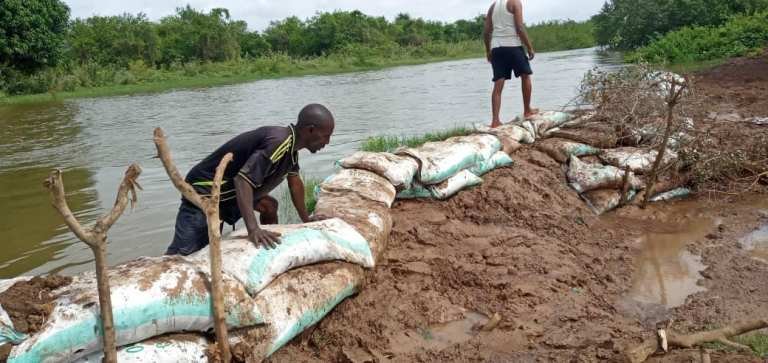
The country’s agricultural sector faces significant challenges, including erratic rainfall patterns, limited access to inputs and markets, and persistent insecurity. The alternating droughts and floods that characterized 2025 highlight the vulnerability of the sector to climate variability and the need for sustained investment in irrigation, water management, and climate-resilient agricultural practices.
The government must ensure that IFAD’s support is aligned with national priorities and that it reaches the communities most in need. Without sustained investment in agricultural infrastructure, research, and extension services, Somalia’s agricultural sector will continue to struggle to meet the food needs of its growing population.