
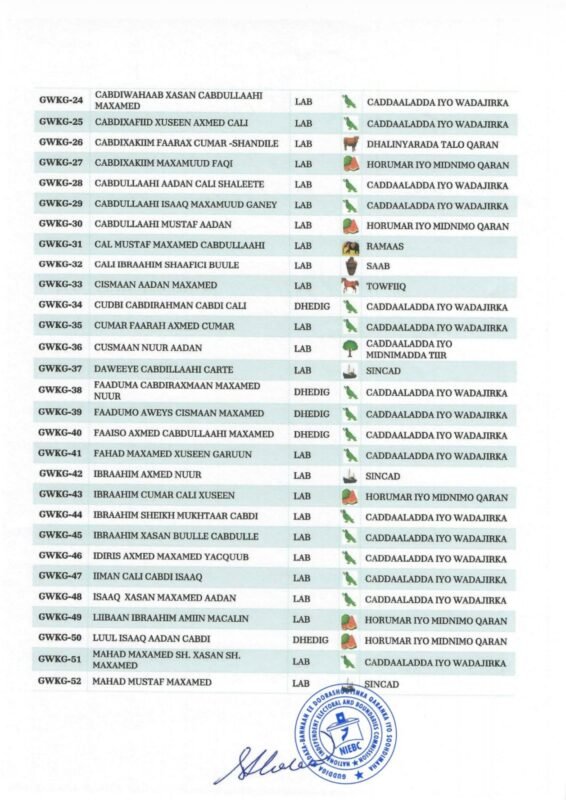
BAIDOA – The National Independent Electoral and Boundaries Commission (NIEBC) has officially released the list of members elected to the South West State House of Representatives, confirming that 92 lawmakers won seats in the May 10 polls held across 13 districts. The commission also announced that the regional presidential election will take place on June 10.
According to the NIEBC, 32 political associations participated in the election, with 132,430 voters casting their ballots. The ruling Justice and Solidarity Party (JSP) secured 51 of the 95 parliamentary seats, while the NPU association won 14 seats, Karaama obtained 11 seats, SINCAD secured 6 seats, and Tiir won 3 seats. The total membership of the regional parliament is 95 seats, meaning three seats remain unfilled and will be determined at a later date.
Women’s Representation Falls Far Below 30% Quota
However, a closer look at the published list shows that only 16 of the 92 elected lawmakers are women. This accounts for approximately 17 percent of the parliament, falling well short of the agreed 30 percent women’s quota outlined in Somalia’s political and constitutional commitments. To fully meet the quota, women were expected to secure at least 28 seats; the current figures reveal a deficit of 12 seats.
The development has sparked immediate concern among civil society groups and advocates for women’s political participation, who argue that the continued failure to implement the quota undermines efforts toward inclusive governance and equal political representation in Somalia. The Federal Elections Implementation Team (FEIT) had previously warned regional states against failure to implement the 30 percent women representation, urging delegates to respect the mandatory quota. International partners have also raised concern over Somalia’s inability to achieve the quota at the federal level, calling for “urgent corrective measures.”
Supreme Court Approves Election Results
The announcement came shortly after the Supreme Court of Somalia formally approved the final outcomes of the South West State local council and legislative elections. After a comprehensive submission and review by the NIEBC, the nation’s highest court determined that the electoral documents satisfied all legal requirements, confirming the legal and procedural soundness of the democratic processes throughout the state’s administrative districts and constituencies.
The ratification establishes the elections as legally valid and final, providing constitutional legitimacy to the newly elected representatives. The electoral commission congratulated the successful candidates and called on political stakeholders, traditional elders, and residents of the region to support the post-election process and maintain stability.
Political Tensions and Disputes Over Process
The elections came at a sensitive time amid heavy political tension regarding the federal government’s management of the transitional period. Even before the results were officially released, top presidential contenders in South West State had issued strong cautions against possible electoral manipulation. Candidate Ilyaas Ali Nuur directly challenged his rival, federal parliament speaker Adan Mohamed Nur (Madobe), asserting that a victory for Madobe under present circumstances would be considered a “theft” of the electoral process. Veteran politician Sharif Hassan Sheikh Aden also raised concerns, stating that he would only accept results if confirmed as authentic.
Security was significantly tightened in Baidoa, with police, intelligence agents, and special forces deployed to maintain stability. The federal government had previously rejected the re-election of Abdiasis Laftagareen in March, describing it as an “illegal pseudo-election.” The newly elected lawmakers are expected to proceed with the next constitutional steps, including swearing-in ceremonies and participation in subsequent parliamentary processes within the regional administration.
NIEBC has maintained that the ongoing elections across the Federal Member States form part of Somalia’s gradual transition toward a more representative democratic system and wider public participation in governance. The commission is also expected to continue overseeing electoral activities in other Federal Member States as the country advances preparations for future electoral reforms.
Recommended Reading On ftlsomalia.com:
- NIEBC announces South West election results as JSP wins 51 seats; candidates warn of vote tampering
- Somali Supreme Court Validates South West State Election Results
- FEIT warns regional states against failure to implement 30% women quota
- International partners concerned at Somalia’s inability to achieve 30 percent women quota
- President Hassan Sheikh commends peaceful Southwest elections, warns against destabilizing protests