
MOGADISHU, Somalia — The Somali Future Council has voiced “deep concern” regarding substantial delays in the nation’s electoral process, accusing senior government officials of neglecting their constitutional obligations.
In a firm press statement issued Wednesday, the council cautioned that the official term for federal institutions was scheduled to conclude on April 14, 2026, as stipulated by the provisional constitution. The group highlighted that the inability to establish an electoral framework compliant with constitutional requirements risks pushing the Horn of Africa nation into a new political crisis.
The council specifically targeted President Hassan Sheikh Mohamud, blaming him for not organizing timely elections and attempting to secure a delay without comprehensive political consensus.
“The President’s term officially terminates on May 15, 2026,” the statement read. “Beyond that date, there will be no legal foundation for him to continue in office without an election based on consensus.”
Warnings of Political Instability
The Somali Future Council has previously issued stark warnings regarding potential delays to the country’s federal elections, urging authorities to adhere to constitutional timelines to avoid a repeat of past political instability. In March 2026, the Council expressed “deep concern” over the possibility of a leadership vacuum or term extensions as the mandates for federal institutions approached their expiration dates.
The warning drew a direct parallel to the political crisis of 2021, when disputes over election delays and term extensions triggered violent clashes in the capital and a prolonged security standoff.
“Somalia is at a critical juncture that requires responsible leadership, political patience, and legal respect,” the Council stated at that time.
Opposition Rejects Constitutional Amendments
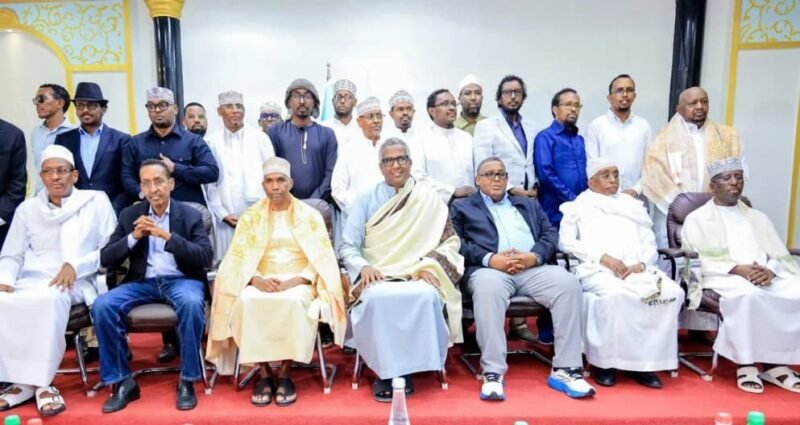
The Somali Future Council—a powerful political alliance comprising the regional governments of Jubbaland and Puntland, alongside the Salvation Forum—has issued a formal public statement directly endorsing Southwest State’s decision to conduct independent regional elections, demonstrating a robust and united front against Mogadishu’s proposed electoral framework.
The core dispute centers on several contentious issues, including federal constitutional amendments passed without regional consensus and the central government’s push for a “one-person, one-vote” system—a model that regional states deem currently impractical and a unilateral mechanism for consolidating federal power.
In March 2026, the Federal Government of Somalia approved constitutional amendments that delay the country’s scheduled 2026 federal elections and extend the term of the current president by one year. The amendments introduce a new electoral framework based on direct parliamentary elections, in which citizens would elect members of parliament who would subsequently select the president. As a result, federal elections are expected to take place in 2027 instead of 2026.
Government Extends Mandate Under New Constitution
In response to the escalating political crisis, senior Somali officials convened a meeting with foreign ambassadors at the Halane diplomatic compound in Mogadishu to reassure international partners that the government remains within legal parameters. Interior Minister Ali Yusuf Hosh, Justice Minister Hassan Moalim, and State Minister for Foreign Affairs Ali Omar Mohamed conveyed to diplomats that both the legislature and executive will continue in office for one year after a new constitution came into force in March.
Speaker of Parliament Adan Madobe has announced that Parliament would extend its stay in office by one year, a move aimed at facilitating the federal government’s transition to a “one-person, one-vote” electoral system. The speaker, speaking during celebrations marking the adoption of the new constitution, stated that the revised framework extends parliamentary and presidential terms to five years and takes effect immediately, effectively adding another year to the mandates of both institutions.
Opposition Warns of Parallel Administration
The Somali Future Council has warned that if both parliamentary and presidential terms lapse without elections or a political agreement, they would move ahead with organizing their own polls and establish a parallel federal administration. Their position is anchored in Somalia’s 2012 provisional constitution, which sets four-year terms for both parliament and the presidency.
A consultative conference in Kismayo held in December 2025 issued a communiqué explicitly rejecting any extensions of constitutional mandates, warning that term extensions would generate political instability, constitutional vacuums, and potential security hazards. The conference established January 20, 2026, as a deadline for President Mohamud to convene an inclusive national conference with all Somali political stakeholders to resolve electoral and constitutional disagreements.
Council Warns Against Politicization of National Army
The Somali Future Council has also cautioned against what it described as the risk of politicizing the Somali National Army, urging authorities to safeguard the force’s neutrality and institutional integrity. In a statement marking the 66th anniversary of the army’s founding on April 12, the council congratulated members of the force and acknowledged their role in defending the country.
However, the group warned that the armed forces must not be used to advance personal or political interests.
“The National Army is not a tool for personal or group interests,” the statement said, adding that any attempt to involve clan dynamics or vested political agendas could undermine the cohesion of the force and weaken national security.
The council expressed concern over what it called signals in recent political rhetoric that could place security institutions at risk if they are drawn into political disputes. It urged the federal government to reinforce the army’s neutrality and prevent interference that could damage its reputation.
Call for Constitutional Respect
The opposition group appealed to the Somali public to “safeguard the constitution” and oppose any moves toward unilateral term extensions or unauthorized transitional governance.
Appealing to the international community, the council requested global partners to carefully observe Somalia’s worsening political situation and to back the implementation of democratic elections founded on an inclusive political resolution.
The statement concluded by underscoring that Somalia’s stability and future depend on constitutional respect, electoral transparency, and inclusive political dialogue.
Government Rejects Accusations
The federal government maintains that the extension is a constitutional necessity to prevent a power vacuum while finalizing the national electoral framework for 2027. Officials argue that the transition to a one-person, one-vote system requires more time and legal adjustments to build a stable and inclusive voting framework.
President Mohamud has firmly advocated for a transition to direct elections, declaring that the country has advanced beyond the traditional indirect voting system.
“Those advocating for indirect elections are individuals pursuing their own agendas. The public interest is what truly matters,” the president has stated.
Referencing over twenty signed agreements that establish the frameworks for direct elections, President Mohamud asserted that reverting to the clan-based indirect voting model is highly impractical. “Indirect elections are a relic of the past; they are no longer relevant,” he declared.
The federal government has not yet issued a formal response to the council’s latest accusations.