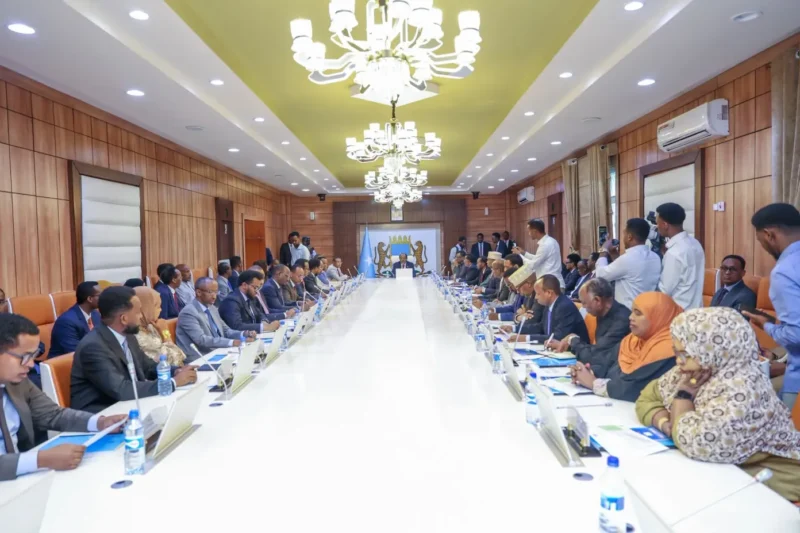

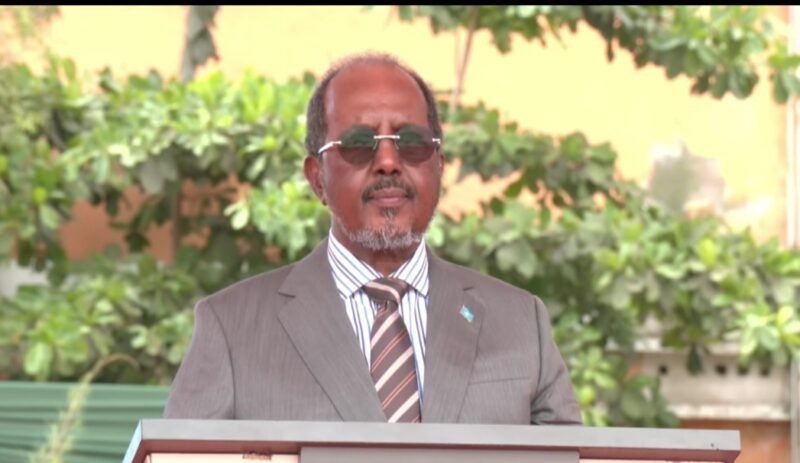
MOGADISHU, Somalia — President Hassan Sheikh Mohamud has reaffirmed his commitment to implementing one-person, one-vote elections, despite growing pressure regarding the electoral process being developed by Villa Somalia, during a meeting with traditional elders at the presidential palace.
Speaking at the gathering, Hassan Sheikh stated that Somalia must progress and would not revert to what he termed indirect and clan-based elections that have characterized the nation’s political system for decades.
“We can never abandon the Somali people’s constitutional right to select their preferred leader after 57 years,” the president emphasized. “The incomplete elections held in the country have resulted in numerous challenges, with insecurity being the most significant.”
During the gathering at Villa Somalia, Mohamud emphasized that Somalia must transition to a “one person, one vote” system following years of indirect elections, declaring that the country has advanced beyond the traditional indirect voting system. “Indirect elections are a relic of the past; they are no longer relevant,” the president has stated.
President Links Indirect Elections to Instability
The president contended that previous indirect elections had fueled extended political conflicts and instability, asserting that direct elections are essential to enhance governance and restore public confidence in state institutions.
The president informed the elders about government initiatives in security, institutional development, decentralization, and combating Al-Shabaab militants.
Elders Urge President to Reconsider
However, several traditional elders present at the meeting encouraged Hassan Sheikh to reassess his stance, warning against making unilateral decisions concerning the nation’s electoral future.
Several elders reportedly told the president that leadership should derive from extensive national consensus and expressed their refusal to accept measures they believe contradict principles rejected during the previous administration.
President Mohamud has previously emphasized that elders continue to be pivotal in peace initiatives and community involvement, stressing the importance of enhanced collaboration between customary leaders and governmental bodies to address regional issues. The head of state affirmed that his administration is dedicated to partnering with elders to reinforce peace-building processes, enhance public services, and maintain stability throughout the nation.
Traditional Leaders Endorse Electoral Reforms in Baidoa
Despite the reservations expressed at the Mogadishu gathering, President Mohamud has previously received strong backing for universal suffrage from traditional leaders in other regions. During a strategic meeting with senior traditional elders in Baidoa, the president heavily stressed the absolute importance of traditional leaders maintaining active involvement in Somalia’s historic transition to a “one-person, one-vote” electoral system. In response, those elders voiced strong, unified backing for the Federal Government’s plan to implement the universal suffrage electoral model, signaling a major political victory for Villa Somalia.
Federal Commitment to Universal Suffrage
Federal authorities remain committed to implementing universal suffrage in South West State, with Prime Minister Hamza Abdi Barre declaring that there will be no elections in Baidoa or across South West other than a one-person, one-vote process. “We will not allow, in any way, disorder, revenge, clan-based discrimination or any trouble in Baidoa,” Prime Minister Hamza stated.
The expansion of voter registration to Hobyo District aligns with the federal government’s broader strategy of transitioning Somalia from indirect clan-based elections to a universal suffrage model. The NIEBC’s enhanced activities in Hobyo District represent a nationwide initiative to quicken voter registration and guarantee broad involvement, especially in communities recently added to the registration process.
Broader Electoral Debate Intensifies
The discourse surrounding Somalia’s electoral framework has intensified in recent times, with opposition figures and some regional leaders voicing apprehensions regarding the viability and inclusivity of universal suffrage amid persistent security and political obstacles.
If completed as scheduled, the South West State elections would mark one of the most significant electoral experiments in Somalia in decades, testing the country’s capacity to transition from negotiated power-sharing to direct public voting at the regional level.
Commitment to Democratic Transition
Elder participants in the meeting voiced their willingness to contribute to nationwide initiatives focused on solidifying peace and promoting developmental progress. The president indicated that continuous partnership with traditional governance frameworks would be essential in building confidence between local communities and the central government, especially in areas experiencing political and security difficulties.
Somalia is endeavoring to shift to universal suffrage after prolonged clan-based indirect voting, a change viewed as crucial for enhancing legitimacy and long-term stability.