
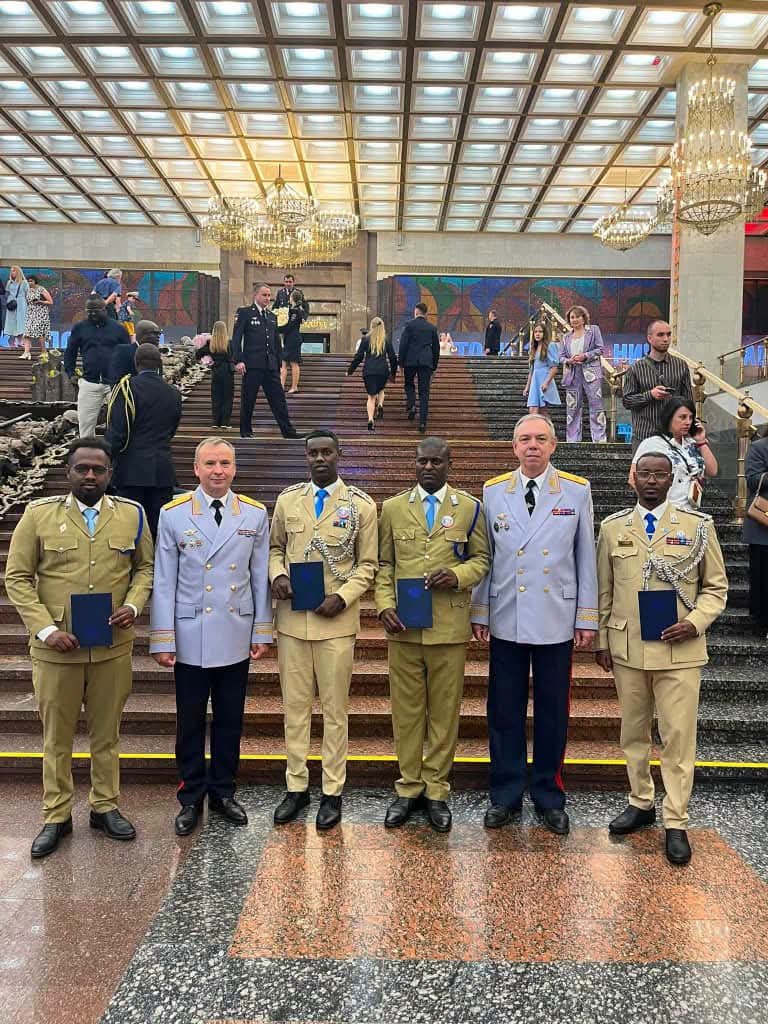
MOSCOW – Four senior officers of the Somali Police Force have graduated with Master’s degrees from Russia’s Academy of Management under the Ministry of Internal Affairs, marking the first such graduation in four decades and signaling a revival of bilateral security cooperation between Mogadishu and Moscow.
The officers, who specialised in General Administration and Strategic Planning, received their qualifications at a ceremony held at the Academy of Administration in Russia. Somali police authorities described the achievement as one that would strengthen leadership and institutional capacity within the force, with the officers expected to apply their expertise in strategic planning, public administration and institutional management as Somalia continues reforms aimed at modernising its security sector.
A Historic Milestone After Four Decades
The graduation represents a significant milestone, marking the first time in more than 40 years that Somali police officers have completed advanced studies at a Russian institution. Government officials hailed the event as a revival of educational and security cooperation between Somalia and Russia, which had largely lain dormant since the collapse of the Siad Barre regime in 1991.
During the Cold War, Somalia and the Soviet Union maintained close military and security ties, with hundreds of Somali officers receiving training in Russian institutions. That relationship collapsed after Somalia’s civil war, but the graduation of the four officers suggests a renewed interest on both sides in rebuilding security-sector ties.
A Diversifying Security Partnership Landscape
The graduation comes as Somalia pursues a diversified foreign policy, expanding international partnerships for security training with countries including Turkey, Egypt, Italy, Uganda, Qatar and the United Arab Emirates. Russia, for its part, has been seeking to deepen its diplomatic and security engagement across Africa, with Moscow continuing to provide assistance to Somalia in the form of police training.
The officers’ training in Russia adds to a growing network of international partnerships that Mogadishu has cultivated to build the capacity of its security institutions. Turkish-trained Somali police officers have previously earned master’s degrees at the Police Academy in Ankara, while Somalia has also signed police development pacts with Italy. The Russian graduation, however, carries particular historical weight given the depth of Soviet-Somali security cooperation in the decades before the civil war.
A Troubling Context: Allegations of Fraud and Mismanagement
However, the celebratory narrative surrounding the graduation sits uncomfortably alongside persistent allegations of fraud and mismanagement in Somalia’s security training partnerships. In 2024, leaked documents obtained by Horn Observer revealed that fake Somali police officers had been enrolled in a Russian-supported law enforcement training programme intended to capacitate the Somali Police Force. The revelations raised serious questions about the integrity of the recruitment and selection processes governing international security training, and whether such programmes are genuinely building institutional capacity or merely providing opportunities for patronage and corruption.
A similar scandal emerged in 2022 when Somalia’s National Intelligence and Security Agency (NISA) was found to have enrolled fake soldiers in a training programme in Eritrea, with officials allegedly pocketing the salaries of ghost recruits. The recurrence of such allegations across different training partnerships suggests a systemic problem rather than isolated incidents, and raises uncomfortable questions about whether the officers who graduated in Russia were selected on merit or through political connections.
The lack of transparency surrounding the selection process for international training programmes has been a recurring concern. The Somali government has not disclosed how the four officers were selected, what criteria were used, or whether the programme was open to all qualified candidates. Without such transparency, the graduation, while symbolically significant, risks being seen as another example of elite capture rather than genuine institutional development.
Way Forward
The graduation of four Somali police officers from Russia’s Academy of Management represents a notable achievement and a potential step toward strengthening the leadership and institutional capacity of the Somali Police Force. However, the broader context of fraud allegations, lack of transparency, and the systemic weaknesses that have plagued Somalia’s security institutions for decades cannot be ignored. If Somalia is to build a professional, accountable police force capable of serving its citizens, international training partnerships must be accompanied by rigorous oversight, transparent selection processes, and genuine institutional reform. Without these elements, the graduation risks being a symbolic gesture rather than a meaningful contribution to Somalia’s security sector development.