
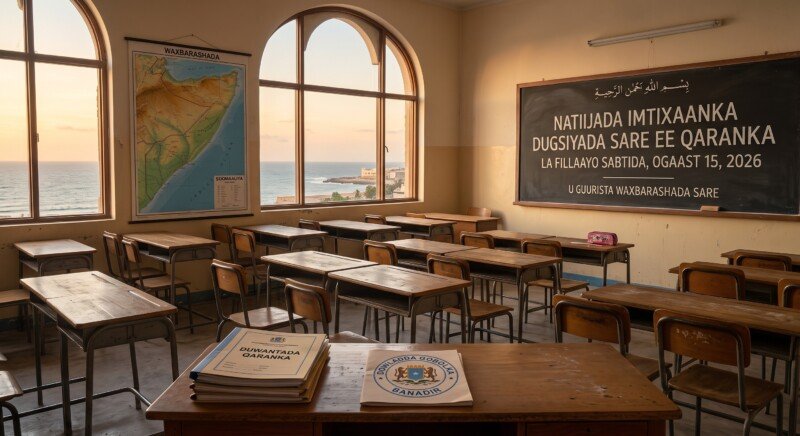
MOGADISHU — The results of the National Secondary School Certificate Examination are expected to be released on Saturday, August 15, 2026, with thousands of students and their families eagerly awaiting the outcome that will determine their transition to higher education.
The announcement will mark a significant milestone for students who sat for this year’s national exams, as their results will determine their eligibility for university admission and other higher education opportunities. The Ministry of Education, Culture and Higher Education is responsible for the assessment and certification of national school examinations, with the education law requiring that secondary school graduates sit for government-administered certificate exams.
Students, parents, and teachers are closely following the release, with successful candidates expected to celebrate their achievements while those who did not meet their expectations will have opportunities to consider their next steps in education.
The results are also expected to reflect the overall performance of students and the state of secondary education across the country. Saturday, August 15, 2026, will therefore be a day of great anticipation for students and their families.
The National Education Consultation Conference recently concluded its second day in Mogadishu, bringing together federal and state-level education ministers to coordinate and strengthen Somalia’s education sector.
Girls dominated the top positions in the Banaadir region’s Grade 8 certificate examinations, securing nine out of the top ten spots with Sumayo Hassan Abshir Aadan achieving a score of 96.88%.
Over 44,000 students passed the Grade 8 exams in Mogadishu, with a pass rate of approximately 96.8 percent and girls accounting for 45.47 percent of successful candidates.
Critical Note
While the release of national exam results is a routine administrative milestone, it also highlights the broader challenges facing Somalia’s education sector. Despite the participation of thousands of students in national exams, millions of children across the country remain out of school due to conflict, displacement, poverty, and lack of infrastructure. The education system continues to face severe resource constraints, with many schools lacking basic facilities, qualified teachers, and learning materials. The government must prioritise investment in education, ensure that resources reach the most marginalised communities, and address the underlying drivers of educational exclusion.