

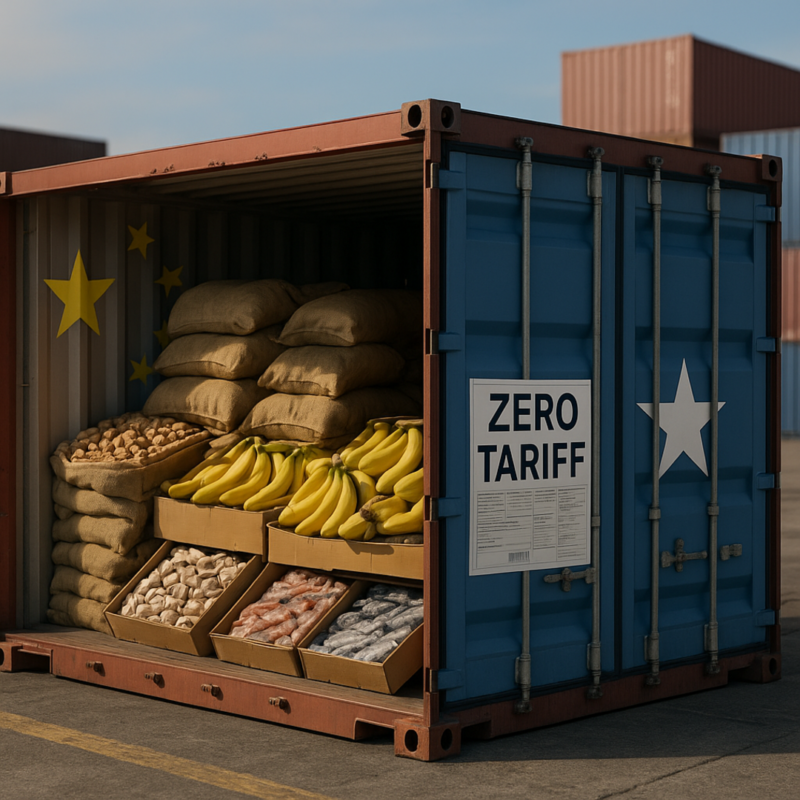
BEIJING: China has announced a historic extension of its zero-tariff policy to all 53 African nations with which it maintains diplomatic ties, effective May 1, 2026, making it the first major economy to offer such unilateral, full-coverage duty-free access to the entire continent. The initiative eliminates customs duties on 100 percent of tariff items for imported products, seeking to boost trade, promote industrialization, and broaden market access for African goods throughout China. Foreign Minister Wang Yi revealed the policy, which is set to transform Africa’s economic framework and create fresh prospects for nations including Somalia.
This zero-tariff framework guarantees that virtually all products from Africa — agricultural commodities, seafood, textiles, and handicrafts — can now enter China duty-free. By eliminating tariffs, the landed cost of African goods in China falls instantly, giving marine products from Somalia, coffee from Ethiopia, and avocados from Kenya an edge over suppliers from other regions. Expanding upon a 2024 policy that initially applied to only 33 of Africa’s least developed countries, China’s latest move demonstrates its dedication to reinforcing economic connections across the continent. This comprehensive arrangement seeks to encourage shared prosperity, advance regional cooperation, and support Africa’s development goals. Somalia recently inaugurated its first-ever national pavilion at the China-Africa Trade Expo in Changsha, showcasing export products including frankincense, myrrh, canned tuna, and dried lemons, as part of broader engagement under the Forum on China–Africa Cooperation (FOCAC).
Opportunities for Somalia
Somalia is positioned to substantially benefit from this policy, which establishes new pathways for exporting its abundant resources. With tariffs eliminated, Somali enterprises can now transport livestock, seafood, and agricultural products such as cashews and bananas to the Chinese market at minimal cost. This advantage cuts export expenditures and improves the competitive position of Somali products in the international marketplace.
Leveraging its strategic coastal location and fertile terrain, Somalia is well-equipped to take advantage of this open trade setting. Somali seafood, encompassing fish and shrimp, can now access Chinese consumers more readily, addressing China’s substantial seafood demand. China has officially lifted domestic tariffs on seafood imports from Somalia, allowing Somali-owned and joint-venture companies to export seafood products to the Chinese market tariff-free. Officials have described the move as a “transformational opportunity” for the country’s fisheries sector. Furthermore, the nation’s agricultural exports are expected to gain from improved market access, enabling local farmers and fishermen to broaden their market presence and earnings.
A Catalyst for Economic Modernization
The zero-tariff arrangement incentivizes Somali producers to enhance product quality to satisfy Chinese market requirements, encouraging innovation and technological progress. This dynamic can attract foreign investment, facilitate knowledge transfer, and advance sustainable growth within Somalia’s export industries. Prime Minister Hamza Abdi Barre recently attended the China-Somalia Trade Conference in Yinchuan, highlighting Somalia’s untapped opportunities in agriculture, fisheries, renewable energy, and infrastructure. The conference brought together more than 100 companies from both countries, with Ningxia officials expressing China’s commitment to expanding trade and supporting development initiatives.
The Minister of Commerce and Industry, Jamal Mohamed Hassan, has held high-level discussions with Chinese Ambassador Wang Yu on strategies for enhancing trade and economic collaboration. The officials examined China’s potential role in fostering Somalia’s broader economic advancement, including investment prospects and industrial expansion. Minister Jamal acknowledged China’s ongoing support, highlighting the significance of broadening commercial ties that would yield tangible benefits for both nations.
Strategic Partnership and Infrastructure Investment
This initiative aligns with China’s broader Belt and Road Initiative, presenting opportunities for enhanced cooperation and investment for Somali businesses and infrastructure endeavors. Somalia and China announced a significant $1.2 billion investment partnership in 2024, set to be implemented during 2025-26, focusing on enhancing infrastructure, energy, and agriculture sectors. The investment marks the first time in 40 years that Somalia has signed such a significant financial agreement with any of its international partners. Reinforced trade connections amplify Somalia’s regional standing, support economic stability, and contribute to improving living conditions in communities throughout the nation.
Somalia and China have reopened a new chapter in their bilateral relations following a landmark meeting between Defense Minister Ahmed Moallim Fiqi and his Chinese counterpart, Admiral Dong Jun, in Beijing — the first ministerial-level defense engagement between the two nations in nearly 40 years. Officials from both sides hinted at follow-up visits to cement agreements, with cooperation expected to extend beyond security to economic development and infrastructure. Talks between Somalia’s Foreign Ministry and Chinese Ambassador Wang Yu have underscored both nations’ commitment to expanding economic cooperation, advancing infrastructure projects, and bolstering security partnerships as a means of promoting regional stability and sustainable development.
Diplomatic and Political Dimensions
The strengthened economic relationship is underpinned by consistent diplomatic backing. Chinese Foreign Minister Wang Yi has reaffirmed Beijing’s strong backing for Somalia’s national unity and territorial integrity, explicitly rejecting any attempts by the breakaway region of Somaliland to establish separate ties with Taiwan. The Chinese Embassy in Somalia has also dismissed claims from Somaliland officials as “shameful fabrication” and part of a “disinformation campaign,” stating that the reality of Somaliland being part of Somalia cannot be changed.
Somalia’s Ambassador to China, Dr. Hodan Osman Abdi, has engaged in constructive dialogue with the China Geological Survey, focusing on capacity building, professional training, and technical expertise sharing. The organization also participates in the Belt and Road Initiative, which fosters economic infrastructure development and international collaborative growth. Discussions have also included SSC-Khaatumo leader Abdulkadir Ahmed Aw-Ali, highlighting a growing recognition of regional voices in Somalia’s national development agenda.
Navigating the Path Forward
While the zero-tariff policy presents substantial potential, Somali businesses must focus on quality benchmarks and packaging to maximize the opportunity. Strategic investments in capacity enhancement, infrastructure, and brand development will be crucial to realize the policy’s complete benefits. The extension of zero-tariff treatment to all African countries with diplomatic ties represents what Beijing has called a “significant measure” to deepen China-Africa trade and investment ties. The zero-tariff treatment will run until April 30, 2028. Industry leaders have noted that the lack of large-scale storage and export systems has forced fishermen to sell locally, limiting earnings. With proper access to global markets, daily yields could scale significantly, describing China’s policy as a “major breakthrough”. The government says it is prioritizing investment in cold storage, logistics, and port infrastructure to support export growth, while encouraging private sector participation.
The full implementation of China’s zero-tariff policy on May 1, 2026, marks a transformative moment for Somali exports. By embracing this historic chance, Somalia can extend its trade reach, stimulate economic expansion, and enhance citizens’ living standards. As the country welcomes this new phase of improved China-Africa relations, the possibilities for sustainable growth and mutual wealth have never been more favorable.
Recommended Reading on ftlsomalia.com:
- Somalia Launches First Pavilion at China-Africa Trade Expo
- Somalia and China Announce a Historic $1.2 Billion Investment Partnership
- Somalia Showcases Fisheries Potential at Blue Economy Forum
- Somalia and China Reignite Defense Cooperation After Four Decades
- China Reaffirms Support for Somalia’s Sovereignty, Condemns Somaliland-Taiwan Ties
- Somalia, China Explore Enhanced Trade and Economic Partnership