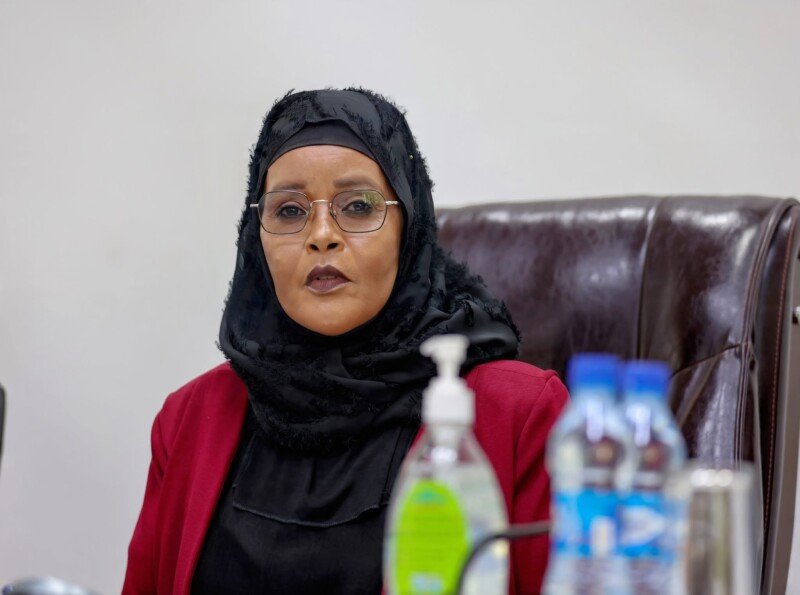


MOGADISHU: The Acting Minister of Labour and Social Affairs, Amina Hussein Ali, participated in the International Labour Day commemoration on Saturday, an event organized by the Federation of Somali Trade Unions (FESTU) with support from the International Labour Organization (ILO). The gathering brought together more than 1,000 representatives from workers, government officials, and social partners, demonstrating a collective commitment to advancing a decent work agenda in Somalia.
The event emphasized the crucial role of workers in sustainable development and reinforced the importance of promoting and protecting fundamental principles and rights at work, such as freedom of association, dignity, and equality. Discussions also highlighted increasing efforts toward investing in employment-intensive job creation for decent work and inclusive labor market development.
In her address, Hon. Amina reaffirmed the government’s strong commitment to enhancing labor legislation implementation in accordance with international labor standards and to developing policies that support decent work and expanded employment opportunities. She also praised the proactive and constructive role of worker organizations affiliated with FESTU in fostering effective social dialogue and collaboration with government and employers to achieve tangible progress in job creation, skills development, and worker rights protection.
This year’s national commemoration was guided by the theme: “Empowering the Somali workforce through decent work and skills development.” The event was officially held on May 2, 2026, bringing together a wide range of stakeholders, including directors from government ministries, representatives of the private sector, labor unions, and members of the Somali Chamber of Commerce and Industry (SCCI). Participants reaffirmed their shared commitment to strengthening the labor market and enhancing the skills and productivity of Somali workers.
Background: Labor Reforms and Workers’ Rights in Somalia
The International Labour Day commemoration comes amid historic reforms in Somalia’s labor sector. After 52 years without meaningful reform, Somalia’s new Labor Code was implemented in 2025, guaranteeing stronger protection for workers, safer workplaces, and more inclusive employment practices. The new Labor Code (Law No. 36, 2024) emerged from extensive social dialogue among Somalia’s tripartite constituencies: the Ministry of Labour and Social Affairs (MOLSA), the Somali Chamber of Commerce and Industry (SCCI), and FESTU, with vital technical and financial backing from the ILO. President Hassan Sheikh Mohamud signed the new Labor Code into law after its approval by both chambers of the Federal Parliament, replacing the outdated 1972 labor law.
The Ministry of Labour and Social Affairs officially unveiled the updated Somali Labour Code during a ceremony in February 2026, marking a significant step in improving labor governance and bringing national employment practices in line with principles of fairness, transparency, and worker protection. The event was presided over by Labour Professor Salim Alio Ibrow, with representatives from FESTU, SCCI, and Federal Member States in attendance.
FESTU, the official national trade union centre representing workers across Somalia, has been at the forefront of advocating for labor rights. In partnership with the United Nations through the UN Transition Mission in Somalia (UNTMIS) and UNICEF, FESTU launched a nationwide education and awareness campaign under the banner “Labour Rights Are Human Rights” to empower Somali workers to know, claim and defend their rights under the newly reformed Labour Code. From October to December 2025, FESTU executed the Labour Rights Education Programme, rolling out educational activities to workers across Baidoa (South West State), Dhusamareb (Galmudug State), and Beledweyne (Hirshabelle State). The program placed particular emphasis on workplace equality and protection, with specialized training sessions for women, young workers, and individuals with disabilities.
Somali workers have continued to use International Labour Day to voice demands for decent work, economic growth, and direct elections. FESTU has also convened trade union leaders to strengthen the implementation of Somalia’s labour migration policy and recruitment regulations, focusing on worker protection and fair recruitment. The nationwide push for labor rights education has generated massive engagement, reaching an audience of more than 2.3 million people across the country.
The Ministry of Labour and Social Affairs has repeatedly reaffirmed its commitment to strengthening compliance measures, aligning with Somalia’s ongoing preparation for the Universal Periodic Review and its dedication to Sustainable Development Goals 8 (decent work) and 10 (reduced inequalities). The Ministry concluded the Workers’ Day event by extending congratulations to Somali workers across the country and abroad, encouraging them to continue contributing to national development and to support ongoing initiatives aimed at expanding employment and strengthening workforce capacity.
Recommended Reading on ftlsomalia.com: