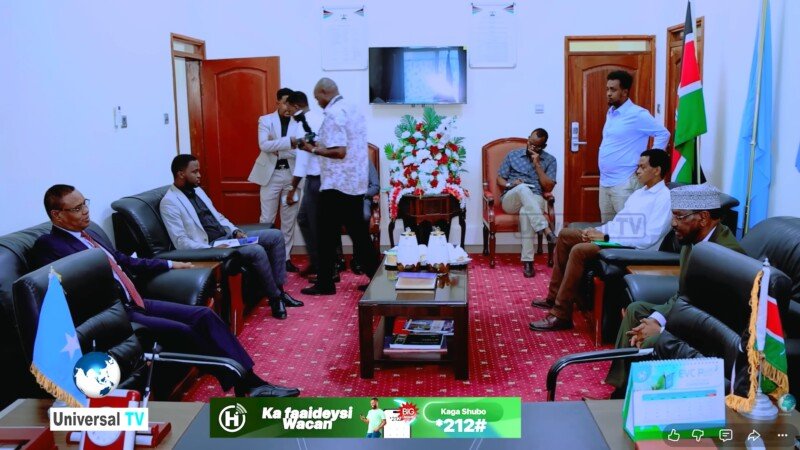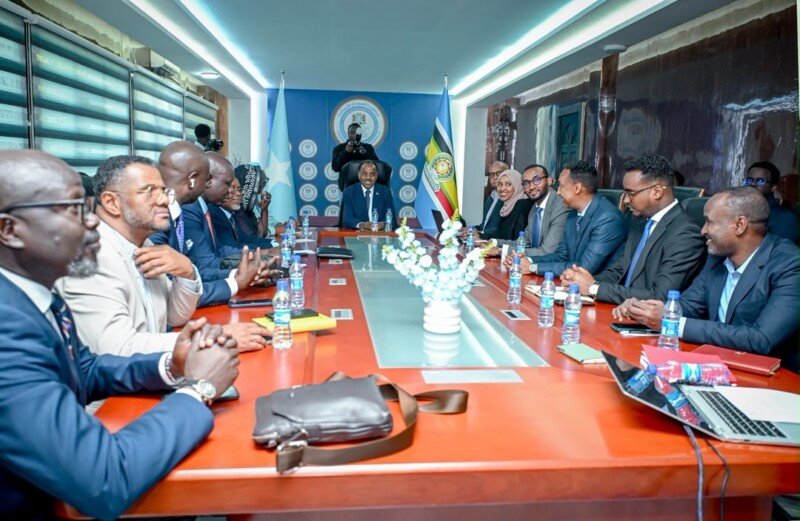

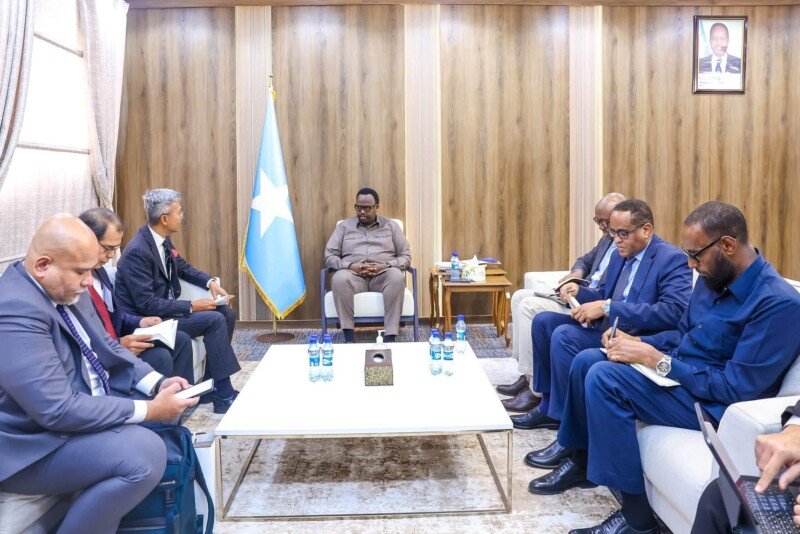
MOGADISHU — Deputy Prime Minister of the Federal Government of Somalia, Salah Ahmed Jama, has received the Ambassador of the Republic of Indonesia to Somalia, T.B.H. Witjaksono Adji, at his office in Mogadishu for talks focused on deepening bilateral cooperation across a range of sectors.
The meeting centered on strengthening ties in education, fisheries, the blue economy, and expanding opportunities for mutual collaboration. Deputy Prime Minister Jama expressed gratitude to the Indonesian government for its continued partnership and reaffirmed the Federal Government’s commitment to enhancing friendly relations between the two nations.
The engagement builds on a series of high-level diplomatic exchanges between Mogadishu and Jakarta in recent months. Foreign Minister Abdisalam Abdi Ali met with his Indonesian counterpart Sugiono in Jakarta for high-level talks aimed at deepening bilateral relations and enhancing cooperation in trade, education, agriculture, maritime security, and development. Minister Ali also extended an invitation for Indonesian businesses and investors to explore opportunities in Somalia’s growing sectors, while Sugiono affirmed Indonesia’s readiness to collaborate more closely in capacity building, vocational training, and people-to-people exchanges.
The diplomatic momentum was further reinforced in July 2025 when the Somali Cabinet approved a visa exemption agreement for holders of diplomatic and service passports from both countries, a decision reached during a Council of Ministers’ meeting chaired by Deputy Prime Minister Salah Ahmed Jama himself. The Deputy Prime Minister underscored the importance of building strategic international partnerships, noting that Somalia is expanding its global diplomatic footprint and diversifying its foreign relations.
Growing Diplomatic Engagement
The meeting with Ambassador Witjaksono Adji comes as Somalia and Indonesia continue to strengthen their bilateral relationship. In January 2026, Foreign Minister Abdisalam Abdi Ali spoke by telephone with his Indonesian counterpart Sugiono, discussing the importance of supporting Somalia’s sovereignty, territorial integrity, and national unity.
On the Somali side, Somalia’s newly appointed Ambassador to Indonesia, Faisal Ahmed Salad, presented his credentials to Indonesian President Prabowo Subianto in May 2025, marking a renewed commitment to deepening diplomatic and economic relations between the two nations. Ambassador Faisal emphasized the vast potential for tangible cooperation in business, trade, agriculture, education, and infrastructure development—sectors vital to Somalia’s recovery and long-term development.
Indonesia, a member of the Organisation of Islamic Cooperation (OIC) and the Non-Aligned Movement, has been a consistent supporter of Somalia in international forums. The two countries have also explored avenues for cooperation within the ASEAN framework, with Somalia and ASEAN charting a path to stronger ties in landmark Jakarta talks that reflected Mogadishu’s ambition to diversify international partnerships beyond traditional allies.
The growing relationship between Somalia and Indonesia is also reflected in the two countries’ shared commitment to south-south solidarity and mutual development. In addition to the fisheries and blue economy sectors discussed in Monday’s meeting, both nations have identified trade, education, and capacity building as priority areas for cooperation.
Ambassador Witjaksono Adji, who presented his credentials to President Hassan Sheikh Mohamud in December 2025, has been actively engaged in strengthening the bilateral relationship since assuming his post.
Critical Note
The meeting between Deputy Prime Minister Salah Ahmed Jama and Ambassador Witjaksono Adji reflects the steady growth of Somalia-Indonesia relations, a partnership that holds considerable potential for both nations. However, the challenge remains in translating diplomatic goodwill into tangible outcomes on the ground. While agreements on visa waivers and high-level exchanges are welcome steps, their impact will ultimately be measured by concrete investments, trade flows, and capacity-building programs that benefit ordinary Somalis. The focus on fisheries and the blue economy is promising, given Somalia’s extensive coastline and untapped maritime resources, but will require significant institutional capacity and regulatory frameworks to attract Indonesian investment. Furthermore, Somalia’s engagement with Indonesia should be part of a broader strategy to diversify international partnerships rather than a substitute for addressing domestic governance and security challenges. The government would be well advised to ensure that bilateral agreements are accompanied by clear implementation plans and accountability mechanisms, lest they remain largely symbolic affirmations of friendship rather than drivers of meaningful development.
Recommended Reading On ftlsomalia.com
-
- Somalia, Indonesia Forge Closer Ties in High-Level Jakarta Meeting
- Somali Cabinet Approves a Visa-Free Deal for Diplomats with Indonesia
- Foreign Minister Speaks with Indonesian Counterpart by Phone
- New Somali Ambassador to Indonesia Presents Credentials, Eyes Stronger Bilateral Ties
- Somalia, ASEAN Chart Path to Stronger Ties in Landmark Jakarta Talks