
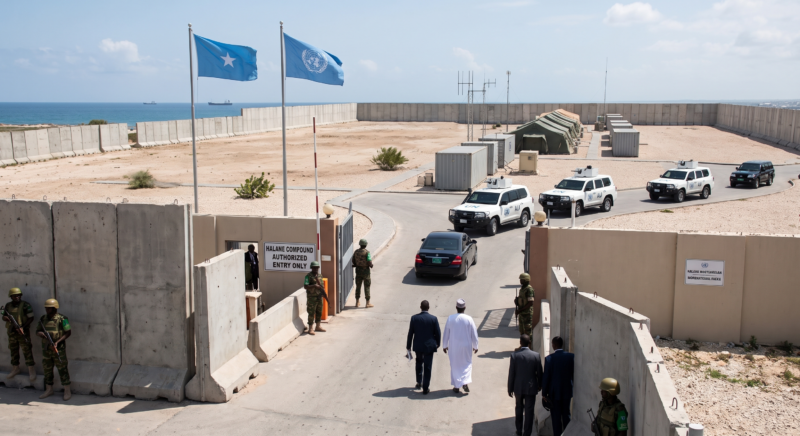
MOGADISHU — A high-stakes meeting between the Somali Future Council (Golaha Mustaqbalka) and representatives of the international community opened this morning at the heavily fortified Halane compound in Mogadishu, as diplomatic efforts intensify to resolve the country’s prolonged political crisis over elections and constitutional reforms.
The talks, held at the secure diplomatic compound that houses foreign missions and is protected by African Union peacekeepers, bring together senior opposition figures and international mediators in what observers describe as a critical effort to break the deadlock that has paralyzed Somalia’s political transition. The Somali Future Council has previously warned of a political crisis as election deadlines approach, and has said it will not allow unilateral government decisions to shape the country’s electoral future.
Sources familiar with the talks told Caasimada Online that the meeting is being mediated by international partners, including representatives from the United Nations, European Union, United States, and United Kingdom, who have been pressing both sides to reach an inclusive agreement to prevent further political instability. International partners have repeatedly urged renewed dialogue, warning that broad political consensus is essential for the legitimacy and stability of any future election process.
Opposition Leaders Present at Halane Talks
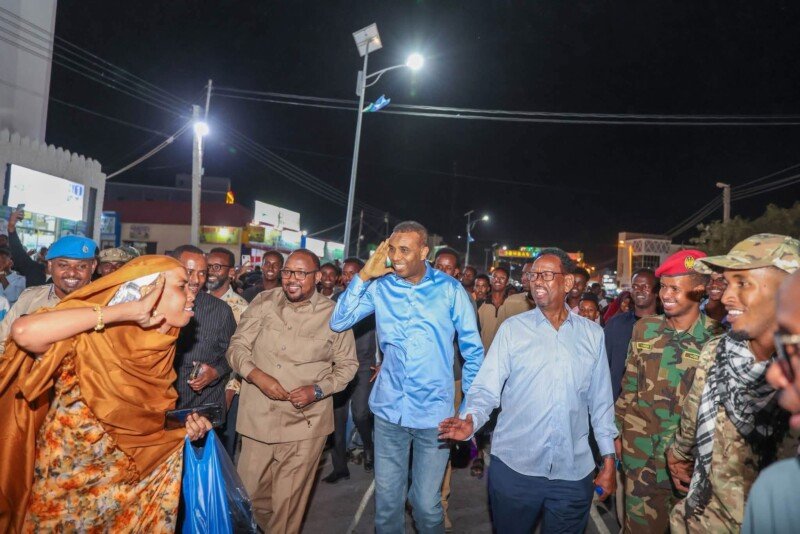
The Somali Future Council delegation at the talks includes former interim President Sheikh Sharif Sheikh Ahmed, former Prime Minister Hassan Ali Kheyre, and MP Ali Abdullahi Cosoble, according to sources. The presidents of Jubaland and Puntland are participating virtually, reflecting the broad coalition that the opposition has assembled since the council’s formation.
The Somali Future Council was established in October 2025 as a unified opposition platform, bringing together key opposition figures including the presidents of Puntland and Jubaland, former prime ministers, and leading members of the Somali Salvation Forum. The council has since positioned itself as the primary counterweight to President Hassan Sheikh Mohamud’s administration.
The Halane compound has emerged as the preferred venue for these sensitive negotiations. Opposition figures have insisted on using this facility, citing safety concerns and distrust of federal security forces, while the government has previously pushed for talks at Villa Somalia.
Core Issues on the Agenda
The talks are focused on the deep divisions that have plagued Somalia’s political landscape for months. At the heart of the dispute are three interconnected issues: the electoral model, the constitutional amendments, and the legitimacy of the president’s mandate.
The federal government has advocated for a transition to a “one person, one vote” system, while the opposition has proposed an alternative “Transitional Direct Elections Model” (TDEM) that would maintain the 4.5 clan power-sharing system during a gradual transition period. The Somali Future Council unveiled this electoral proposal as a compromise framework to break the country’s protracted political deadlock.
The constitutional dispute has further complicated the situation. The opposition argues that President Hassan Sheikh Mohamud’s four-year term, as stipulated in the 2012 provisional constitution, expired on May 15, 2026. Opposition leaders have declared that the president will lose his legal authority unless national elections are held or a constitutional alternative is agreed upon.
The government, however, maintains that constitutional amendments passed in March 2026 have extended the president’s mandate. Senior officials have suggested that the administration could remain in power for up to two additional years under the new framework, a position the opposition has rejected.
Previous Talks Collapsed; New Push for Breakthrough
The current round of negotiations follows the collapse of previous talks at the Halane compound in May 2026, where disputes over the electoral model and the president’s mandate remained unresolved despite facilitation by American and British diplomats. Those negotiations ended without a breakthrough, deepening the political crisis.
The European Union has welcomed opposition participation in the national dialogue, describing it as a constructive step toward building consensus. The United Nations Transition Mission in Somalia (UNTMIS) and the United Kingdom have also expressed support for the engagement, calling on all stakeholders to participate constructively and in good faith.
Political observers tracking the negotiations have identified two possible scenarios. The first is a breakthrough agreement that would break the political deadlock and pave the way for a consensus-based electoral framework. The second is a collapse of the talks, potentially leading to the international community withdrawing its mediation efforts and leaving Somali stakeholders to resolve their differences independently. Analysts have emphasized that both sides face significant pressure to compromise, given the sensitive transition period the country is undergoing.
Critical Note
While the resumption of talks between the opposition and international community represents a necessary step toward resolving Somalia’s political crisis, the deep-seated nature of the divisions suggests that a quick breakthrough remains unlikely. The opposition’s rejection of the president’s mandate and the constitutional amendments, coupled with the government’s insistence on its preferred electoral model, has created a zero-sum dynamic that mediation alone may not resolve. The international community’s role, while constructive, risks being undermined if Somali leaders perceive external pressure as favoring one side over the other. Furthermore, the opposition’s demand for an independent mediator, while understandable given the lack of trust between the parties, may delay substantive negotiations. The government would be well advised to demonstrate genuine flexibility on the electoral model and constitutional timeline, while the opposition must recognize that total rejection of the government’s legitimacy leaves little room for compromise. Without a willingness from both sides to make meaningful concessions, these talks risk joining the long list of failed mediation efforts, with the Somali people bearing the consequences of continued political paralysis. The international community should consider conditioning its continued engagement on concrete progress toward an inclusive political settlement, rather than merely facilitating talks that may produce little more than procedural agreements.
Recommended Reading On ftlsomalia.com
- Somali President and Opposition Leaders to Meet in Mogadishu
- New Round of Talks Opens Between Somali Government and Opposition as International Mediators Step In
- UN and UK Welcome Somali Future Council Talks as EU Envoy Calls Participation “Constructive Step”
- Somali Future Council Unveils Transitional Direct Elections Model for 2026
- Opposition: President’s Mandate Expires May 15 Without Elections
- International Community Calls for Somalia to Resume Dialogue Amid Political Standoff