
MOGADISHU — Somalia’s opposition leaders have stated that President Hassan Sheikh Mohamud will not be recognized as head of state once his term concludes on May 15, signaling an escalating political dispute over the nation’s electoral schedule . This stance directly contradicts Prime Minister Hamza Abdi Barre, who asserts that the government’s authority remains valid beyond that date .
During discussions with local journalists at the Mogadishu residence of former President Sharif Sheikh Ahmed, opposition lawmaker Yusuf Gamadid explained that the president would forfeit his legitimacy if his term concludes without a political consensus on elections . In such a situation, he noted, Mohamud would be regarded as a former leader rather than a current one .
Opposition Threatens Parallel Electoral Process
These comments follow similar statements from opposition figure Abdirahman Abdishakur Warsame, who recently indicated that the group might initiate a separate electoral process and form a competing administration if agreement cannot be achieved . Abdishakur has strongly criticized the Federal Government’s recent decision to unilaterally appoint an interim administration for South West State, describing the executive action as a blatant and illegal breach of both the Federal and State Constitutions . He accused President Mohamud of strategically planning the intervention to secure his own future re-election, claiming the president is actively pursuing an electoral process where he serves as both a competing candidate and the ultimate arbiter .
This warning mirrors positions presented during last year’s Kismayo conference, where opposition leaders discussed alternative political frameworks. Senior Somali opposition leaders gathered in Kismayo for a crucial political conference that formalized the Somali Future Council, a new opposition coalition uniting politicians from Mogadishu with representatives from Puntland and Jubbaland administrations . The conference intended to address what opposition figures described as unilateral decisions made by the federal government concerning elections, constitutional amendments, and the political transition process .
Term Extension Dispute Intensifies
Prime Minister Hamza Abdi Barre disputed the assertion that the president’s authority terminates in May, contending instead that it spans five years under both the 2012 draft constitution and the newly ratified constitution . According to this interpretation, he mentioned, the current term would continue for an additional year .
Nevertheless, Somalia’s political customs have predominantly followed four-year terms for both presidential and parliamentary positions under the provisional constitution. A consultative conference in Kismayo issued a comprehensive communiqué explicitly rejecting any extensions of constitutional mandates . The conference emphasized that the Federal Parliament term concludes on April 14, 2026, and the presidential term ends on May 15, 2026, warning that term extensions would generate political instability, constitutional vacuums, and potential security hazards . The communiqué established January 20, 2026, as a deadline for President Mohamud to convene an inclusive national conference with all Somali political stakeholders .
In 2021, Mohamud himself urged former President Mohamed Abdullahi Farmaajo to relinquish power after his four-year term concluded .
Constitutional Changes Deepen Divisions
The dispute over term lengths is rooted in recent constitutional changes. Somalia’s Federal Parliament officially adopted the nation’s revised Constitution following a highly polarized review process . The landmark approval of Chapters 1 through 13 triggered both jubilant celebrations from federal officials and severe backlash from regional administrations and opposition groups . The State Minister for Labor and Social Affairs abruptly resigned from Prime Minister Hamza Abdi Barre’s cabinet, citing profound, irreconcilable disagreements over the amendment process between the Federal Government and his home administration of Puntland .
Opposition Expands Consultations
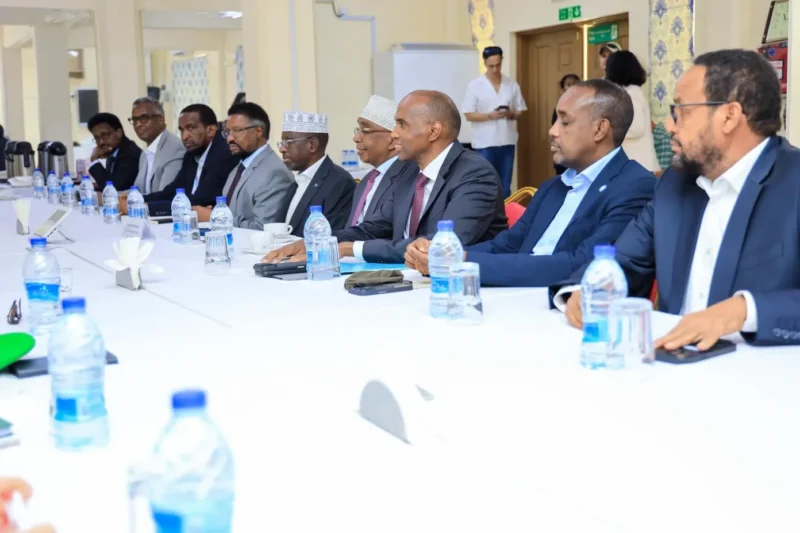
Amidst this conflict, opposition leaders have expanded discussions with diverse stakeholders, including traditional elders, religious scholars, legislators, and women’s organizations . The negotiations aim to establish a coordinated response in case the president’s term concludes without an established electoral agreement .
Such mobilization is not unprecedented in Somali politics. During the 2022 electoral period, opposition leaders similarly united following parliamentary approval of a two-year term extension for then-President Farmaajo . That resolution provoked violent clashes in Mogadishu, divided security force factions, and brought the nation close to broader conflict before the extension was ultimately withdrawn . This incident continues to serve as a significant reference for both opposition groups and the general public .
Federal Government’s Position
The federal government maintains that the extension is a constitutional necessity under the new constitution, which was ratified in March 2026 . The new constitution extends the presidential term from four years to five years and stipulates that the president will be elected by parliament, while members of parliament will be chosen directly by citizens . Officials argue that the transition to a one-person, one-vote system requires more time and legal adjustments to build a stable and inclusive voting framework .
Outlook
As the presidential term enters its final weeks, the opposition’s stance signals mounting political pressure on the administration . The threat of a parallel electoral process and the formation of a competing administration suggests that political tensions could escalate further as the May 15 deadline approaches .
The federal government has yet to issue an official response to the opposition’s latest statements . The coming weeks will be critical in determining whether dialogue or further confrontation defines Somalia’s political future . The international community, including the United Nations, African Union, and European Union, continues to monitor the situation closely and has urged all stakeholders to engage in constructive dialogue to resolve the deepening political impasse .