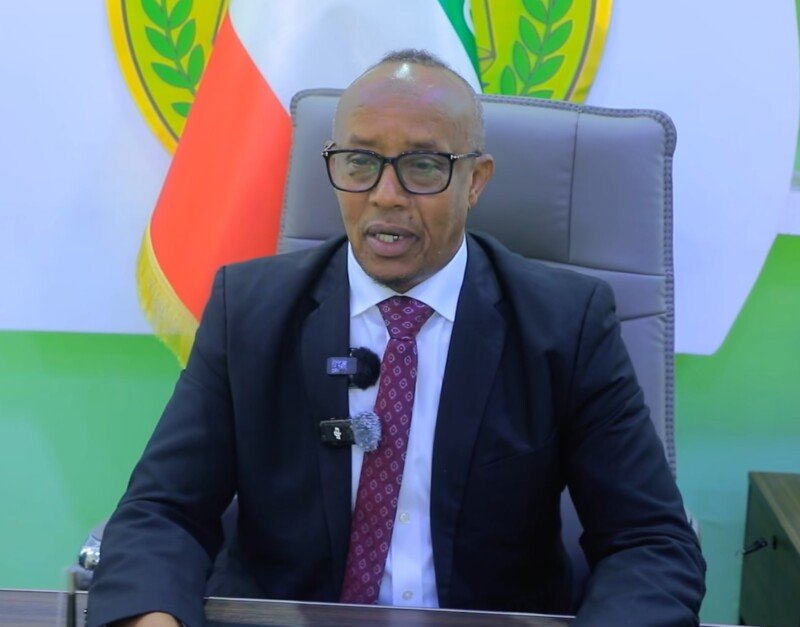

MOGADISHU — Burhaan Adan Omar, Chairperson of the Independent Constitutional Review and Implementation Commission (ICRIC), has issued a directive to government bodies and the Somali public regarding compliance with the Federal Republic of Somalia’s Constitution (2026), specifically addressing the prohibition of dual office-holding for ministers serving in parliament.
The Commission referenced its constitutional mandate as outlined in Chapter 15 of the Constitution and stated that all administrative measures, appointments, or oaths performed by government entities must adhere to the provisions of the Constitution. Any actions or matters conflicting with the Constitution will be considered invalid, and there exists a constitutional duty to rectify them and ensure legal compliance.
Ministers Must Choose Between Cabinet and Parliament
The directive specifically requires ministers serving in either chamber of the Federal Parliament of Somalia or the legislative assemblies of Federal Member States to relinquish their positions within the timeframe specified in Article 81(1)(f) of the Constitution. Similarly, all future appointments must follow the constitutional procedures outlined in the Constitution.
The controversy over dual office-holding is not new. Just two weeks after Somalia’s Federal Parliament ratified the new constitution, severe political tensions over its practical implementation emerged when the federal government appointed several sitting MPs to high-level ministerial positions despite the explicit constitutional prohibition. Critics argued that the immediate violation of the new framework undermined the very legal foundation the government sought to establish.
According to official records, Somalia’s cabinet currently has 25 ministers, and a significant number of them also hold seats in either the upper or lower house of parliament. Under the new directive, those officials are required to choose one position and vacate the other.
ICRIC’s Mandate and Constitutional Review Process
ICRIC has been actively working to advance Somalia’s constitutional review process. The Commission convened in August 2025 to accelerate work on Somalia’s long-delayed constitutional review process, focusing on advancing priority activities and finalizing the remaining chapters of the provisional constitution. Commission members reviewed progress on contentious provisions, aiming to resolve outstanding legal and political issues that have hindered completion.
The Commission has also held consultative meetings with senior officials from the Accountant General’s office to finalize the financial provisions of the constitution, discussing the constitutional framework for the Accountant General’s office within the Finance Chapter to ensure clear legal foundations and robust institutional structure.
ICRIC has convened public consultations focused on the constitutional rights of Persons with Disabilities (PWDs), drawing broad participation from disability rights advocates, community leaders, and government officials. The Commission has reaffirmed its commitment to a participatory review process, stressing that constitutional reform must be both inclusive and reflective of Somalia’s diverse society.
Constitutional Vacuum and Political Uncertainty
The directive comes amid heightened political tensions following the expiration of the Federal Parliament’s mandate on April 14. Former Prime Minister Omar Abdirashid Ali Sharmarke has warned that Somalia has entered a “difficult phase of a constitutional vacuum,” highlighting growing political uncertainty after the federal parliament’s mandate expired and with the president’s term set to end in the coming weeks. “The Federal Government of Somalia is now operating on borrowed time and has very few viable options left to implement the agendas they invested so heavily in,” Abdirashid stated.
Authorities in Puntland have expressed concern that Somalia is experiencing a constitutional vacuum with escalating political uncertainty, advocating for immediate consultations to avert potential instability. According to a statement released by the Puntland Council of Ministers, Somalia’s provisional constitution mandates the expiration of the Federal Parliament’s constitutional mandate on April 14, 2026, as stipulated in Article 60, while the presidential term concludes on May 15, 2026, as outlined in Article 91.
Constitution Ratified Amid Opposition
The constitution was ratified in March 2026 following a highly polarized parliamentary vote despite opposition from regional leaders. Former President Mohamed Abdullahi Farmajo issued a stark warning, stating that President Mohamud’s unilateral signing of the new constitution heightens governance challenges and directly threatens the unity of the Somali people. Farmajo indicated that the strong opposition from regional states, diverse legislators, and former national leaders demonstrates that the initiative lacks the popular support and political consensus strictly required for constitutional legitimacy.
Following the document’s ratification, Speaker of the House of the People, Adan Mohamed Nur (Madobe), officially declared the constitution to be in full effect and confirmed that both the president’s and parliament’s electoral mandates had been legally extended by one year under the revised provisions. The new constitution extends the presidential term from four years to five years and stipulates that the president will be elected by parliament, while members of parliament will be chosen directly by citizens.
Selective Application and Political Fallout
The controversy over dual office-holding highlights broader concerns about selective application of the constitution. For many political observers and opposition figures, the episode exposes a constitution that is being applied selectively by Villa Somalia. Opponents argue that its strict limitations on ministerial appointments were blatantly ignored, while its new rules were eagerly invoked to extend the current administration’s executive and legislative authority.
The review process has been comprehensive and inclusive, involving consultations with various stakeholders to ensure the amendments reflect the aspirations of the Somali people. The Independent Constitutional Review and Implementation Commission engaged with religious scholars to align the Constitution with Islamic teachings and conducted youth consultations to incorporate the perspectives of younger generations.
Implementation Roadmap and Public Awareness
The Commission will provide a detailed plan regarding the constitutional transition and implementation process, along with a public awareness initiative focused on constitutional matters. Somalia has launched a Digital Platform for Public Consultations on Constitutional Review, developed by ICRIC, which serves as a pivotal tool for engaging with the public and gathering valuable feedback on proposed constitutional amendments.
The Commission is dedicated to ensuring every citizen receives a copy of the Constitution and making it readily available to all members of society. Some ministers are reportedly reluctant to resign from parliament, fearing they may struggle to regain their seats in future political contests. Legal and political uncertainty remains over when the new constitutional clauses should take effect, as the current government was formed under Somalia’s previous Provisional Constitution, under which ministers could simultaneously hold parliamentary seats.
The implementation of the directive is expected to affect arrangements within both the executive and legislative branches as affected officials make decisions on whether to remain in cabinet positions or continue their roles in parliament.