

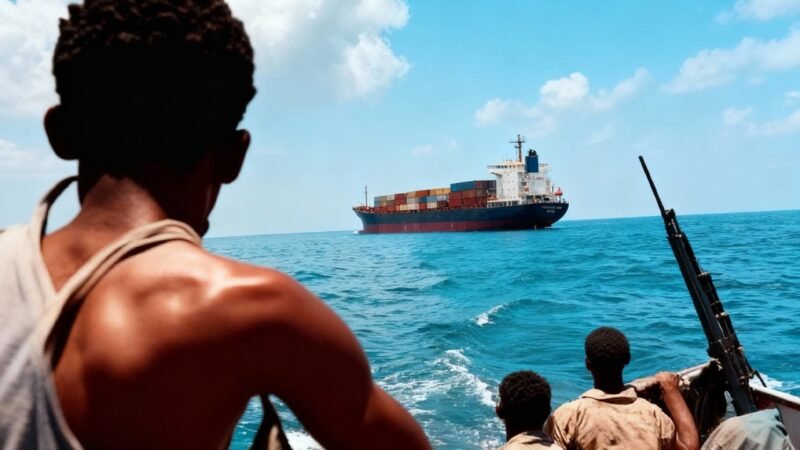
GAROWE — Somali pirates holding the Cameroon-flagged cargo vessel M/V LUTUF have demanded a ransom of approximately $2 million for the release of the ship and its crew, according to unconfirmed reports, as the resurgence of piracy off the Somali coast continues to escalate.
The LUTUF was seized on August 17 approximately 3.5 nautical miles off Marraya in Puntland’s Eyl district by eight armed pirates who directed it toward the Nugaal coast. The ship, owned by Polar Movement Shipping, was carrying weapons, communications and satellite equipment bound for the TURKSOM Turkish military training facility in Mogadishu. The crew consists of ten members: six Indian nationals, one Turkish national, one Georgian, and two Serbian security guards.
The ransom demand, which has not been officially confirmed, follows a pattern that recalls the peak of Somali piracy when ransoms routinely reached millions of dollars. Between April 2005 and December 2012, an estimated $339 million to $413 million was paid in ransoms for ships seized off Somalia and the Horn of Africa, according to the Pirate Trails study by the World Bank, UNODC and INTERPOL.
Turkish authorities have not issued any official statement on the incident, and the circumstances surrounding an airstrike on August 18 that killed four men and wounded two others near the Garmaal coast remain unclear. The airstrike came after a small boat delivered khat to the hijacked vessel and returned to shore.
Puntland has issued a strongly worded statement condemning the airstrikes, stating that it possesses specific intelligence indicating that “forces beyond Puntland” are involved in the new piracy operations, and that there are political and financial officials providing support to these groups. Puntland did not name the specific forces or officials it suspects.
Puntland emphasized its commitment to combating piracy and its readiness to cooperate with nations engaged in counter-piracy operations, but strongly opposed the manner in which some recent operations have been conducted. “The Puntland government is against airstrikes by international warships targeting civilians and their property in areas close to the coast where hijacked ships are held,” the statement said, warning that such strikes could damage cooperation between Puntland security agencies and international partners involved in counter-piracy efforts and cause harm to civilians not involved in piracy.
Six Ships Hijacked in 2026 as Piracy Resurges
The LUTUF hijacking is not an isolated incident. Just three days later, on August 20, six armed men seized the fuel tanker M.T. Sibu 1 approximately 136 nautical miles east of Al Mukalla, Yemen, directing it toward the Puntland coast. The Sibu 1 carries 20 crew members, 16 of whom are Indian nationals. The vessel had previously been under US sanctions for its involvement in shipping Iranian oil.
The seizure of the Sibu 1 brings the total number of commercial vessels hijacked by Somali pirates since April 21 to six: Honor 25 (April 21), Sward (April 26), Eureka (May 2), Asana (July 17), LUTUF (August 17), and Sibu 1 (August 20).
The International Maritime Organization has issued an urgent appeal for the release of 44 seafarers who have been held hostage by pirates off the Somali coast for several months, warning that their humanitarian situation is deteriorating rapidly due to severe shortages of food and water and mounting security threats. The IMO reported that 24 attacks, including both attempted and successful incidents, have been recorded in the past three months, with perpetrators using increasingly heavy weaponry and violence.
Pirates have demanded $10 million for the release of the MT Eureka’s crew, which includes eight Egyptians and four Indians. The vessel, a Togo-flagged product tanker carrying approximately 2,800 tonnes of diesel, was boarded by armed attackers on May 2 off the coast of Yemen’s Shabwa province and forced toward Somali waters. The crew’s families have reported that the captors have issued direct death threats and warned they will kill the hostages unless a ransom is paid within an extremely tight deadline.
Puntland’s Response: Accountability and Legal Process
Puntland President Said Abdullahi Deni has addressed the escalating security situation, expressing dissatisfaction with how recent airstrikes were conducted and emphasizing the need for legal accountability. “We are not satisfied with how things happened, and we are deeply concerned. If someone commits a crime, we do not need to take extrajudicial action; crime has a legal process to follow,” Deni stated at a public gathering in Jariiban district.
The President also highlighted the need to address the root causes of piracy, particularly the involvement of youth. “On the other hand, if we do not address the situation of these young men, it will lead to more problems,” he said, emphasizing that these young men are sons of the region and calling on the community and traditional elders to play a role in addressing their situation.
Root Causes of Piracy Resurgence
The resurgence of Somali piracy has been attributed to several converging factors. Naval analysts point to a shift in international naval resources toward the Red Sea, where Iran-backed Houthi rebels have been attacking shipping, creating a security vacuum that pirate groups are exploiting. The redeployment of warships has reduced the naval presence off the Somali coast, allowing pirate groups to operate with greater impunity.
Somali pirates have also demonstrated increased organizational capacity, converting captured merchant vessels into floating bases from which they are launching new attacks. The MV Sward, a cement carrier hijacked on April 26, is now being used as a “mothership” to launch smaller attack skiffs against vessels in the Indian Ocean.
Security officials say the pirate groups are receiving support from local communities and militias in coastal areas, complicating efforts to apprehend them or deal with the vessels they hold. The groups have access to financing, boats and land-based support networks that had been dormant for years.
Critical Note
The LUTUF hijacking and the subsequent ransom demand mark a significant escalation in the resurgence of Somali piracy. The seizure of six vessels in four months, including a ship carrying Turkish military cargo, demonstrates that pirate networks have reconstituted themselves and are operating with renewed confidence. The fact that pirates are demanding ransoms in the millions suggests they believe they have the leverage to extract significant payments.
The international community’s response has been reactive rather than preventive. The redeployment of naval assets to the Red Sea has created a security vacuum that pirates are exploiting. The absence of a coordinated international response risks allowing piracy to re-establish itself as a profitable criminal enterprise, with potentially devastating consequences for maritime trade and regional stability.
The Somali government and international partners must address the root causes of piracy, including the lack of economic opportunities in coastal communities, illegal fishing, and the absence of effective governance. Without a comprehensive approach that combines security, economic development and governance, the cycle of piracy is likely to continue. The Puntland government’s recognition of the need to address the youth involvement in piracy is a welcome step, but it must be accompanied by concrete actions to provide alternative livelihoods and opportunities.
Recommended Reading On ftlsomalia.com
- Puntland Questions Foreign Airstrikes Amid Piracy Resurgence and LUTUF Hijacking
- UN Maritime Agency Warns of Worsening Humanitarian Crisis as Piracy Resurges
- Somali Pirates Turn Hijacked Ship into Mothership as Piracy Surges in Puntland Waters
- Piracy Fears Grow as Three Vessels Hijacked Off Somalia in Week