

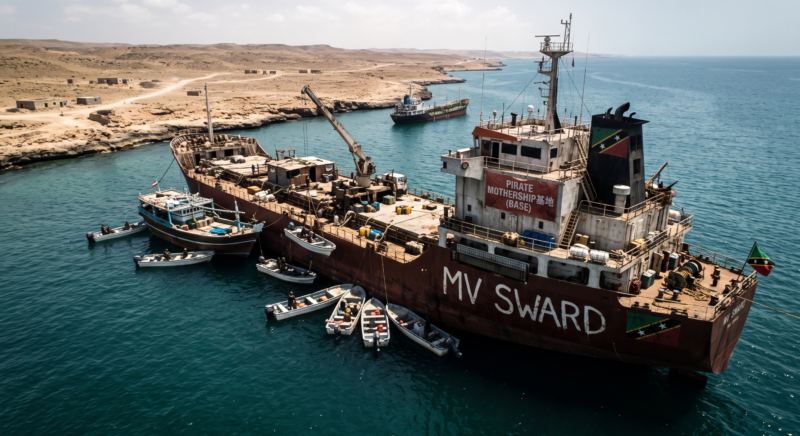
GAROWE – Somali pirates have converted a captured merchant vessel into a floating base from which they are launching new attacks, marking a significant escalation in the resurgence of maritime crime off the Horn of Africa that had been dormant for over a decade.
The MV Sward, a cement carrier hijacked on April 26, 2026, approximately six nautical miles northeast of the coastal town of Garacad in Puntland, is now being used as a “mothership” to launch smaller attack skiffs against vessels in the Indian Ocean. The vessel, flying the flag of St. Kitts and Nevis, was en route from Egypt’s Suez port to Mombasa, Kenya, when it was seized. Its 15-member crew, comprising 13 Syrians and two Indians, remains hostage.
A New Kind of Pirate Threat
Security officials say the MV Sward seizure was the work of a new group of “opportunistic criminals” operating from Garacad, mostly formed of “rural youth” from an area “awash with weapons,” motivated by poverty and anger over illegal fishing by foreign vessels. A previously unseen pirate faction has now been linked to the attacks. A Puntland security official said that the group that seized the MV Sward were all from the same clan and sub-clan, a factor that complicates counter-measures.
The vessel has been anchored near the Somali coast, and pirates have been using it as a base to stage new attacks. On July 16, the group used the MV Sward to launch an attack on two Iranian fishing dhows, which were captured and later released after a ransom of $20,000 was paid. The hijackers are also holding the oil tankers Honour 25 and MT Eureka, with a total of 44 seafarers now held hostage across the three vessels. The International Maritime Organization (IMO) has warned that the humanitarian situation of the hostages is deteriorating rapidly due to severe shortages of food and water and daily threats of violence.
Regional Conflict Creates Security Vacuum
The resurgence of piracy is being attributed to the diversion of international naval assets to the Red Sea and the Gulf of Aden, where Iran-backed Houthi rebels have been attacking shipping. With naval patrols stretched thin, pirates have exploited the security vacuum to resume operations. The United Kingdom Maritime Trade Operations (UKMTO) has raised the piracy threat level along the Somali coast to “substantial.”
Puntland authorities have also accused the federal government of arming pirate groups. President Said Abdullahi Deni has alleged that Mogadishu has armed and backed pirates whose activities have resurged along Puntland’s coastline in recent months. In his sharpest attack to date, President Deni accused President Hassan Sheikh Mohamud of creating armed pirate groups, dismantling the country’s federal system, and destabilising regional administrations across Somalia.
Local Support and Security Crackdown
Puntland security officials say the pirate groups are receiving support from local communities and militias in coastal areas, complicating efforts to apprehend them or deal with the vessels they hold. In one incident, a suspect linked to the MV Sward hijacking was arrested in Garacad but was later freed after armed militiamen attacked the police station, killing one officer. The suspect was eventually transferred to Garowe.
Puntland has intensified its crackdown on piracy. On July 17, authorities executed Ibrahim Ahmed Kooshin, who was convicted of killing the Jariiban district police commander, Major Guuleed Cabdulqaadir Kadleeye. The commander had been actively involved in countering illegal arms trafficking and piracy networks along the Mudug coastline.
A Familiar Pattern Re-emerges
The current piracy surge evokes the 2008-2011 crisis, which cost the global economy an estimated $18 billion annually at its peak. The IMO reported a 17 percent increase in global piracy and armed robbery incidents between 2024 and 2025, with incidents rising from 146 to 171. Naval analysts attribute the resurgence to the shift in international naval resources toward the Red Sea. The use of a captured vessel as a mothership is a tactic reminiscent of the piracy heyday, when hijacked vessels were used as floating bases to extend the range of attacks.
Way Forward
The conversion of the MV Sward into a pirate mothership marks a dangerous escalation in the resurgence of Somali piracy. The diversion of international naval assets to the Red Sea has created a security vacuum that pirates are exploiting with increasing sophistication. Puntland’s efforts to combat piracy are hampered by local support for the pirate groups and the ongoing political rift with the federal government. Without a renewed international naval commitment and a coordinated approach to address the root causes of piracy, the threat is likely to grow, with potentially devastating consequences for regional stability and global shipping.
Recommended Reading On ftlsomalia.com
- Global Naval Shifts Fuel Somali Piracy Return
- Piracy Fears Grow as Three Vessels Hijacked Off Somalia
- UN Maritime Agency Warns of Worsening Humanitarian Crisis
- Puntland and Federal Government Near Armed Conflict
- Puntland Police Arrest Suspect in Killing of Jariiban District Police Commander
- Pirates Demand $10 Million for Hijacked Ship