
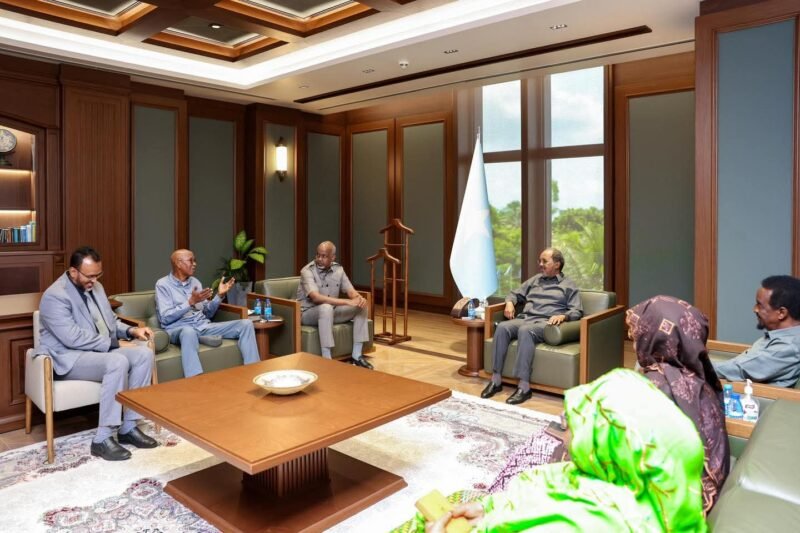
MOGADISHU – President Hassan Sheikh Mohamud convened a high-level consultative meeting with prominent Somali poets and literary figures at the Presidential Palace on Tuesday, examining the crucial role of Somali arts and literature in enhancing public awareness, advancing state-building initiatives, and restoring a cohesive national identity.
The gathering was joined by the President’s Advisor on Public Awareness and Civic Mobilization, Mr. Abdirahman Abdikarim Abdi, who coordinates traditional communication channels with federal government policies. President Hassan praised the Somali poets for their enduring and significant contributions to safeguarding national unity, preserving Somali cultural heritage, and conveying messages that motivate and inform citizens. He highlighted that literature and poetry serve as fundamental pillars in reconstructing national consciousness and reinforcing social unity among Somalis, especially during a critical transitional phase.
Harnessing Literary Influence for Stability and Governance
The gathering centered on leveraging traditional oral arts and modern creative forms to boost public consciousness, support peace efforts, and restore national unity throughout the nation. President Mohamud thanked the cultural leaders, acknowledging their historical role in preserving the nation’s existence as a cornerstone for social harmony and psychological healing. He emphasized that Somali poetry serves as a vital tool for consolidating public thought and nurturing collective patriotism during transitional phases – a role that organizations like the UNDP have recognized with initiatives such as the Home of Somali Poetry, which aims to harness the art form as a powerful tool for promoting peace.
The President stressed that the intentional use of literature is crucial for shaping public discourse and safeguarding the country’s cultural identity against extremist influences. Somalia has often been characterized as “a nation of poets,” with oral poetry standing as perhaps the nation’s most revered art form, recited even in the most distant communities and by extremists in remote areas. This meeting signaled the government’s intent to reclaim that heritage and deploy it systematically as part of its state-building toolkit.
Strategic Approaches to Formalizing Cultural Heritage
Throughout the dialogue, the poets offered perspectives and suggestions on advancing Somali culture, fostering patriotism, and employing Somali creative arts to promote peace, governance, and national progress. The creative representatives pledged to utilize their literary works to strengthen governance systems, expand civic education programs across all federal member states to ensure nationwide stability, and support the national vision of peacebuilding and informed civic engagement.
The President’s push to formally integrate poets into the national development agenda aligns with a broader government strategy. Initiatives such as the Southwest State Book Fair in Baidoa have already demonstrated how poetry readings, cultural exhibitions, and literary events can be mobilized as tools for social cohesion. Similarly, Mogadishu’s annual Somali Culture Week has consistently highlighted traditional costumes, dance, and literature to foster cultural appreciation and unity.
Institutional Commitment and Long-Term Cultural Revival
The Minister of Information, Culture and Tourism, Abdifatah Kasim Mohamud, has also taken concrete steps to rejuvenate the country’s cultural infrastructure. During a recent visit to the Somali National Theatre, the minister pledged to safeguard the rights of the country’s artists while rehabilitating and modernizing the historic cultural landmark. He commended the role of Somali national artists in raising public awareness, promoting peace, preserving Somali culture, and enhancing social cohesion – themes that resonate directly with the poets’ discussions with the President.
To further institutionalize this collaboration, the Ministry signed a landmark cooperation agreement with Mogadishu University to advance media professionalism and cultural development. The agreement outlines collaborative initiatives including curriculum development in journalism, joint media production projects, and the preservation of Somali cultural heritage – all of which would directly benefit the poets and artists who form the backbone of the country’s creative sector.
A Pledge to Build a Brighter Future
The meeting concluded with a shared commitment to formalize these consultations into a sustained partnership. The poets and literary figures pledged to weave narratives that promote social harmony, condemn extremism, and inspire civic participation across all federal member states. By elevating Somalia’s cultural ambassadors and formally integrating them into the national development agenda, the federal government is signaling a shift from simply preserving heritage to actively harnessing it as a pillar of governance, peace, and national progress.
“These poets are the guardians of our collective memory,” President Mohamud was quoted as saying during the closed-door session. “Their words carry more weight than any political speech. We must give them the platform and resources to shape the Somalia we are building.”
Recommended Reading On ftlsomalia.com:
- Somali Poets Preserve Cultural Storytelling Despite Turmoil
- Baidoa Hosts Southwest State Book Fair to Promote Literacy and Peace
- Minister Pledges Support for Somali National Theatre and Cultural Development
- UN Launches ‘Home of Somali Poetry’ Initiative
- Information Ministry and Mogadishu University Sign Media and Culture Development Agreement