
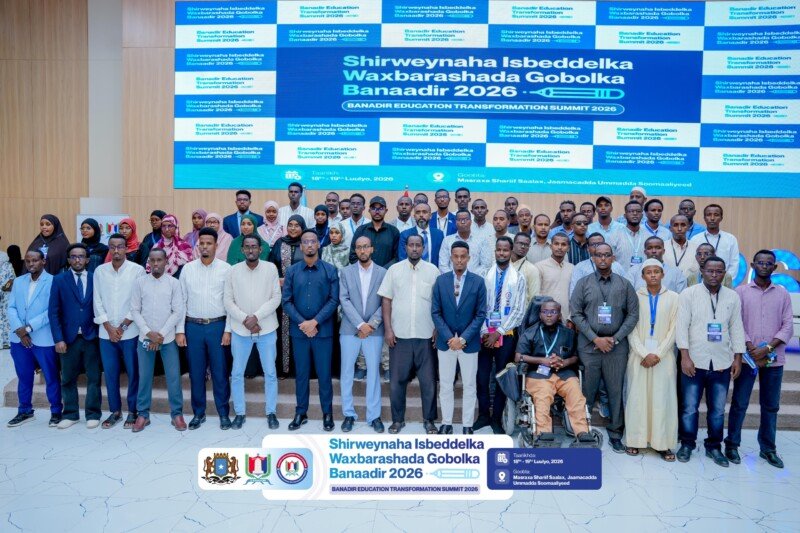
MOGADISHU – The Banadir Regional Administration has concluded a two-day education transformation conference, where officials and experts discussed the challenges and opportunities facing the region’s schools, with a focus on improving quality, management and access.
The conference was officially opened on Saturday by the Governor of Banadir Region and Mayor of Mogadishu, Dr. Hassan Mohamed Hussein (Muungaab). In his opening address, he emphasised that education is the most important pillar for achieving sustainable development, economic growth and building the capacity of the next generation. He also reiterated the administration’s commitment to prioritising reform, modernisation and quality improvement in the education system.
Over the two days, participants analysed the challenges and opportunities facing education in Banadir, presenting research and studies on quality enhancement, school management, curriculum development, student behaviour, teacher quality, and strengthening partnerships among education stakeholders. The second day focused specifically on presenting research and studies that offered recommendations and practical solutions to inform planning and implementation of reforms.
Conference Outcomes and Commitments
In his closing remarks, the Director General of Education for Banadir Region, Abdirahman Ali Mohamed, thanked all experts, researchers, school administrators, teachers and stakeholders who participated. He said the recommendations and outcomes from the conference would be translated into practical plans to further improve quality, efficiency, and access to education services across Banadir.
The conference concluded with a consensus and commitment to strengthening collaboration between the government, education institutions, researchers and all education stakeholders to implement sustainable reforms that will improve the quality of education in Banadir.
The Education Crisis in Banadir
The conference comes against a backdrop of significant challenges facing education in Mogadishu and the wider Banadir region. The Banadir Regional Education Directorate recently announced that 41,639 primary school students are expected to participate in the Grade 8 Certificate Examinations, highlighting the scale of the education system in the region[reference:0]. However, many schools in Mogadishu operate without adequate facilities, textbooks or trained teachers. Teacher salaries are often delayed or insufficient, leading to low morale and high turnover. The quality of education remains uneven, with many children emerging from the system without basic literacy or numeracy skills.
President Hassan Sheikh Mohamud officially inaugurated Somalia’s 2025/26 academic year in Mogadishu, marking the start of a new school cycle with a strong emphasis on teacher development and examination integrity[reference:1]. The launch coincided with the conclusion of a nationwide teacher training program that equipped 300 educators with updated teaching skills and modern classroom approaches[reference:2].
Prime Minister Hamza Abdi Barre has unveiled a comprehensive reform of the national education system, highlighting that for the first time in contemporary Somali history, the salaries of newly hired teachers are fully funded through domestic national revenues[reference:3]. Through a nationwide initiative, the government has recruited and deployed 10,000 qualified teachers across both urban centers and remote areas[reference:4].
A Pattern of Grand Commitments
The Banadir administration’s focus on education reform is not new. The 3rd National Education Conference, opened by Prime Minister Hamza, focused on reforming the nation’s education system, standardizing curricula, and expanding access to quality learning nationwide[reference:5]. Previous initiatives have promised sweeping changes, but the gap between policy and practice remains wide.
Mayor Muungaab himself inaugurated the Grade 8 National Exam, praising students’ commitment and emphasising the importance of education in rebuilding Somalia[reference:6]. However, translating these commitments into tangible improvements has historically proven difficult. Without sustained funding and political will, the conference risks becoming another exercise in documentation rather than transformation.
Mogadishu’s education system also faces unique challenges, including the presence of internally displaced persons, poverty and ongoing insecurity. Al-Shabaab attacks have repeatedly targeted schools, forcing closures and traumatising students. These challenges require more than policy recommendations; they demand sustained investment, political will, and a coordinated response from all stakeholders.
Way Forward
The Banadir Education Transformation Conference 2026 has concluded with ambitious promises and a reaffirmation of the importance of education for the region’s future. However, the gap between the conference’s rhetoric and the reality of Mogadishu’s classrooms remains stark. Parents and students continue to contend with overcrowded classrooms, inadequate facilities and uncertain prospects. The success of this conference will ultimately be measured not by the papers it produced, but by the number of children who are able to read, write and build a future.